Tag: microadventuring

  • How to Plan a Micro-Adventure on Your Bike

    How to Plan a Micro-Adventure on Your Bike

    Last week, my friends Andy Owens and Richard Cammett (accompanied by the lovely Abby Smith — and our two dogs Willow and Ted — in the car) rode bikes from Manhattan to Montreal. The boys were pros, having done the trip from Boston in their college years. I was a total noob, who definitely struggled, but am proof that you don’t need to be a diehard cyclist to plan your own biking adventure.

    I skinned both knees, got some gnarly bruises and even sat out for portions of the trip. But, as they say, you live, you learn. Here’s how to plan your own long distance cycling micro-adventure — minus the physical injuries.

    Step 1. Pick your destination.
    Choosing your cycling destination can be as systematic as a lottery raffle. We headed to Montreal because the boys had already made the trek from Boston several years before. If you want a little more order than throwing darts at a map, consider the following:

    • How long do you have to travel? Are we talking a weekend or a full week off of work? Also, ask yourself if you’d like any rest days and how much time you’d like to spend at your destination.
    • How many miles do you want to log every day? We rode roughly 100 per day (although I cheated and jumped in the car for dozens of miles here and there). I wouldn’t suggested more than 80 for beginner cyclists, but if you’d like to stop and sightsee along the way, you can always bump it down to 50. Then, crunch the numbers and figure out how far you can travel.
    • Pick a place that’s exciting to you for some reason. For us, Montreal was a lively city AND we got to cross the Canadian border (which makes it feel like you’ve logged some serious miles). Maybe you want to head south because you’re a diehard BBQ fan or maybe a band you like is playing in a city a couple hundred miles away. Choosing a destination that excites you is key to making all of your hard work feel worth it in the end.
    (cred: Abby Smith)
    Andy taking a water break (cred: Abby Smith)

    Step 2. Get your gear.
    I started the trip with virtually nothing, not even a bike, meaning I learned the very basics. Before you head out to REI or EMS, determine if you’ll have car assistance or not. Without a car, you’re going for the lightest, most minimal luggage ever (we’re talking dirty cycling shorts every day), but with a car following you, you have a lot more flexibility in terms of what you pack. We were lucky enough to have car assistance. This is the gear we couldn’t have succeeded without:

      • A bike: I’m sure most people interested in pedaling across the country not only already have a bike, but also know a lot more about them than I do. If you don’t, people like these guys can certainly help you out. Here’s what I learned from my trusty pals and my own experience: The lighter, the better (read: carbon fiber). Correct fit counts (ask the workers at the shop to help you with this one). Electronic gear-shifting systems are seriously smooth. And bikes are majorly expensive. I was lucky enough to get a BMC granfondo on loan that fit all of my above recommendations. It was incredibly fast, comfortable and easy to ride. It’s also worth more than my car and WAY out of reach had I needed to buy it myself.
        Cost: About $700 – however many thousands of dollars you’re willing to spend
      • Clip-in pedals: These are those small pedals that attach to cycling shoes. They allow you to pull, as well as push, with each pedal stroke. They’re essential for long distance trips because they distribute your leg power more efficiently and make your pedal rotations much more effective.
        Cost: I spent about $250 on both the shoes and pedals
      • Bike shorts: Trust me on this one. Your butt will thank you later.
        Cost: Around $30
      • Cycling gloves: These prevent blisters from the handlebars. They are 100 percent necessary. Go for lightweight ones with vents if you’re doing a summer ride. Sweaty hands are no fun.
        Cost: Roughly $25 – $50
      • Spare tubes: I packed three spares for our 400-mile trip and didn’t use one. One of the guys, on the other hand, blew through four on the first day. It’s better to err on the side of caution with these.
        Cost: $8 per tube
      • Spare tire: This is wise if you’re riding over a few hundred miles. I didn’t use mine, but one of the guys did. If you’re riding a route without bike shops along it, you probably want to pick one up before your trip.
        Cost: $50 – $70
      • Sunglasses: Not only will these shade your eyeballs from the sun, but they’ll also protect them from wind, bugs, rain and whatever else may be flying through the air. You don’t necessarily need to invest in cycling glasses – just make sure they fit under your helmet comfortably.
        Cost: $25 – $300
      • Either a jersey or saddle bag (or both): These carry your snacks, spare tubes and whatever else you’re bringing along.
        Cost: $40 – $60
      • Helmet: Duh.
        Cost: $50 – $250 

    Step 3. Train. Hard.
    This is the step that I made the biggest mistake on. I definitely didn’t train hard enough. Riding to work is not enough unless your commute is 50 miles. Start small with 15-mile rides and work your way up to the distance that you plan to ride every day on your trip. Also, unlike training for a marathon, at first you’ll want to allow 24 to 48 hours between long rides to let your muscles recover. But eventually, you’ll want to ride long distances back-to-back because that’s what you’ll do on your adventure. I started training about two months before the trip and that was definitely not enough, even with hard training. For a newbie setting out on a 400-miler, I’d suggest at least four months of prep. You may even want to Google around for a set training program (this 20-week one looks pretty legit). Something else that I learned the hard way? Clip-in pedals aren’t as easy as they look if you haven’t used them before so practice ahead of time.
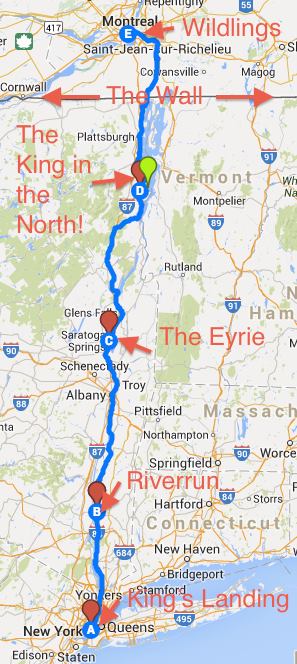
    Our route, Game of Thrones style (cred: Andy Owens)
    Our route, in Game of Thrones style (cred: Andy Owens)

    Step 4. Plan your route.
    Google Maps offers mostly reliable cycling directions, and I’d suggest using this to plan your route. We camped along the way, using sites found at state parks or from this awesome site. You could also stay in hostels, use Couchsurfing or Warm Showers, which is pretty much the cycling equivalent. My one word of advice would be to plan your stops directly along your route. Ten extra miles may not seem like a lot now, but it sure feels like it after you’ve already logged 90.

    Step 5. Pack your grub.
    How you approach this part is pretty personal. We basically lived off of Clif bars and energy gels, with a daily diner lunch. We also packed freeze-dried meals for camping. I always like to cook something that’ll reheat well (in this case, beans, chicken and rice), freeze it the night before the trip and bring it along to heat on a camping stove or fire the first night. That way, you’re not living on Ramen the entire time. Keep in mind that eight hours of cycling burns around 4,500 calories, so pack plenty and keep a couple granola bars on you at all times. Also, account for water, especially if you’re camping at sites without potable water. I filled up my two 20-ounce bottles every 25 miles or so.

    Step 6. Map out breaks.
    Don’t pedal through the miles so quickly that you can’t stop and enjoy the scenery. We stopped after day three of our four-day ride to take a full 36 hours off of the bike seats. Luckily, the boys had a friend from college who worked on a farm in upstate New York. We spent a day weeding crops, feeding pigs and chowing down on her amazing, homegrown meals. I’d highly suggest planning out breaks like these along the way. They make all of those miles more bearable and will often be the most memorable parts of your cycling micro-adventure.
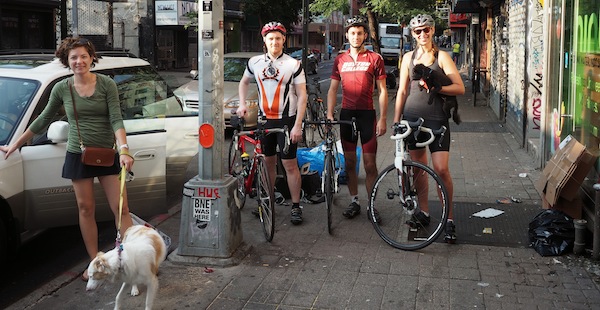
    From right to left: Abby S., Willow, Andy, Richard, me, Ted (cred: Chris Robles)
    From left to right: Abby S., Willow, Andy, Richard, me, Ted (cred: Chris Robles)
  • A Skate Trek Microadventure with Lauren Rains

    A Skate Trek Microadventure with Lauren Rains

    Lauren Rains is the editor at large of Outdoor Minded Mag, one of Nerve Rush’s favorite websites. Lauren is struck by wanderlust and spends most waking hours of her life either 1) exploring the outdoors around the globe or 2) working on various passion projects, be it film, to microadventures, to cooking chili. You can read about her adventures in life, business and travel on her blog, The Mad to Live. You can also catch up with her on Twitter at @LaurRAINS.

    Lauren took the time to chat with Nerve Rush about a recent microadventure that she completed. Lauren, take it away!

    Skate_TrekM2LIVE-Skatetrek

    1. What is a microadventure? What is microadventuring?

    A microadventure is basically a 12-48 hour (sometimes more) mini-expedition done through human-powered transportation (walk, bike, paddle, run, etc) that challenges you both mentally and physically, can be done in your own local backyard, and is one hell of a good time.

    You see, I’m a traveler at heart. Wanderlust bit me in the butt when I was an awkward teenage girl, and while I’ve replaced awkwardness with sexiness ;-), the travel bug is still with me and going strong. I’ve lived all over from China to Argentina to France, so when I’m in the US, microadventuring is my way of traveling when I’m not technically traveling. It combines my love for travel and exploring, with my love for outdoor adventure and challenge.

    While I typically look at microadventures as backyard adventure challenges to satisfy my wanderlust while I’m not traveling, this coming fall I will be embarking on my next world travel excursion and beginning my international microadventure series. After completing the Camino de Santiago (a 2 month walking pilgrimage across Spain) in August and September, I’ll be traveling to complete microadventurse around the world, including walking across Ireland by foot, kayaking the isles of Scotland, and then heading over to South East Asia to do things like SUP the western coastline of Thailand.

    2. Deconstructing your most recent skating microadventure, tell us more about:

    a) Logistics

    The plan was to start at sunrise and get there before nightfall. It would be an entirely self-supported trip, and upon reaching my final destination in downtown Denver, I’d hop on the bus and head straight back to my apartment in Boulder where I’d pass out immediately.

    Everything went according to plan except that by the time night fell, I still had 5 miles to go, and I forgot to bring a headlamp with me, making skating through the pot-holed filled streets of Denver quite an interesting challenge.

    Below you’ll see a map of the route I took, which I found through a bike forum online where people were discussing the best way to bike from Boulder to Denver.

    microadventure route

    b) Clothing

    While I love wearing top technology clothing, I decided to wear my “everyday” clothes on this trek:

    Jeans, a loose tank top, an open button-down plaid shirt for the warmer part of the day, and my Patagonia goose down jacket I can’t live without for the morning and evening.

    One of the great aspects of micro-adventuring is you don’t necessarily need all of the best, most expensive gear out there. I will say, however if I had chosen to do this over the summer, I would have sported a wicking base layer as wearing cotton will just slow you down and get heavy once you begin to sweat.

    c) Gear

    BOARD: I used a longboard from OZ Boards for this trek as my sponsor. I chose to seek out OZ as a sponsor because:

    1. They are a Colorado-based company, and being that this is where I now reside, I felt proud to be supporting a local business doing great things in my own backyard.
    2. They handcraft their boards with sustainable woods and use processes to make them – no bulk decks coming from China – this was made with 2 hands by a longboarder who loves what they do.
    3. They’re a small business run by entrepreneurs with passion. I fit right into this category with my own endeavors and love supporting those who are on a similar mission.

    BOARD COMPONENTS:

    Wheels – Abec 11 Flashback wheels | Bearings – ABEC 7 | Board Length – 40” | trucks – Randall R-11 180mm

    BACKPACK: I take my Kelty daypack with me wherever i go. It’s been with me on all my microadventures from the “50-Mile Walk Along the Atlantic” to “2 Days of Trekking the Himalayas.”

    ACCESSORIES: I rocked a Solepack, which is a backpack accessory, that clips around either side of the bag and holds another pair of shoes. While this is perfect if you’re hiking to a rock climbing destination and need both pairs of shoes, I used this to hold some flip flops I could rock after reaching my destination 12 hours later, knowing my feet would be a bit tired of my shoes.

    WATER: The Camel Pak is likely the greatest thing since sliced bread. When the sun is beating down and you don’t have the time or energy to stop and go, stop and go just to take a swig from your water bottle, the Camel Pak solves all of those problems.

    d) Food & Energy

    Water and Cliff Bars (white chocolate macadamia nut to be exact) throughout the day. I took a break around 3PM just outside of Denver to snack on an Italian sub. Upon reaching Denver, I went and got myself a hot chocolate and took it all in.

    e) Physical Training

    The most important part of training for this trip is to learn how to push with both feet. This is absolutely essential. Could you imagine skateboarding for 12 hours straight pushing on the same leg over and over and over again? Your leg would fall off after first turning to jelly.

    Other than that, just be in decent shape. I rock climb a few days a week after work, so I’m constantly keeping my body in check. As long as you aren’t a couch potato, it doesn’t take a lot of training to be able to accomplish t his type of trek.

    lauren rains longboarding

    3. You told me you had a mentor. Tell us about him/her.

    When it comes to adventuring, the mentor I who has inspired me the most is Alastair Humphreys. He’s the one who turned me onto the idea of microadventures, being that he was nominated as a 2012 Adventurer of the Year by National Geographic for a project he did called “A Year of Microadventures”. My goal is to become the twenty-something, American female version of him – same amount of badass, just I don’t have a beard to freeze to grow icicles on!

    Al Humphreys is a jack-of-all-trades adventurer: telling his stories with beautiful writing and videos with amazing cinamaphotography and photography. He speaks about his experiences to live audiences, self publishes books, has a popular blog – I admire his success, his commitment, and his dedication to quality on all fronts.

    skate trek with lauren rains

    4.) One of your upcoming spring microadventures is TAHOE CROSSING: A SUP Across Lake Tahoe at its Widest Point of 22 Miles. Tell us a bit about this.

    This idea was inspired by another one of my mentors, Jenny Kalmbach, a professional SUP who is not just an amazing athlete, but an amazing woman. She’s been nominated and has won the Female Paddlers of the year in the SUP awards, and once did a SUP journey called Destination: 3 Degrees in which she and fellow pro SUP Morgan Hoesterey, crossed the channels in Hawaii to bring awareness to plastic contamination in the ocean. In fact, she did a piece on the online magazine I run, Outdoor Minded Mag, for our Outdoor Hours series about the part of the trip they paddled over 80 miles through the night to cross one of the channels.

    The Logistics: I’ll be SUPing across Lake Tahoe in an expected 12 hours. This trip will be supported in that I’ll have a kayak with me there to film and photograph the adventure, as well as to help me navigate the boats as well as keep a cooler full of a few cold brews and a burrito.

    I look forward to seeing if this will kick my ass more than skateboarding 30 miles in 12 hours from Boulder to Denver!

    Where did you go on that first trek?

    I titled the first trek “From Sea to Marsh”. I started at the edge of the Atlantic Ocean, and didn’t stop until I hit the Saint John’s River 30 miles due west from the coastline. It was an extremely tough skate trek being that Florida is the flattest state in the US. There were no hills to glide down – it was one push after the next – through the morning, afternoon, and night. It kicked my ass, and I loved every moment of that day!

    How big a challenge was it?

    A big one!!! It was actually more of a mental challenge than a physical one. Sure, my legs felt like jelly by the end of it, but what was tough was going 12 hours on a solo mission skate trek. I remember at around 3 PM the sun was beating down, I was tired, I was hungry, and I knew I still had 15 miles to go. I wanted to turn back, and the only one there to tell me to keep going was myself.

    I think moments like those are very important though – when you face a challenge and you and you alone must get yourself through it. It builds our life muscle.

    What impact has skating had on your life muscle?

    Skating has taught me how to enjoy the process of getting from A to B. And I don’t just mean this in terms of 2 cities, but in terms of going after the things that I want most in my life. Sometimes, we get so focused on our final destination and outcome, that we forget to enjoy the ride, and to focus on the steps we need to take to get there.

    For the Boulder to Denver skate trek, I was so focused on getting to Denver before the sun set. Around 5 PM, the sun was fading and I still had a ways to go – and so I realized at that moment to stop rushing, to take it in, to let this be MY day, and to enjoy the process.

    Skate_TrekLauren-Rains-Skate-Microadventure-1

    What do you do when you’re not skating?

    I work a lot, but I love my work! I run Outdoor Minded Mag, which is an online digital magazine for world travelers that love outdoor adventures. I also run my own web design / media consulting company called Wild World Creative that caters to the travel industry. And when I’m not working, I like to just have a cold beer with friends. And when I’m not in the US doing that, then I’m traveling around the world and exploring. I also love rock climbing.