[vimeo id=”50299395″ width=”600″ height=”350″]
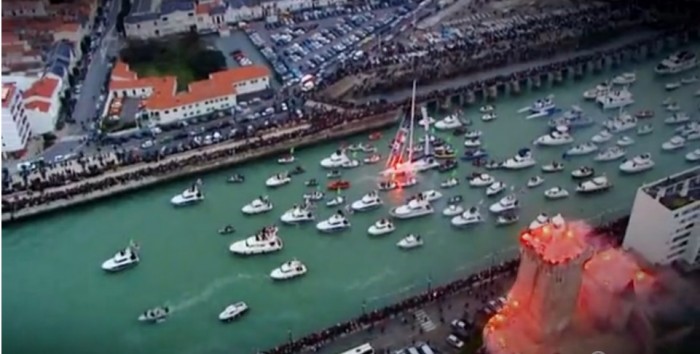
Shot for the 2012 Vendée Globe, one of the world’s most intense adventure races, this clip showcases an extreme atmosphere. You might learn a bit of French!
[vimeo id=”50299395″ width=”600″ height=”350″]
Shot for the 2012 Vendée Globe, one of the world’s most intense adventure races, this clip showcases an extreme atmosphere. You might learn a bit of French!
 32-year old Dave Cornthwaite is downright cool.
Former graphic designer turned adventurer and motivational speaker, Dave became disenchanted with work and, having recently taken up longboarding, decided to set out on an adventure. One year later, Dave skateboarded his way from Perth to Brisbane–yes, across the entire continent of Australia–received his first world record and book deal and never looked back.
Since then, Dave has paddled 2 of the world’s longest rivers from source to sea, crossed England (and Lake Geneva) by Stand Up Paddleboard, broken a world speed record on a human-powered hydrofoil — I could go on. The man is righteously adventurous.
I’m thrilled and humbled that Dave took the time out of his schedule to chat with us here at Nerve Rush HQ. We asked him a few questions about his Expedition1000 project, particularly his August 2012 plan to swim 1,000 miles of the lower Missouri River.
Until recently I wasn’t interested in doing a swim because I didn’t think I’d see anything, but then slowly I realised I would have a view, just a different one (two inches above the water!). Despite appearances, I’m not totally crazy, so I decided to swim downstream on a river with a decent current, and the Missouri fit the bill.
I’m not after any records on this one, it’s simply a personal challenge for someone who doesn’t swim so much to see how it feels to be in the water for so long. It’ll take 50 days, 20 miles a day between Yankton, SD and St Louis, MO. I’ll be dragging my own gear on a raft but will also have a team on the water around me. I love trickling down my experience to others so am assembling a team to do everything from still photography to safety kayak, all of them will be paddling the full 1000 miles on canoes, kayaks and SUP. If anyone would like to join the team here’s the link:
Hah! Well, now you ask…. I can’t remember the last time I swam more than 50 metres. I’ve just sailed across the Pacific and didn’t even touch the water. And I’m about to cycle a 4-wheeled bike from Miami to Memphis. I’ll do about a month of basic swimming, but nothing can prepare you for an expedition like the expedition itself. So I’ll take it easy the first couple of weeks and build up my strength. Besides, I figure I’ll be a brilliant swimmer by the end of the trip!

Sure. If you want to call this a career, my goal is to undertake 25 separate journeys, each at least 1000 miles in distance and each using a different form of non-motorised transport. Along the way I’m encouraging people to get off their butts, to combine sport and travel to stay healthy and get in touch with nature a little more. I’ve not met anyone who spends time outdoors and keeps fit that hasn’t seemed pretty much at peace with themselves, so I figure the more people who do it the better. I’m also aiming to raise £1 million for charity, including the breast cancer awareness organisation CoppaFeel. Great cause, it’s all about giving ourselves as much life as possible.
I’m really social media active on my journeys, sharing tales through video, words and still images. Check out www.davecornthwaite.com, I’m @DaveCorn on Twitter and www.facebook.com/expedition1000.
See you there!
![Race Across America (RAAM) [Race Profile]](https://www.nerverush.com/wp-content/uploads/2012/02/RAAM2011-route-picture-final.jpg)
Have you ever visited a restaurant serving the “worlds best burger”, an ice cream shop with the “world’s best milkshake” or a beachside stand claiming the “worlds best fish tacos”?
The whole world title thing is a bit overused. Usually the burgers are dry, the shakes aren’t creamy, and the fish tacos are, well, fish tacos. It’s just a bunch of marketing nonsense.
RAAM is known as The World’s Toughest Bike Race.
In this case it’s not an overhyped claim.
It’s a fact.
It all began in 1982 when four people got together at the Santa Monica Pier on the pacific coast near LA, mounted their two-wheelers, and started racing. The finish line was a little bit further down the road, at the Empire State Building in New York City.
The Race Across America (RAAM) was born.
Worldwide attention is not surprising, due to the sheer insanity of the undertaking, and what these athletes must accomplish to earn the title of “RAAM Finisher.”
Riders have a maximum of 12 days to ride 3000 miles from Oceanside, CA to Annapolis, MD. It’s an epic coast-to-coast battle of endurance, focus, and sheer will.

If you are quick at math you may have figured out that a rider must average around 250-300 miles a day to finish in the allotted timeframe. Try doing that in one day, let alone 10 or 12 in a row.
But that’s not all.
This race has no stages, unlike the Tour de France for example. At the start line the clock begins, and it never stops. It keeps on ticking until the athlete gets to the east coast. RAAM is 30% longer than the Tour de France and must be finished in roughly half the time, with zero rest days.
But when are they supposed to sleep you ask? Um yeah, apparently there isn’t much slumbering going on.
Frontrunners sleep as little as 90 minutes a day. To even have a chance of finishing in 12 days a solo racer can’t sleep for more than 4 hours a day.
In the process they will climb some 170,000 vertical feet, while battling the elements as well as their own physical and mental fatigue.
Grueling. Gutsy. Insane.
There are a total of four race categories: Solo, 2-person, 4-person, and 8-person. Within those are subsets broken down by gender, age, and type of bike used.
The teams are run like a relay. While one team member is racing the others are catching a snooze.
Solo riders don’t have this option.
Both solo and team riders operate with a mandatory crew, typically consisting of 8-12 people in 2-4 chase vehicles. Crews are responsible for supporting the racer with any and all logistical pieces including food, bike repair, clothing, and other needs. Perhaps most importantly they cheer their rider on, making sure to keep spirits high, and the pedals cranking.
This allows the rider to focus on one thing only, the race.
And what a mental battle it must be. Simply staying up with little sleep for nearly two weeks is enough to push somebody over the edge. When you add in extreme physical activity and outside forces like desert heat, mountain passes, rain, wind, traffic, and treacherous roads, it becomes clear why this race is so incredibly challenging.
Then there is the looming idea of throwing in the towel, cutting your losses, quitting.
When you push yourself so hard, for so long, with no sleep, this will enter an athlete’s psyche. It’s another very real obstacle to overcome.
Like all athletes, racers have their own personal reasons to take on such a daunting task. Many individuals raise money for a cause adding the side benefit of helping out others in the process. Millions have been donated to charities as a result of RAAM.
Taking a cross continent bike ride is on many a bucket list. Racing across country is an entirely different animal, especially given these intense parameters.
Do you have what it takes?
RAAM takes place annually, for information on how to qualify to participate visit RAAM’s official site.
The Worlds Toughest Bike Race? I say hell yes!
What are your thoughts on RAAM? Leave comments below. Also, if you find out where the world’s best burger is, we’d like to know.
This post is sponsored by U.K. bike shop, bikesnbits — Get Dawes Bikes.
![La Ruta de los Conquistadores [Race Profile]](https://www.nerverush.com/wp-content/uploads/2011/10/La-Ruta-de-los-Conquistadores-Trail.jpg)
La Ruta de los Conquistadores begins today and runs through November 5th. Stay tuned for any developments from the race! Check out the official website here: http://larutadelosconquistadores.com/ruta2011/
Held annually in mid-November and starting in the small Pacific Coast beach town of Jacó, Costa Rica, La Ruta de los Conquistadores is a coast-to-coast mountain biking race that follows the route taken by the Spanish Conquistadors led by Juan De Cavallón in the sixteenth century.
Undoubtedly one of the most difficult athletic events on the planet, La Ruta attracts hundreds of the very best mountain bikers and endurance racers from around the world each year. The unique and daunting Costa Rican territory is so harsh that, back in 1540, it took the Conquistadors 20 years to cross it—today, modern-day racers do it in 4 days.
That’s intense.

The course covers 240 miles and, between its sea-level start and finish, crosses 5 mountain ranges with a cumulative climb of 39,000 feet. You read that right. 39,000 feet.
The terrain is varied and covers every imaginable riding surface, from gravel to pavement, hard-packed dirt, thigh-deep mud, volcano ash, sand, fireroad trails, singletrack and more.
Racers ride through jungle, over active volcanoes, through farms, coffee fields, forests and small villages. They experience Costa Rica’s hot tropical climate as well as its cold-high mountain temperatures. The highest point in this grueling odyssey is the Irazú Volcano, which towers over San José at an altitude of 11,259 feet.
Costa Rica is one of the most biodiverse places on the planet, packing a full 5% of the Earth’s species of birds, plants and animals onto just 0.01% of the planet’s land mass. La Ruta’s course takes racers through nine of the country’s twelve different microclimates, soaking them, freezing them, sweltering them—it’s a hell of a course.

Román Urbina, a native Costa Rican, started the event in 1992. Urbina, an elite athlete known for staging challenges to publicize Costa Rica’s endangered wildlife, decided to retrace the Conquistadores’ steps on his mountain bike with 34 fellow adventurers. They battled coastal heat, climbed up active volcanoes, forded rushing rivers by shouldering their bikes and skidded through mud—one of the original racers offered up $50 to whomever managed to finish first.
For the next twelve years, only local Costa Ricans competed. In November 2005, Swiss racer Thomas Frischknecht won the race and a year later, Colombian Leonardo Páez took the crown. Costa Rica’s Federico Ramírez is the course’s legend, having won La Ruta five separate times. These days, at least a couple hundred riders attempt the annual course, the majority of them international. It’s been estimated that roughly 10% of the riders are women.
La Ruta de los Conquistadores is a personal growth experience. While a few race La Ruta, most are just happy to finish the course. The race is about appreciating Costa Rica’s unique and natural beauty, about challenging yourself to survive arduous adversities.
[images via Zero Kelvin / Tico]
![Iditasport Impossible [Race Profile]](https://www.nerverush.com/wp-content/uploads/2011/07/5391148877_750e56e3f6-500x198.jpg)
The Iditasport Impossible is the ultimate test of endurance. Forget your Ironmans, Ultra Marathons and the lot. Let us know when you’re tired of playing at the kiddie table. The Iditasport Impossible is the Ironman’s badass uncle who did a tour in Vietnam and then went back for vacation.
Yes, you have to be nuts to do it.
The Idistasport is Alaska’s Human Powered Ultra Endurance Race. There are four divisions: bike, ski, foot, and snowshoe.
For the babies and small children, there’s the Iditasport 130, which as you might guess, runs 130 miles from Knik, Alaska to Finger Lake. 130 miles is the upper limit of most ultramarathons. For the Iditasport; however, things are just gettting started.
Next up is the Iditasport Extreme, which runs 350 miles over the Alaska Range from Anchorage to McGrath. There aren’t any roads. You only get out by snowmobile or airplane. This is for the prepubescent boys who want to prove their manhood. 350 miles.
Then there’s the Iditasport Impossible, which skips a whole other category of difficulty and is only for those interested in inflicting so much pain on themselves that they could be locked up in a room with padded walls, and they’d still find a way to inflict hurt themselves. This ridiculous race is 1,000 (that’s one thousand) miles from Anchorage, Alaska to Nome, Alaska. If you’re wondering where those are, keep wondering, because it’s entirely too far. To give you an idea of how far it is, completing the Iditarod Impossible would be like trying to go from New York to St. Louis. In snow…during subzero temperatures, with no backup plan. Absolutely insane.

I wish there were more details to relay about this insane race in the tundra, but apparently most people that attempt it either die or spend the rest of their life trying to repress the memories of this tortuous event that there aren’t many details that actually escape. All the things we know, we have to gather from a few janky looking website (who cares what your website looks like when you’re a tundra-proven badass?)
If you’re crazy enough to enter and have the cash to pony up for the registration costs (a pretty penny at $1150, not including drop bags, lodging, food and other contacts beyond the McGrath checkpoint which could run you as much as $5,000), here’s what you can look forward to.
I haven’t confirmed this yet, but I’m fairly certain the t-shirt just says “I’m a badass.”
If you’re one of the few that finish, you get forever bragging rights to say you’ve done a race too painful to accurately remember. And, if you’re lucky enough to not only survive, but actually win the whole thing, you get a free entry for the following year, to relive all the pain and agony you just got done with. Absolutely free. Congratulations.
Just to give you an idea how impossible the Iditarod Impossible actually is, in 2001, 130 competitors started. 4 Finished. Good luck.
[Photo]