Tag: skydiving

  • 9 of the World’s Most Extreme Jobs

    9 of the World’s Most Extreme Jobs

    For those who spend their days trapped in a cubicle, the idea of extreme jobs may be too far-fetched to understand, but for those who live for adventure, battling rough waves or traversing cliffs may be considered dream jobs. There are those out there who risk their lives on a daily basis in pursuit of thrill and a paycheck. Here are nine of the world’s most extreme jobs.


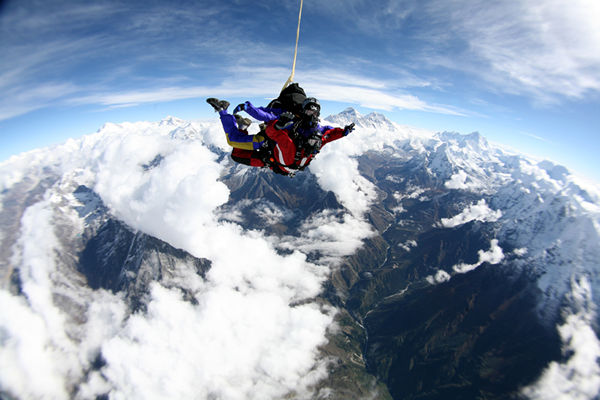
    9. Skydiving Instructor

    Skydiving instructors’ jobs involve much more than falling from great heights. Not only do these professionals have to worry about their own bodies and actions, but they’re also responsible for both teaching and assisting newbie jumpers.

    Wages: Outside of owning a skydiving business, the job of an instructor generally leans toward seasonal or part time, earning around $25 per every class taught.

    Extreme factor: What could be more thrilling than soaring through the air after jumping from a plane? Skydiving earns extreme job points for the simple act of the fall itself. It also involves the responsibility of another’s life. On average, there’s one death for every 142,000 jumps.

    safari

    8. Safari Guide

    Lions and tigers and bears… Safari guides get to see nature at its wildest. They learn about plants and animals, drive through rough terrain and are responsible for both their own survival as well as that of the group for extended periods of time.

    Wages: Wages may vary dramatically, depending on the location of the safari, but the median guide averages $73,000 per year.

    Extreme factor: The animals that safari guides encounter are often dangerous, but those in charge are trained to deal with them before hand. The real risks often come in smaller packages, like poisonous snakes or insects. There are also, of course, risks of diseases that aren’t seen in the U.S.

    whitewater rafting

    7. Whitewater Rafting Guide

    Whitewater rafting guides live a life of true adventure, cruising down wild rapids and steering their way through rough currents.

    Wages: Depending on experience, company and location, raft guides often make somewhere between $2,000 and $9,000 per season.

    Extreme factor: The extremity of a whitewater guide depends largely on the location and its surrounding rivers. While some guides may lead simple, lazy trips down a calm river, others could be navigating customers through class 5 rapids. As with any whitewater sport, for which the overall fatality rate is 0.87 deaths per 100,000, rafting has its share of danger.

    divers

    6. Scuba Diver

    Commercial divers get to experience the great unknown and see creatures most of us will never encounter. Divers may head underwater to inspect, fix or collect artifacts that sit below the water’s level. Some may even conduct experiments or run scientific tests.

    Wages: The median income for a commercial scuba diver is just under $48,000.

    Extreme factor: As always, with pushing the body to new extremes, come extreme risks. The most common causes of death for divers is equipment failure, heart attacks and mistakes in the ascent or descent. Roughly every 200,000 dives results in at least one death.

    pilot

    5. Search and Rescue Helicopter Pilots
    Outdoor adventurers take risks, often ill-advised ones, and for these mistakes are search and rescue helicopter pilots sent to save those in extreme danger. They may need to save sailors from sinking boats or rescue rock climbers from misjudged climbs.

    Wages: The median salary for a search and rescue pilot is $57,000.

    Extreme factor: These pilots fly into dangerous situations where others have already failed. They must right wrongs and often find themselves in life or death situations that require fast-thinking and skilled decisions. When one of these planes crashes, nearly one third of the accidents are fatal.

    mining

    4. Miners

    Although definitely not as typically “extreme” as other occupations on this list, miners face some of the highest fatality rates of all outdoor jobs.

    Wages: The average mining salary, depending on the state, could be anywhere between $40,000 and $100,000 per year.

    Extreme factor: Mining is one of the oldest, yet one of the most extreme professions in the outdoor world. If thought of as almost a form of caving, this makes sense. They risk cave-ins and suffocation on a daily basis. There are over 15 mining-related deaths per 100,000.

    crabfishingboat

    3. Fishermen

    There’s a reason the Discovery Channel’s the Deadliest Catch has been running for 10 consecutive seasons. Whether they’re battling choppy waters or reeling in gigantic catches, the life of a fisherman is rarely dull. It’s also one of the most deadly professions in the U.S.

    Wages: For risking their lives on a regular basis, fisherman are a bit short-changed. The median salary for a fishermen is just over $30,000.

    Extreme factor: With nearly 95 percent of the country’s salmon supply stemming from Alaska, many fishermen call the Last Frontier home. Alaska’s waters, however, are notoriously choppy and unpredictable, often resulting in massive waves and slick, icy decks. Over 120 out of 100,000 workers die on the job.

    logging

    2. Logging Workers

    Logging workers, like lumberjacks, are portrayed in folktales as strong, indestructible men like the famous Paul Bunyan with his Blue Ox. The fictional tale isn’t far off base when compared to modern day logging workers. The job demands grueling, manual labor, literally surrounded by risks.

    Wages: In today’s industry, logging workers average around $37,000 per year.

    Extreme factor: In many ways, logging workers are at Mother Nature’s mercy every single day. They’re surrounded by falling trees and sharp tools, resulting in nearly 128 deaths per 100,000 workers. But it’s not only about strength of overcoming fears, the physical part of cutting down and loading up timbre takes a ton of muscle.

    everest

    1. Everest Guides

    Mountaineering guides lead extreme lives, taking their lives, as well as their groups’ lives, into their hands with every climb, but Everest guides take extreme to an entirely different level. The world’s tallest peak has been conquered by more than 6,000, but has little over a 55 percent success rate for those who attempt it. And when guides lose their way or meet unlucky deaths on the mountains, climbing customers are left to find their own way back to safety, much like Jon Krakauer in Into Thin Air.

    Wages: Mountaineers are generally paid by the day, but wages range dramatically based on company, position and mountain and climb they’re guiding. A guide at Mount Rainier may start at $125 per day, but those on bigger, more dangerous mountains, such as Everest, they tend to make more. Climbers pay between $5,000 and $7,000 for a Sherpa guided summit attempt. Western-guides, on the other hand, expect their climbers to fork over somewhere between $45,000 and $65,000.

    Extreme factor: Not only must these workers be incredibly skilled mountaineers, but they must also deal with changing weather and altitude adjustments. Often, they need to make split-second, life or death decisions. Fatality rates for anyone who climbs Everest are incredibly high. In fact, there have been over 4,000 deaths of Sherpas, those who are often much more acclimated to the mountain’s conditions, in the past decade. A Sherpa stationed at a base camp on Everest is 10 times more likely to die than a commercial fisherman, making an Everest mountaineering guide the most extreme job in the world.
  • Beautiful Wingsuit Videography with Ludovic Woerth

    Beautiful Wingsuit Videography with Ludovic Woerth

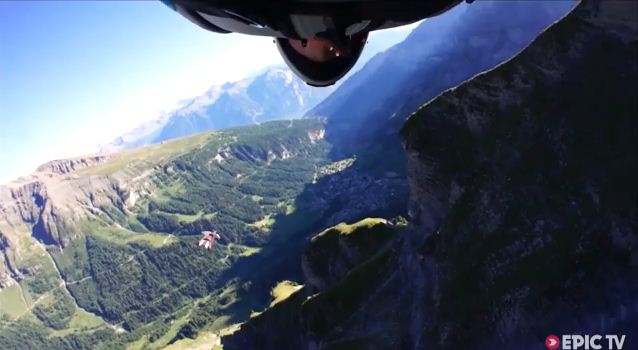
    Originally from Strasbourg, France, Ludovic Woerth is a wingsuit videographer. For five years, he taught himself how to skydive and then started BASE jumping. What a job.

  • Paraplegic’s First Solo Skydive

    Paraplegic’s First Solo Skydive

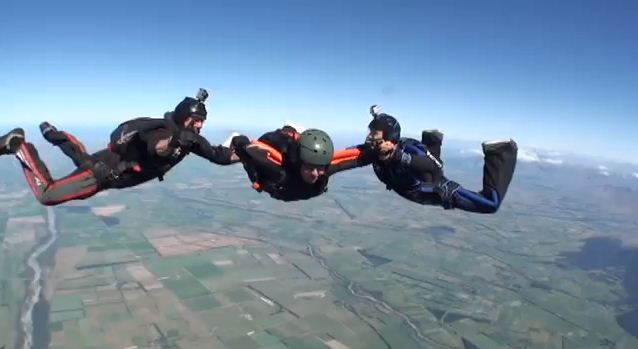
    Christine Lawn, a paraplegic, completes her first solo skydive at New Zealand’s skydiving school near Pudding Hill. Paraplegic skydiving for the win!

  • Felix Baumgartner 22-Mile Supersonic World Record Stratos Skydive

    Felix Baumgartner 22-Mile Supersonic World Record Stratos Skydive

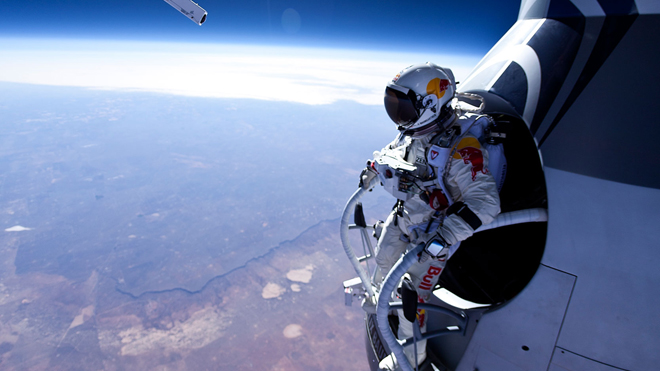
    red bull stratosFolks, skydiving history will soon be made.

    Felix Baumgartner, Austrian aviation specialist, plans to leap out of a space capsule from an altitude of 120,000 feet, rocketing his way at predicted speeds of over 700 mph to the earth’s surface.

    UPDATE:

    [highlight color=”yellow”]10/14 | 3:42pm EST: And he did it. WAHOO![/highlight]

    Quick Essentials

    Some quick facts you should know:

    > The planned jump is 120,000 feet, or 22 miles above the Arizona desert

    > The freefall should be around 5 minutes and 30 seconds. Felix Baumgartner is predicted to break Mach 1, the speed of sound, ripping through the air at speeds of over 700 miles per hour.

    > Baumgartner will travel in a 55-story high balloon, built out of a polyethylene plastic that happens to be one-tenth the thickness of a sandwich bag. This balloon is incredibly lightweight and will carry him all the way from the ground up to 120,000 feet.

    Check out this CGI video to get a visual sense of what to expect:

    [youtube id=”VCqnQq86fkY” width=”600″ height=”350″]

    The History: Seven Years, Felix Baumgartner and Red Bull

    Called the Red Bull Stratos Project, this multi-million dollar, seven-yar endeavor involves experts in the field of aeronautics, engineering and medicine.

    Felix Baumgartner, the protagonist in this epic storyboard,  is a 43-year old former Austrian paratrooper who has 2500+ jumps to his name. Baumgartner’s celebrated history of daredevil stunts include world records for the lowest BASE jump and for being the first to skydive across the English Channel. Who comes up with ideas like this?

    [youtube id=”r-TCO2IdoTA” width=”600″ height=”350″]

    In the video above, you’ll get a stronger sense of the complexities of the project. Joe Kittinger, meteorologist and current world record holder, has been advising Felix throughout the process. In 1960, Kittinger jumped from 102,800 feet, as part of Project Excelsior.

    During initial bouts of claustrophobia, Kittinger helped Felix develop a 40-item checklist to help ease his mind. Even though a specially designed balloon carries Baumgartner upward at a speed of 1000 feet/minute, there is significant alone time in the process.

    If the jump proves successful, Baumgartner plans to hand his 25+ year daredevil drawers up, to settle down with his girlfriend and to fly a rescue helicopter. The man recognizes that he has been pushing the limits — this is his final hoorah.

    Check out this video of Felix Baumgartner performing a 96,000 foot, second test jump over the summer.

    [youtube id=”s_SzUnkYcR4″ width=”600″ height=”350″]

    The Jump: 22 Miles, 700+ MPH

    Click the image below for a play-by-play mission timeline:

    felix baumgartner red bull stratos

    What Could Go Wrong

    Unfortunately, a lot could go wrong.

    For one, Baumgartner could find himself in a flat spin. In low air, high-altitude dives like this, an uncontrolled flat spin could push Baumgartner to an unconscious state. He could face temporary blindness as blood rushes to his head and extremities. Yikes.

    It is predicted that Baumgartner will step out of his capsule into temperatures of minus 10 degrees Fahrenheit. As he rockets toward earth, he could experience up to minus 70 degrees Fahrenheit. Fortunately, his custom-designed space suit should protect him up to temperatures of minus 90 degrees.

    When Baumgartner’s body approaches the speed of sound, shock-shock interaction could endanger his pressurized suit. Hopefully, because these sonic forces are less intense when the air is thin, it won’t be an issue.

    The Skydiving Suit: Custom-Engineered

    felix baumgartner supersonic skydive

    Any skydive above 62,000 feet requires a pressurized suit. Otherwise, water in the body turns to gas, and the body distends via a process called ebullism.

    Not fun.

    Red Bull partnered up with the David Clark Company, based out of Massachusetts, to create a custom suit modeled on those worn by Air Force pilots during high-altitude recon missions.

    The suit has four layers — a liner, a bladder fitted to Baumgartner’s body, mesh to hold the bladder in place and a flame-retardant exterior. The suit is designed to protect Baumgartner from a fairly large temperature range, -90 to 100 degrees Fahrenheit, with a ventilation hose to provide warm or cool air as needed.

    The composite helmet weighs 8 pounds, with a retractable sunshade visor and an integrated heating circuit to prevent fogging. The helmet is also equipped with an oxygen regulator that will pump out 100% oxygen during the ascent and descent. A drinking port will provide Baumgartner with enough water.

    Finally, five cameras will live on the suit to film what will undoubtedly be the ride of Baumgartner’s life.

    Follow Along in Real Time

    The whole shebang will be broadcast live, without feed delay or interference — an engineering marvel, I might add — from Red Bull Stratos.

    There are also several tweets from Red Bull – below are a few notables:

    https://twitter.com/RedBullStratos/status/255415156702584832

    https://twitter.com/RedBullStratos/status/255466402809516032

    https://twitter.com/RedBullStratos/status/255313839053221888

    https://twitter.com/RedBullStratos/status/255158801370603520

    https://twitter.com/RedBullStratos/status/254740216185778176

    [photos via Red Bull Content Pool]

  • Greg Gasson Skydives Without a Parachute

    Greg Gasson Skydives Without a Parachute

    Some people get a rush by skydiving. For those where skydiving isn’t enough, there’s basejumping. For those where that’s not enough, there’s skylining. For those where that isn’t enough, there’s

    skydiving without a parachute. Say what? Yes, skydiving without a parachute. We’re all for adrenaline rushes, but this is as crazy at is sounds. There really aren’t words to describe this, so just go ahead and watch.

  • The Best Place to Skydive on Every Continent

    Skydiving is a prominent thing to do on most people’s bucket lists. It frequents itself at the top of the list so often that some say skydiving has lost its perennially #1 ranking as the world’s biggest rush.

    So why not step it up a notch, Nerve Rush style. Skydive on every continent!

    Below are the best places to skydive on each of the 7 continents:

    1. North America: Skydive Santa Barbara

    With a drop-zone located only a few miles away from the Pacific Ocean sky-dive Santa Barbara offers up breath-taking panoramic views of the California coast line. This drop zone isn’t just a create spot for first timers. For those that have jumped before but are looking to add a little extra thrill to the experience, Santa Barbara offers up the highest tandem skydive in North America. An 18,000 ft jump with over a minute and a half of free-fall time is sure to give a fix to any adrenaline junkie.

    2. Europe: Skydive Switzerland (Interlaken)

    Aside from its chocolate, banks, and watches, Interlaken, Switzerland houses one of the most extraordinary drop zones in the world. At the base of the Swiss Alps and nestled between Lake Thun and Lake Brienz you will have the option of jumping from an airplane or helicopter. Scenic views of mountain tops and glaciers offer a unique look as your shoot opens. If skydiving wasn’t enough to tickle your fancy, Interlaken also gives you the opportunity to test your nerves through hang-gliding, Alpin rafting, and paragliding.

    3. Africa: Skydive Victoria Falls

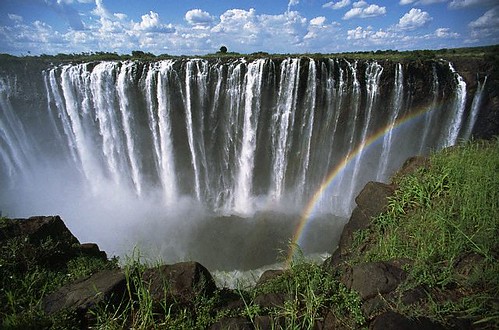
    From bungee jumping, to elephant back riding, and now skydiving. Victoria Falls in South Africa, located on the Zambezi river between Zambia and Zimbabwe, gives those with a few screws loose a chance to see one of the worlds largest and most beautiful waterfalls from a unique perspective. A 25-minute scenic flight with Skydive Vic Falls gives you a chance to see the falls up close as well as many other local landmarks.

    The indigenous name for the Falls is “Mosi-oa-Tunya” – which translates to “The Smoke that Thunders.” If that doesn’t scare the crap out of you, I don’t know what will.

    4. Asia: Skydive Dubai

    Well on its way to becoming one of the worlds best skydiving resorts on the planet, Skydive Dubai offers thrill-seekers a chance to fly over a man-made peninsula that is literally on the water and even has its own private beach. After taking in the views that include the World archipelago, the 7-star Burj Al Arab hotel and the Burj Khalifa – the tallest building in the world – you can take a dip in the Arabian sea or enjoy the world-renowned night life. If that is not enough, hop on a quad and rip in up in the desert.

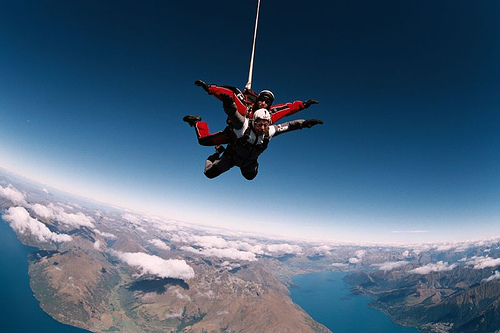
    5. Oceania: Skydive Queenstown, New Zealand

    Deemed the adventure capital of the world, Queenstown is located on the south island. Between Queenstown and Rotorua, a 2nd location on the north island, 180,000 people have tumbled out of  planes since 1990. The first commercial skydiving operation in New Zealand gives you the chance to leap from up above the Remarkable’s mountain range (how fitting is that). The Rotorua location is found between two towering volcanoes and is surrounded by mud pools, active geysers, and steaming lakes. The sky above this drop zone is known as Ranginui, or the Maori Sky God.

    6. South America: Skydive Sao Paulo, Brasil

    Perfect blue skies and wonderful weather make Sao Paulo a pristine drop zone. Located near the Atlantic ocean just outside of Rio De Janeiro, this jump offers up one of the most beautiful skylines in the world. If you time it right, you might be able to get a jump in as well as catch Formula 1 race, attend the ATP Brasil Open, or an Indy 300 event. The 2011 Skydiving world championships were held here..so you know it’s legit.

    7. Antartica: OK..Maybe Not

    This is not for the noob. Valery Rozov was the first man to climb the nearly 10,000 ft Mountain, Ulvetanna and base jump off of it. The free fall lasted roughly 45 seconds through -30 degree Fahrenheit winds. Although you might not be able to experience what Valery did there is a chance to get close.

    *Bonus 1: Skydive Mount Everest in Nepal.

    Falling from 29,500 ft in the air will give you plenty of time to pull your shoot. You’ll also be able to land on the highest drop zone in the world at 12,350ft. The Everest jump team only conducts four jumps over the course of a year. You’ll need to throw down a few clams as well to prove your serious. About $25,000 worth! Word on the street is that you get a pinky ring and diamond studded wing suit, John Travolta style. Reserving your spot needs to be done six months prior to the jump date. If you’re looking to put some hair on your chest, this may be your best shot.

    *Bonus 2: Outerspace

    For a jump that is seriously out-of-this-world, check out Felix Baumgartner and team Red Bull starts. These fools plan to jump from a stratospheric balloon 120,000 ft above the earth. Felix will be testing the limits as gravity yanks him back into our atmosphere at supersonic speeds. This jump will exceed the current world record held by Joe Kittinger in 1960 by nearly 18,000 ft.

    I’m not sure how long the free fall will be..due to the weight of this guys balls.

    If you decide to put this on for bucket list better save it for last.

  • Experiencing Human Flight in Melbourne

    Experiencing Human Flight in Melbourne

    Part 1 of a surreal look at what extreme skydiving is all about–floating effortlessly at the upward limits of our Earthly atmosphere. Shot in February 2011, watch world champions Fred Fugen and Vince Reffett from Soul Flyers demonstrate a bit of 3D coaching to some of Australia’s leading adrenalinists.

    Shot on a GoPro camera.