Tag: ultramarathon

  • Inside a 70-Mile Himalayan Stage Race

    Inside a 70-Mile Himalayan Stage Race

    I recently corresponded with Priya Darshini, Race Director and CEO of the WindChasers 70-Mile Himalayan Stage Race.

    What’s the history behind WindChasers?

    The WindChasers started out as a fun run organization with the objective of getting more and more people to run while discovering stunning remote locations in India that would otherwise be very difficult to access. Our quest was to eventually find the perfect running course for marathoners who wanted to progress to running ultras as well as something that would be challenging for elite ultra marathon runners.

    During one of our recent runs, Ram Sethu, another Race Director, and me mapped and designed the most stunning yet challenging race course that we had ever seen. The WindChasers became official in the year 2011 and we launched our first event, the Sandakphu 70-Mile Himalayan Stage Race.
    I have personally run around 9 Ultras (all in the Himalayas) and several marathons and half marathons.

    How many people are involved in putting on a race like this?

    Ram Sethu is my partner at The WindChasers and the other Race Director. He has run several marathons and ultras including The Last Desert races in Sahara, Gobi and several others in the Himalayas and elsewhere around the world.

    Our Course Director is Pemba Sherpa. He is an experienced climber and has spent most of his life in the mountains. He trained with his late grandfather Ang Tsering Sherpa a.k.a Mountain Man and is a celebrated climber and was on the first ever expedition to summit Mt. Everest with Mallory and Irvine in 1924.

    Ram, Pemba and I with our incredible crew of 25 sherpas hold the fort down at The WindChasers race.
    Our Official Medic this year is Dr. Anil Menon (MD, MPH) a.k.a ‘Space doctor.’ Dr. Menon is experienced in wilderness medicine, trauma, and is an aerospace medicine fellow from Stanford University. He works at trauma centers in Houston and Los Angeles and at NASA supporting launch and landing of astronauts to the International Space Station.

    Dr. Menon is an experienced runner himself and has supported ultra marathons in the Sahara Desert. He has also worked as a medic on Mount Everest expeditions, disaster response Reno Air Races, Indy 500, Earthquake disaster relief and Haiti to name a few.

    What’s the course like? What can racers expect this year?

    The Sandakphu 70-Mile Himalayan Stage Race is a challenging yet spectacular 70-mile 4 day boutique stage race located at the border of India and Nepal in the Himalayas.

    The course starts at 6000ft taking one through a pristine and stunning Himalayan national forest on day one, leading to the most surreal view of Kanchenjunga, the third tallest mountain in the world, on Day 2 at 12,000 feet. Day 3 is the full marathon day at 12,000 feet where runners literally run through clouds while Kanchenjunga, Mt. Everest, Lhotse and Makalu keep runners company! The final day takes runners from 12,000 feet back to 6600 feet as the course cuts through the mountain taking runners through quaint little nepali villages, forests and even waterfalls!

    The altitude, unpredictable weather and course which consists mainly of cobble stones and gravel make it rather challenging but it’s probably the beauty of the Himalayas that will take your breath away.

    Runners can also expect the most supportive and warm crew that will take care of them like we would our own family.

    If I’ve never run an ultramarathon before, is this race for me?

    Yes, our race is specifically designed for runners who are looking to run their first ultramarathon.

    Do you have any training resources you can share with our community?

    Once runners sign up for our race, our team puts together a personalized training program for each runner if requested.

    Awesome, thanks Priya for your answers! Folks, if you’re looking for a race to run and an adventure to experience, check out The WindChasers here. Registration opens April 2015!

  • NR002: Joe Mauko, 70 Lbs Overweight to Ultrarunner

    NR002: Joe Mauko, 70 Lbs Overweight to Ultrarunner

    Welcome to the Nerve Rush podcast, episode 2.

    In this episode, we chat with Joe Mauko. Joe reached out to me a few months ago, and he wrote:

    Alan, I am doing four impossible things to fundraise for cancer in 2014:

    • Run 70km to the start of a marathon, and then run the marathon
    • Complete a 100-mile ultramarathon
    • Complete a 24-hour treadmill outside in a Toronto intersection
    • Complete a 250+km multiday ultramarathon race in Chile’s Atacama Desert

    What’s fascinating about all of this, is that while Joe just completed his fourth and final bullet point last month, 5 years ago he had almost lost everything.

    He had a lien on his house. He was in a state of perpetual fatigue. He was recovering from cancer. He was 60-70 lbs overweight.

    In this episode we talk about what drove Joe to start running. What those first few weeks and months of running were like.

    We talk about how he got lost during a 100-mile race, what ultramarathon training consists of, and what racing through the Atacama

    You’re going to hear it in his voice, folks. Joe Mauko is passionate. He exudes the kind of optimism and level-headedness we could all use a little more of.

    I had a lot of fun hearing his story, and I know you will too.

    Mentioned in this episode:

  • Ode to a Serendipitous Ultramarathon in NYC

    Ode to a Serendipitous Ultramarathon in NYC

    It was in the late afternoon of a Thursday in June when I picked up my phone.

    “Alan, are we going to do this? We’ve been talking about it for so long.”

    While I think my brother,  Dan, was a bit antsy after a long week in the office, the man had a point. For the last few years, we had discussed running a marathon together.

    Marathon Failed Attempts

    It’s not like we hadn’t tried before.

    I made a valiant attempt in college. My friend Gabi and I ran through St. Louis’ Forest Park several times over the course of 8-10 weeks, following a strict four- month training schedule. After a particularly long run one weekend, my knee gave way when I got out of bed the next morning. Gabi and I made the executive decision to postpone our long distance exploits. Turns out that was a good decision, as we both pledged the same fraternity and likely wouldn’t have had much free time to safely finish our training.

    My brother also once tried to run a marathon. I remember one of his training runs while we were visiting family in Indiana. It was Christmas time – cold and windy, and my brother went out for a solo 14-mile run. My family thought he was crazy, but I knew what he was going through. Despite biting gusts in his face during the latter half of his run home, he celebrated a victory that morning. He had officially run a longer distance than I ever had.

    Like me, Dan’s knees started bothering him and he didn’t finish his training. Over the next couple of years, I got into obstacle racing and rock climbing, joining a local gym and racing events like the Tough Mudder, the Spartan Race, and even a zombie apocalypse-inspired mud run. Scary stuff.

    Throughout 2013 and 2014, Dan and I had talked about another attempt. This time, we would train together. We went back and forth, trying to find the perfect race to sign up for. Do we race locally? Do we pick a city and fly there for the weekend? What races are available given our hectic work schedules, upcoming bachelor parties and vacations and conferences?

    Holding Ourselves Back

    Thing is, we couldn’t find a race that “worked.”

    It wasn’t until Dan’s phone call last June that we realized…we don’t need a race. All we have to do is put our shoes on and run. We’ll figure out the details later. Trying to find the perfect race was holding us back from what’s most important. Let’s just start running, and we’ll take it from there.

    He called on a Thursday, and we started our four-month training program that next Tuesday.

    Our Marathon Plan

    The plan was simple.

    We’d follow the same four-month training plan that we had used before. While we both live in New York City, it was easier for us to train alone during the week and then, occasionally, to sync up on Saturdays for longer runs. I would train along the west side of Manhattan, hugging the Hudson River during my runs, and my brother would train along the East River.

    We’d call each other regularly to chat about how we were feeling, to make sure we trained at the same pace, and to psyche each other up for the next run.

    Unfortunately, after about 10 weeks of training and one particularly long run, Dan told me that something didn’t feel right. He had suffered knee and ankle injuries in the past, and he didn’t feel like continued stress was the right decision at the time.

    Finishing Alone?

    I’m proud of Dan for listening to his body, but I was upset that I no longer had a training partner. At that point, I was more than halfway done with my training, and I had just run the longest I have ever run before, a 16-mile Saturday morning session.

    I decided to press on. There were still, of course, some details to sort through:

    • What would I eat the few days leading up to the race?
    • Without aid stations, what water and food would I carry with me?
    • What was my route? How would I hit 26.2 miles running around Manhattan like a crazy person on a Sunday morning, avoiding traffic?

    Enter Joel, Ultramarathon Runner

    Satisfied with my training, I set out to run my “DIY marathon” on Sunday, August 10th.

    A few days prior to the run, I received a serendipitous text message from Joel Runyon, close friend and co-founder of Nerve Rush, an extraordinary human being who recently set out to run seven ultramarathons on all seven continents.

    “Hey, I’m coming to NYC. You around?”

    I responded back.

    ”Yes, any chance you want to run a marathon with me on Sunday morning?”

    I figured, Joel was in the middle of ultramarathon training, so he likely had a longer run scheduled that weekend anyway. My hypothesis was validated when Joel agreed to join me on Sunday. I made a last minute trip to REI to pick up his favorite Clif Shot Bloks, and made plans to meet Joel at 7:00am the next morning.

    The Serendipitous Ultramarathon

    For the more novice ultramarathon runner, finishing the race safely is the most important accomplishment one can hope for.

    The time doesn’t matter nearly as much as listening to your body, knowing how and when to take breaks, and constantly battling the “please stop now this is hurting” voice in the back of your head.

    While I had been training at an 8:00-8:30 min/mile pace, Joel had been working with a professional ultramarathon coach at a slower pace. About 4-5 miles into our run — we both went out way too fast! — we both slowed down. Turns out this was a smart decision, as the temperature quickly picked up to 85+ °F. It was a hot and humid day, not ideal for long distances.

    We ran up the Hudson River Parkway, from 10th Street to 109th Street, where we darted east until we hit the northwest corner of Central Park. We ran the Central Park Loop (a little over 6 miles) two times, then we made our way back to the Hudson River to run home.

    Along the way, we snuck into a 5K race and “borrowed” their aid station, took a quick bathroom break, and stretched where we needed to. Running an ultramarathon, I learned, is about managing your body, and that’s what Joel taught me to do.

    With about two miles left in our run, Joel looks at me and says, “Hey, want to make this an ultra?”

    While ultramarathons tend to follow 50K, 100K, 50-mile or 100-mile courses, an ultramarathon is technically any race over the normal 26.2 mile distance.

    Joel whipped out his fancy GPS watch, and we ran around a couple of Hudson River piers to tack on an extra tenth of a mile, putting our final race distance at just over 26.3 miles.

    I set out to run a marathon, but I learned how to run an ultramarathon.

    This won’t be my last 🙂

    Alan & Joel Ultramarathon in NYC
    Just after Joel and I finished the NYC “ultramarathon.”
  • 8 Leadership Skills I Applied to Finishing My First Ironman

    8 Leadership Skills I Applied to Finishing My First Ironman

    This is a guest post from Jarie Bolander, an engineer by training, entrepreneur by nature and leader by endurance. Jarie combines leadership and endurance athletics over on his blog, Leading from Within. You can also find Jarie on Twitter via @EnduranceLeader.

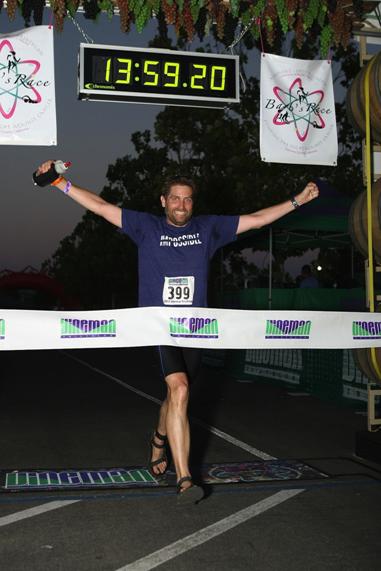
    On July 28th, 2012, I achieved one of my life goals. I finish an Ironman distance triathlon. It ended up taking me 13:53:21 to complete the 2.4 mile swim, 112 mile bike and 26.2 mile run. Getting through the race took a tremendous amount of dedication, mental fortitude, support from family and friends and lots and lots of training.

    My successful completion of an Ironman only occurred because I chose to stay positive and lead myself to victory by tapping into the following leadership skills:

    1. Setting A Goal

    All organizations and individuals need goals. Without goals, we are adrift on the sea of life.

    Goals need to be specific and achievable for us and not what society might thrust upon us.

    My Ironman goal was to finish. I had some rough time goals in mind for each leg but my real goal was to finish before the cut-off time of 16 hours. My specific goals for each leg were:

    • Swim: Goal: 1 hr. (Actual time 1:10 hrs)
    • Bike: Goal: 7 hrs. (Actual time: 7:06 hrs)
    • Run: Goal: 5 hrs. (Actual time: 5:19 hrs)
    • Overall: Goal: 13 hrs. (Actual time: 13:53:21)

    You’ll notice that the actual times don’t add up to 13:53:21. That’s because there are two transitions (Swim to Bike and Bike to Run) that are timed separately. You’ll also notice that the time in the picture is different. My wave started 6 minutes later than the official race time.

    Even though I did not hit my overall goal, I’m happy with my performance since I finished before the sun went down and the cut off time.

    Next time, I’ll do better.

    Jarie Finishes First Ironman2. Devising A Plan

    Goals are great but without a plan to achieve them, goals are just empty promises.

    Plans are a good way to determine if your goal is actually achievable. Without a solid plan, your goals will be next to impossible to achieve.

    My plan to complete the Ironman was to device a training schedule that got me in shape to finish–yet not consume–all my free time. I decided that the best plan was to train by time and not distance. That way, I could plan my life accordingly. I got this idea from Be Iron Fit —an excellent book on training by time not distance.

    3. Gathering Support

    All leaders need supporters to help them achieve their goals. Supporters are also how a leader gauges their organizations impact and reach. A solid group of supporters will be invaluable for a leader and their organizations ability to get stuff done.

    My support network is wide and diverse. Some, like on the Impossible League, I have only met virtually, while others I see daily. These supporters were a vital part of my success because they believed I could do it and frankly, I did not want to let them or myself down.

    4. Sticking to the Plan by Executing It

    Once a specific and achievable goal is defined, a plan devised and support gathered, it is now time to execute the plan.

    If the plan is solid, then it will be easy to implement. If it’s not, then the desire will be to constantly change the plan. This needs to be avoided since a constantly shifting plan is just as bad as no plan at all.

    Executing my training plan was pretty simple —only train enough to finish. This meant I had to get the time in by training around my life. This also meant that I had to resist the urge to overtrain (e.g. Put in more miles instead of sticking to my time based training plan).

    Another big aspect of training is getting started. There were some days I really just wanted to stay in bed but forced myself to train instead. Those were some of the best training days I ever had.

    5.  Zigging and Zagging When You Have To

    Plans can and should change when conditions warrant. Every leader needs to know when the path they are on is just not going to get them there.
    By zigging and zagging, you can adjust your plan according to the situation you find yourself in.

    I had to zig and zag a couple of times to stay on my training plan and to complete the race.

    The biggest zig and zag came 3 weeks before the race. I got a nasty cold that would just not go away. I had to stop training for 3 days to recover. Even after that, the cold lingered but it did slowly get better. I’m glad I rested when I did, because on race day, my cold was completely gone.

    6.  Helping Others Succeed

    The main job of a leader is to build other leaders and help as many people as they can be successful. This is the only way to create an organization that can sustain itself and perform at a high level. The same goes for individuals.

    The reason I love racing is because of the esprit de corp that endurance athletes have. I have never met an endurance athlete that did not want everyone to finish.

    For me, helping others succeed is giving my fellow endurance athletes the encouragement to endure on. This takes many forms but the most powerful one is words of encouragement. I always say something positive to anyone I may pass or passes me.

    7. Finishing Strong

    Goals are meant to be completed and there is no better feeling than pushing hard to finish strong. Finishing strong is all about enjoying the final movements when the plan comes together, the team is excited and the finish line is in sight.

    The picture that accompanies this post is me crossing the finish line. Notice that I’m in full stride, arms raised and smiling. Sure, I was tired and sore but I felt the energy of the crowd, the courage in my heart and the pride in knowing that I did it.

    8. Thanking Your Supporters

    A leader can never say thank you enough. It’s probably the most important two words a leader will ever utter other than I’m sorry.
    Thanking supporters not only gives them the recognition they deserve but it also reinforces the fact that it took others to achieve the goal.

    I had a lot of support in my quest to be an Ironman. Some of this support was from people I met on the course (thanks Michael), those online and all my friends and family. To all of you, thanks!

    What’s Next?
    The great thing about finishing a life goal is that inspires you to want to achieve another one. I’m not exactly sure what’s next but two things keep on popping up —an ultra-marathon or a Goruck. Whichever one I do (I might do both), I know that I’ll apply these same leadership skills to finish strong.