Author: Abigail Wise

  • Hitting the Line: Slacklining Trend Continues to Grow

    Hitting the Line: Slacklining Trend Continues to Grow

    In the 70s, after climbing hard all day, exhausted rock climbers would return to camp at Yosemite National Park and look for a way to occupy the time until their next climb. With armfuls of rope, webbing and carabiners at their disposal, climbers started to slackline. They’d pull webbing tight between two trees and take turns balancing across the line. In recent years, the sport has gained momentum and popularity through competitions, taking it to new lengths by longlining, higher heights through highlining and flips and tricks through tricklining.

    Due to the new demand for supplies, companies started producing nylon webbing, which resulted in a new competitive market. Gibbon Slacklines currently dominates this industry offering a range of gear from webbing of various widths to graphic T-shirts.

    [youtube id=”0GQOdhU-RMc” width=”600″ height=”350″]

    Some companies are starting to take the business side of slacklining outside of gear. Dakota Collins founded Rocky Mountain Slackline LLC, filled with what he refers to as slacklining consultants. Collins’ company strives to spread the sense of balance, peace and control that he feels while balancing on a slackline. Rocky Mountain Slackline offers courses and guidance in all areas of the sport in an effort to share the fast growing trend.

    Collins had only been slacklining for about a year and was in college studying sustainability, but after falling in love with the sport, he decided to take a break to go full force with his slacklining company.

    “Here at Rocky Mountain Slackline, we don’t actually sell any slacklines. We’re just trying to sell the service,” said Collins. “We’re really trying to get it out there in the community and get people exposed to it so they can see what the benefits are behind slacklining.”

    slacklining a canyon

    Rocky Mountain Slackline hopes to accomplish this through workshops, camps and clinics for everyone from recreation center workers to those involved with school and education programs. From tricklining at promotional gigs to planning a record-breaking longline trek up a mountain, Collins has his hands in virtually every aspect of the sport.

    “It’s applicable to anyone’s lifestyle and whatever you’re looking to get out of it, you can,” said Collins. “Slacklining for me is therapeutic. And that’s what I’m really going after. That’s my big shabam.”

    But not everyone looks as positively at slacklining. National parks worry about damaging natural resources by stripping tree bark or snapping tree trunks. City officials who work in public parks also frown upon slackliners spreading long lines across crowded areas, tripping visitors and causing bike accidents. For these reasons, it’s been banned across many parks and college campuses in both the U.S. and Canada.

    Collins hopes to help overcome some of these negative connotations by teaching responsible slacklining behavior. He urges slackliners to always wrap trees, protecting both the bark and the athletes’ gear. Another solid rule Collins adheres to: never set up on a tree less than 12 inches thick in order to avoid snapping the trunk. He also strives to leave an outdoor area even cleaner than when he arrived and encourages his clients to follow suit.

    “We want to show the community that it’s safe, beneficial and a new type of fitness training,” said Collins. “It’s not just some hippie, pot smoking sport.”

    photo & video credit: Mike Barry, Rocky Mountain Slackline LLC

  • Matt Samet: Fighting Drugs with Rocks

    Matt Samet: Fighting Drugs with Rocks

    Rock climber Matt Samet, 41, former editor-in-chief of Climbing Magazine, didn’t plan on becoming a writer too. During a break from studying geology at the University of Colorado at Boulder in the early ‘90s, a conversation with his father helped point him toward journalism.

    “It’s funny. It’s the kind of thing that only a father could say,” said Samet. “My dad was like, ‘Just think about what happens when you’re 40 and your fingers hurt all the time and you’re living in a van at the climbing area. Is that what you really want?’ And even then, I knew that he had a point.”

    Samet, a native of Albuquerque, N. M., went on to study journalism and moved to Italy, traveling across Europe to report on the World Cup and sport climbing.

    Samet, an accomplished climber himself, has tackled routes that most rock climbers never touch. He redpointed [successfully completing a climb from the ground without ever putting weight on the rope while pinning all of the safety gear as the climber ascends] difficult climbs such as Zulu, at Colorado’s Rifle Mountain Park. He was the first to complete Chewbacca, a bouldering problem [typically climbs done on huge boulders] on West Mountain at Hueco Tanks State Historic Site in Texas. The feat is so challenging and dangerous that no other rock climber has ever successfully repeated it.

    But one of the toughest ascents Samet conquered wasn’t on a rock wall. Throughout his traveling, writing and climbing, Samet said he battled an addiction to prescription drugs.

    At age 21, doctors prescribed Samet some benzodiazepine tranquilizers to help him cope with anxiety and panic attacks. Although benzodiazepines, such as Ativan, Klonopin, and Xanax, are often prescribed to treat anxiety, the FDA recognizes the risk of severe addiction to these medications. The FDA warns that withdrawal symptoms of Xanax can include life-threatening seizures. The FDA also says that spontaneous reporting system data suggest that the risk of dependence is greatest for those treated longer than 12 weeks. At one point, Samet took benzodiazepines daily for seven years.

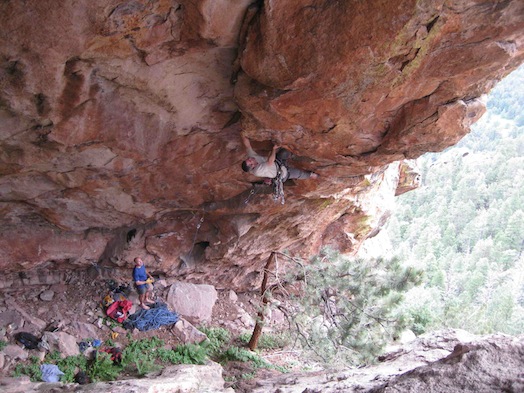
    matt samet rock climbing

    Samet’s memoir tells his story of climbing and addiction. Death Grip is set for release on February 11, 2013. The 300-page book narrates how the author sought out risk, danger and adventure, while at the same time, suffering from anxiety, depression, extreme dieting and a crippling dependency on benzodiazepines.

    His drug use was not always apparent to those around him.

    “I never knew he was on benzodiazepines,” said Pete Takeda, a fellow climber who met Samet in 1992. “I imagine he was just maintaining rather than being high.”

    Samet had been off of all the benzos for about a year when he first started dating his wife, Kristin Bjornsen, in February of 2007, she noted. He was still suffering withdrawal symptoms, such as panic attacks, trouble breathing during approaches to climbs and heat sickness on sunny days, she added. On the couple’s first road trip together to Canyon City, after dating for a month or two, the stress of travel and a new environment aggravated his symptoms.

    “He went into a dark, silent state,” said Bjornsen. “I thought it was me, that I was boring him or he was unhappy in the relationship and not having a good time. Over time, I’ve learned not to take it personally, that he just needs space during those times.”

    As a writer and editor, Samet said that one of the downfalls of his addiction was that the drugs affected his focus and vocabulary recall.

    “When I was coming off of them, I couldn’t form coherent thoughts for a year or two,” said Samet. “You can read Burroughs, who was a junkie, or Bukowski, who was an alcoholic and think, ‘These guys got messed up all the time and sat down to write.’ But I don’t think they really did. I think it was just a literary persona that they adopted. I really don’t think it helps anyone’s writing.”

    The benzodiazepines, not only affected Samet’s writing, but they dulled his fear during dangerous climbs, such as Chewbacca in Texas and Primate at the Flatirons, near Boulder, Colorado.

    Something that drug addiction and rock-climbing have in common is an increase in dopamine levels, said Michael Bardo, a professor of psychology at the University of Kentucky and the director of the Center for Drug Abuse Research Translation. He said that high-risk takers have a greater release of dopamine in the brain compared to low-risk takers. A stimulating event, such as rock climbing, is an attempt to overcome the under arousal.

    Samet said that, throughout his life, rock climbing has helped him cope with anxiety and agoraphobia.

    “It’s a fear that you can relate to and understand and, to a large degree, control,” said Samet. “It’s within you to find a solution and push through your fear. Whereas in most other areas of life, scary, weird, creepy things can happen, over which you have no control and often no understanding.”

    Fellow rock climber Ted Lanzano, who met Samet in 2008, admires Samet for his consideration. Last fall, Samet and Lanzano climbed a route called Choose Life in the Flat Irons of Boulder, Col., that Samet had established 10 years earlier.

    “He called it Choose Life not for political reasons,” said Lanzano. “But rather because of a decision he made not to climb the route on lead on traditional gear, which would have been extremely dangerous.”

    Even though Samet completed Choose Life without falling long before Lanzano, he continued climbing the route with Lanzano, waiting for him to successfully finish.

    “Climbers and other more serious athletes have a tendency to be a little self-centered and Matt is not like that at all,” said Lanzano. “Most climbers would have moved on after completing the route, but he still went up to there with me multiple times so I could keep trying. I eventually did it, largely thanks to Matt’s support.”

  • Risks and Rocks: The Mentality Behind Mountain Sports

    Risks and Rocks: The Mentality Behind Mountain Sports

    most dangerous sports in the world

    Rock climber and former Climbing Magazine editor Matt Samet knows his sport is dangerous. Until last year, he was the only climber to have successfully scaled Primate, a 90-foot route on Seal Rock in the Flatirons above Boulder, Col. With protective gear that was likely to tear under impact of a fall at the hardest sections, Samet climbed the most difficult part, 60 feet above the ground and over a giant boulder that he jokingly named “The Pillow.”

    In the past two decades, climbing’s popularity has increased, resulting in an influx of climbing gyms in Chicago and elsewhere. But injury rates are on the rise too. The number of patients treated in U.S. emergency rooms rose 63 percent since 1990, according to the Center for Injury Research and Policy of the Research Institute at Nationwide Children’s Hospital in Columbus, Ohio.

    Samet respects the dangers, but climbing creates a healing kind of fear compared to the agoraphobia and anxiety he suffers from. For years, he said he used prescription benzodiazepines to treat his condition and that led to a benzo addiction. Now, instead of using drugs, Samet relies on rock climbing near his home in Boulder, Col., for relief.

    “It [rock climbing] is a fear that one can understand because you have a reason to be anxious or frightened at that point: you don’t want to fall,” said Samet. “It makes sense in a way that’s not chaotic. So in a way that’s the cure for the angst I feel in modern society.”

    Whether climbers hit the Himalayas or a rock wall in the gym, rock climbing offers a rush.

    That may be why drug use is often connected psychologically to rock climbing through a parallel personality dimension. Researchers call the personality trait that drug users and rock climbers have in common sensation seeking, according to Michael Bardo, a professor of psychology at the University of Kentucky Director and Director of the Center for Drug Abuse Research Translation. Sensation seekers are more likely to partake in high-risk activities, he said. Experts say that sensation-seekers’ brain function reinforces risky behavior.

    Bardo works at a research center that views risk-taking as a predictor of drug use. Bardo said that high-risk takers tend to have a greater release of dopamine [a chemical neurotransmitter that helps control the brain’s pleasure and reward centers] than low risk takers.

    “The current thought is that the brain of risk-taker is under-aroused and thus the stimulating event is an attempt to overcome this under arousal,” said Bardo.

    Not all researchers agree that rock climbers should be classified as risk-takers. Dr. Eric Brymer, psychologist and researcher at Queensland University of Technology, in Australia, said that non-participants have typically associated risk taking and extreme sports in the same way that drug taking and risk taking have been linked. But his research suggests that risk taking and extreme sports are not necessarily tied together, Brymer said.

    “Most athletes spend years training and learning to ensure that risks are not taken,” he said. “I would not classify extreme sport athletes as risk takers.”

    Colorado climber Ben Spannuth agrees that a significant amount of training, discipline and reflection are necessary for rock climbing. The sport demands almost daily practice to get into a rhythm of feeling comfortable and moving well across the rock, he said.

    “When I feel challenged everything seems to drown out except the immediately upcoming series of holds and how I’m going to move through them,” said Spannuth. “To be honest, the majority of the time I spend climbing is actually spent hanging on a rope thinking about what movement the holds are going to create.”

    alex honnold rock climbing fitness

    Immediacy and challenge as well as discipline and training are important to rock climber Alex Honnold, famous for free-soloing, a form of climbing done without any ropes or protection.

    “I only set projects a few months out,” said Honnold. “I don’t have a big plan, I just go climbing all the time.”

    The part of rock climbing that is so physical plays a role in brain chemistry. Physical activity increases dopamine release in the pleasure pathway, said Bardo. Experts note that other physically demanding sports such as running, football and tennis also stimulate pleasure sensations.

    “Any novel or stimulating events release dopamine in pleasure pathways of the brain,” said Bardo. “Rock climbing is certainly novel and stimulating.”

    Honnold, a Sacramento, Calif., native who spent 16 years learning his sport, said he would not classify the stimulation he finds in free-soloing as a surge of adrenaline. An intense rush while soloing would indicate a problem and safety concern.

    “I wouldn’t say I get a rush,” said Honnold. “I would say I get a deep satisfaction. Doing something challenging and doing it well is one of the best feelings in the world. Skydiving is a rush. Or dropping in on a big line on skis. But climbing is so slow and demanding that’s it’s not the same kind of rush”.

    Spannuth said that this aspect of challenge and problem solving, combined with physical activity has a positive effect on lifestyle. The action portion helps relieve stress, and much of the benefit comes from his love of the sport. Climbing certainly isn’t the only sport people enjoy, said Spannuth. But activities that contain physical challenges combined with problem solving and social components seem more likely to have these effects for him than something like forcing a mandatory run on the treadmill for 30 minutes each day.

    “In my mind, it’s far from a workout when I head to the climbing gym or to climb outside,” said Spannuth. “Furthermore, climbing has additional mental health benefits by getting people outside.”

    Mountaineer Billi Bierling, who works for Elizabeth Hawley of the Himalayan Chronicler, said she too enjoys the physical challenge and outdoor aspect of climbing mountains. She said she feels privileged to take long treks up mountains, such as Everest and Makalu, because she gets to witness views that most people never see.

    “When I come back from an expedition, of course my body feels tired, but I feel good because I’ve been outside for the last seven weeks and I haven’t had to deal with an office,” said Bierling. “For me, that is an expedition. For a lot of people, it’s the summit, but for me the summit is a bonus.”

    These days, athletes aren’t only risking their lives climbing mountains, but jumping off of them as well. Recently, BASE jumping has taken off. Extreme athletes, such as Nasr Al Niyadi and Omar Al Hegelan, jump from fixed objects, often mountains, and use a parachute to break their fall.

    A recent study published in the New Zealand Medical Journal found that 35 BASE jumpers observed suffered an injury in at least one of the 9,914 total jumps they had collectively made, resulting in an estimated 0.4 percent injury rate. Professional football has a 6.9 percent chance of injury per player per game, according to the National Football League Players Association’s injury report, “Dangers of the Game of Football.”

    Honnold said that flying sports, including paragliding, speed wings and BASE jumping, have a growing presence in the mountains. He also said that the increase in climbing gyms is bringing new talent into the sport. These gyms make climbing more accessible, especially in cities without mountains, and allow athletes to build strength and technique for outdoor climbing.

    “I don’t know where the sport is heading,” he said. “Except for the obvious: harder and faster.”

    As mountain sports increase in both popularity and risk-level, Bardo pointed out that risk-taking should not be viewed as a fully negative personality trait.

    “If you look at this type of behavior in animal species [such as monkeys], risk-takers are often the best at locating new sources of food, water and mates,” said Bardo. “On the downside, they are also most likely to fall victim to predators.”

    photo courtesy of Andrew Burr