Category: Sky
-

Uh, a Personal Jetpack? Yes Please.
ack” width=”300″ height=”168″ />
It’s taken 3 years of testing, but Troy Hartman, professional aerial stuntman with a colorful history of insane, gut-wrenching stunts, has finally done it.
His original goal was to build a proprietary jet-engine powered wing (à la Yves Rossy). In the process of designing the wing, two concerns materialized right out of the gate; 1) operating the jet engine close to his body and 2) operating the jet engine at high-altitude. Yep, I’d say those are both pretty important.
The jet-engine powered wing turned into a much more involved project. Troy realized that if he was going to put this much effort into testing and prototyping, he might as well–in his words–trick it out. The final result, after weeks of tinkering in his garage (and a number of failed tests in the empty fields of Southern California), was a fairly compact jet backpack of Troy’s own design.
Phase 1 testing was done on skis. In a YouTube video that’s reached more than half a million eyeballs, Troy demonstrated fast uphill ascents and reached a top speed of 47 mph.
Phase 2 testing, I’m happy to report, was a raging success. Filmmaker Brent Barbano and his crew captures it beautifully below.
[youtube id=”Yolum7_0UCA” width=”600″ height=”350″]
And when I flip that switch to fire the jet pack, just the sound and power send this pulse of adrenaline through my veins. And it’s electrifying.
Troy Hartman, Professional Aerial Stuntman

With a degree in Aeronautical Engineering and a background in the U.S. Air Force, Troy Hartman is no stranger to the aerial world. He’s a professional aerial stuntman, BASE jumper and inventor.
Troy pioneered skysurfing. The story goes — he snuck a board onto a skydiving plane and jumped out before anyone could stop him. The sport flourished, as did Troy; he went on to become an X Games Gold Medalist. His commercial was the #1 ranked advertisement of Super Bowl 1998.
For a time, Troy was a television host on the MTV series “Senseless Acts of Video.” After 3 seasons of 40+ gut-wrenching stunts, many of which has never been done before, Troy stepped out of the spotlight to focus on smaller projects of his own.
Oof. A Personal Jetpack!
Troy’s personal jetpack utilizes engines that are designed for Unmanned Aerial Vehicle (UAV) applications. What that means is..they’re massive. Twice the thrust of those used by Yves Rossy.
The engines run at 100,000 RPM and 1500 degrees Fahrenheit, mere inches from his skin.
Both Troy and Brent, the filmmaker, are currently collaborating to produce more content, in addition to documenting the continuing development of the jetpack and jet-engine powered wing.
Stay tuned, folks.
You can find out more information about Troy on his personal website.
[pics courtesy of Brent Barbano & film crew]
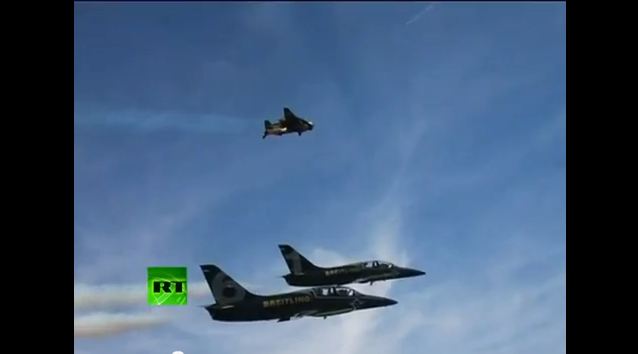
‘Jet Man’ Stunts Alongside Fighter Jets Over Alps
A whopping title, but a whopping video. Jetman Yves Rossy soars across the Swiss Alps, boasting is own tailor-made jet pack. Leaping from a helicopter and performing a series of aerial acrobatics, Rossy joined two fighter jet planes in synchronized flight.
In the past, Rossy has also flown the English Channel and looped around a hot-air balloon.
Nerve Rush HQ salutes you, sir.

Skydive over Wadi Rum with Skydive Jordan
As Lead Adventurer here at Nerve Rush HQ, I recently took off for a week to experience adventure in Jordan as part of a partnership with the Jordan Tourism Board. One of these incredible adventures was skydiving over Wadi Rum (the valley of the moon). While practically extraterrestial, we’re still debating internally whether we can include this on our top 7 places to skydive on each continent (does the moon count as a continent?). Anyways, between finishing my jump on the moon (which, by the way, is every bit awesome as it sounds) I sat down with Marwan Atalla, director at Skydive Jordan to find more about the details behind this unique adventure.
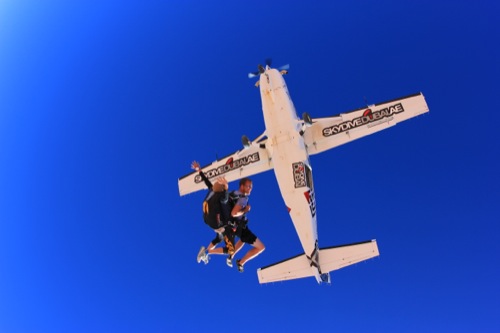
Marwan, what can you tell us about Skydive Jordan, one of the most unique adventures in the Middle East?
The Royal Aero Sports Club of Jordan (RASCJ) was established with the purpose of promoting aero sports, and enhancing the tourists’ experience in Jordan. To date, RASCJ has offered Hot Air Balloon Rides, Micro-Light flights and Ultra-Light flights. The idea of introducing Skydiving has been under consideration for 3 years, but we wanted to do it safely, and professionally. We did our research and determined that Skydive Dubai had become one of the world renown skydiving facilities in the world. We approached them, and quickly found out that they were willing and enthusiastic partners. We signed a partnering agreement for offer skydiving in Jordan for a three week period during the summer if 2012. This would be a good way to test the location and the demand. Needless to say, everything exceeded our expectations, and Skydive Jordan 2012 was a huge success.
What makes Wadi Rum such a great jump zone location?
There are quite a few things about Wadi Rum that make it quite special, but the four main items include:
1. Weather
2. Location and proximity to Aqaba (only 40 minutes away).
3. The availability of a natural flat area for the skydiving operation.
4. The majestic view all the way from the ground, to 15,000 feet, and back down really makes you look like you’re skydiving on the moon.

I speak from firsthand experience – you treat your customers ridiculously well, from signing up to the waiting room and jumping. What is your secret?
One of our goals is to enhance tourism. Tourism is all about service, and the experience of the tourist is a crucial part of his/her trip. Our goal is to create positive, lasting memories for anyone visiting the south of Jordan and hope that this one-of-a-kind skydive experience can add to their overall experience in the country.
Is skydiving new to Jordan? Could you talk about your partnership with Skydive Dubai?
Jordan did have a very small skydiving operation, but it was located in an international airport, with a very small aircraft – so it was not sustainable. In order to move to a more sustainable model we entered into a partnership with Skydive Dubai which allowed us to tap into a pool of professionals with hundreds of thousands of hours of combined experience, as well as the latest equipment, aircraft and safety systems. We operate the skydive operation now as a partnership.

Could you walk through what it costs to Skydive Jordan? What kind of packages and jumps does Skydive Jordan offer?
The backbone of our revenue is the Tandem operation, in which a customer jumps with a licensed tandem master. We charge JD 190 per jump and jumpers get videos and photo stills included in that price. The price is below market in the Middle East and Europe thanks to the sponsorship of Skydive Dubai. Licensed sports jumper pay JD25 per jump.
Nerve Rush note: The current conversion rate is close to JD1 = $1.4US. To get US costs, simply multiply those costs by 1.4x.

Any future plans? What other adventures do you guys have up your sleeve?
We plan to do Skydiving again in summer 2013. We are also looking into parasailing and gyrocopters. Safety is our number one concern, so we deliberately take our time and study all aspects of any new aero sport before introducing it. We also have to coordinate with the Civil Aviation Regulatory Commission of Jordan, which oversees our operations.
—
Thanks Marwan for sharing the gut-wrenching adventure of Wadi Rum with us first-hand. We’ll definitely be coming back! If you’re searching for Middle East adventure, check out Skydive Jordan.
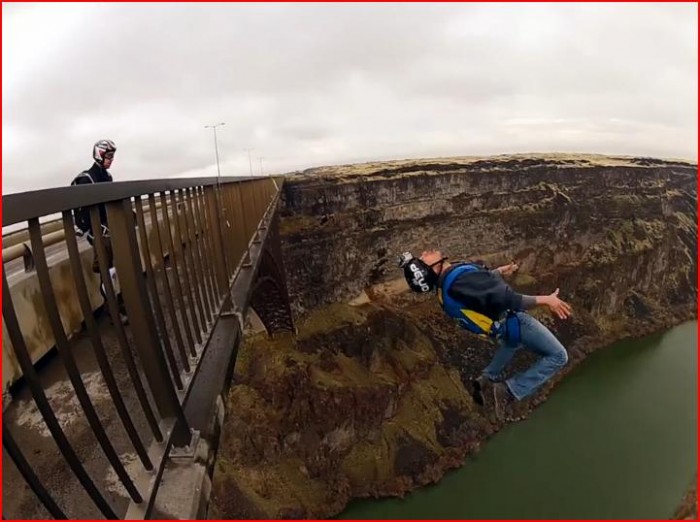
“10 Days of Sketch” BASE Jumping Trailer
Ladies and gentlemen, meet the Seattle BASE Clan, a group of BASE jumpers out of Seattle, Washington. They’ve got some gnarly videos over on their Facebook page. This one features jumps in Twin Falls, California and Moab.
Show them some love!
[Submitted by W. Hayes Holman]

Greg Gasson Skydives Without a Parachute
Some people get a rush by skydiving. For those where skydiving isn’t enough, there’s basejumping. For those where that’s not enough, there’s skylining. For those where that isn’t enough, there’s
skydiving without a parachute. Say what? Yes, skydiving without a parachute. We’re all for adrenaline rushes, but this is as crazy at is sounds. There really aren’t words to describe this, so just go ahead and watch.
The Best Place to Skydive on Every Continent
Skydiving is a prominent thing to do on most people’s bucket lists. It frequents itself at the top of the list so often that some say skydiving has lost its perennially #1 ranking as the world’s biggest rush.
So why not step it up a notch, Nerve Rush style. Skydive on every continent!
Below are the best places to skydive on each of the 7 continents:

1. North America: Skydive Santa Barbara
With a drop-zone located only a few miles away from the Pacific Ocean sky-dive Santa Barbara offers up breath-taking panoramic views of the California coast line. This drop zone isn’t just a create spot for first timers. For those that have jumped before but are looking to add a little extra thrill to the experience, Santa Barbara offers up the highest tandem skydive in North America. An 18,000 ft jump with over a minute and a half of free-fall time is sure to give a fix to any adrenaline junkie.

2. Europe: Skydive Switzerland (Interlaken)
Aside from its chocolate, banks, and watches, Interlaken, Switzerland houses one of the most extraordinary drop zones in the world. At the base of the Swiss Alps and nestled between Lake Thun and Lake Brienz you will have the option of jumping from an airplane or helicopter. Scenic views of mountain tops and glaciers offer a unique look as your shoot opens. If skydiving wasn’t enough to tickle your fancy, Interlaken also gives you the opportunity to test your nerves through hang-gliding, Alpin rafting, and paragliding.
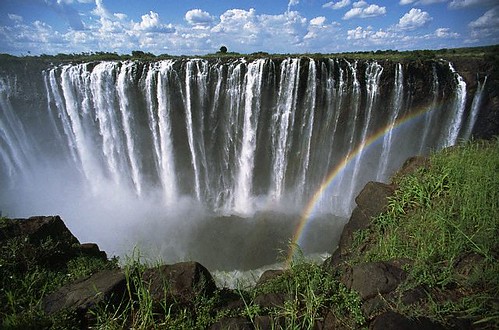
3. Africa: Skydive Victoria Falls
From bungee jumping, to elephant back riding, and now skydiving. Victoria Falls in South Africa, located on the Zambezi river between Zambia and Zimbabwe, gives those with a few screws loose a chance to see one of the worlds largest and most beautiful waterfalls from a unique perspective. A 25-minute scenic flight with Skydive Vic Falls gives you a chance to see the falls up close as well as many other local landmarks.
The indigenous name for the Falls is “Mosi-oa-Tunya” – which translates to “The Smoke that Thunders.” If that doesn’t scare the crap out of you, I don’t know what will.

4. Asia: Skydive Dubai
Well on its way to becoming one of the worlds best skydiving resorts on the planet, Skydive Dubai offers thrill-seekers a chance to fly over a man-made peninsula that is literally on the water and even has its own private beach. After taking in the views that include the World archipelago, the 7-star Burj Al Arab hotel and the Burj Khalifa – the tallest building in the world – you can take a dip in the Arabian sea or enjoy the world-renowned night life. If that is not enough, hop on a quad and rip in up in the desert.
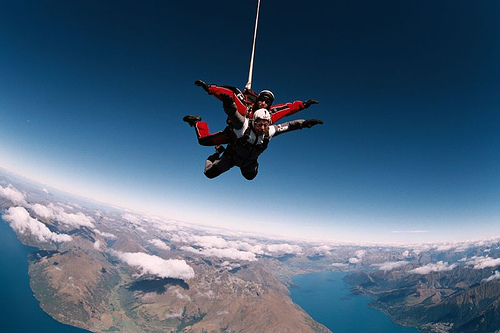
5. Oceania: Skydive Queenstown, New Zealand
Deemed the adventure capital of the world, Queenstown is located on the south island. Between Queenstown and Rotorua, a 2nd location on the north island, 180,000 people have tumbled out of planes since 1990. The first commercial skydiving operation in New Zealand gives you the chance to leap from up above the Remarkable’s mountain range (how fitting is that). The Rotorua location is found between two towering volcanoes and is surrounded by mud pools, active geysers, and steaming lakes. The sky above this drop zone is known as Ranginui, or the Maori Sky God.

6. South America: Skydive Sao Paulo, Brasil
Perfect blue skies and wonderful weather make Sao Paulo a pristine drop zone. Located near the Atlantic ocean just outside of Rio De Janeiro, this jump offers up one of the most beautiful skylines in the world. If you time it right, you might be able to get a jump in as well as catch Formula 1 race, attend the ATP Brasil Open, or an Indy 300 event. The 2011 Skydiving world championships were held here..so you know it’s legit.
7. Antartica: OK..Maybe Not
This is not for the noob. Valery Rozov was the first man to climb the nearly 10,000 ft Mountain, Ulvetanna and base jump off of it. The free fall lasted roughly 45 seconds through -30 degree Fahrenheit winds. Although you might not be able to experience what Valery did there is a chance to get close.
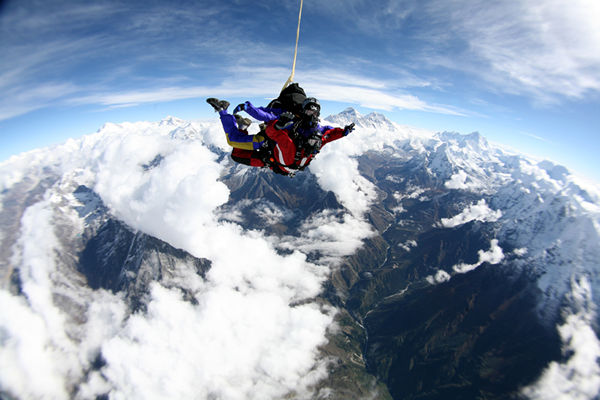
*Bonus 1: Skydive Mount Everest in Nepal.
Falling from 29,500 ft in the air will give you plenty of time to pull your shoot. You’ll also be able to land on the highest drop zone in the world at 12,350ft. The Everest jump team only conducts four jumps over the course of a year. You’ll need to throw down a few clams as well to prove your serious. About $25,000 worth! Word on the street is that you get a pinky ring and diamond studded wing suit, John Travolta style. Reserving your spot needs to be done six months prior to the jump date. If you’re looking to put some hair on your chest, this may be your best shot.
*Bonus 2: Outerspace
For a jump that is seriously out-of-this-world, check out Felix Baumgartner and team Red Bull starts. These fools plan to jump from a stratospheric balloon 120,000 ft above the earth. Felix will be testing the limits as gravity yanks him back into our atmosphere at supersonic speeds. This jump will exceed the current world record held by Joe Kittinger in 1960 by nearly 18,000 ft.
I’m not sure how long the free fall will be..due to the weight of this guys balls.
If you decide to put this on for bucket list better save it for last.
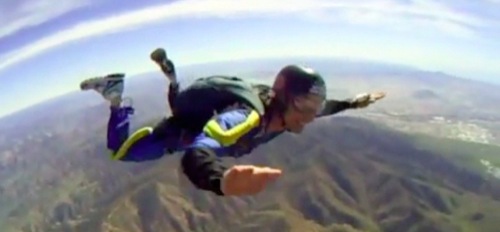
Getting Your AFF Certification with Kurt Swann
<img class="aligncenter size-large wp-image-2344" style="border: 1px solid black;" title="Kurt Swan AFF Cert” src=”http://alan.mystagingwebsite.com/wp-content/uploads/2012/05/IMG_0004-600×400.jpg” alt=”Kurt Swan AFF Cert” width=”600″ height=”400″ />Editors note: In the last year, Kurt Swann has gone from watcher, to tandem jumper, to AAF certified jumper. This is his story.
Skydiving. That’s the one item that seems to be on most everyone’s “bucket list.”
When most people say “skydiving,” they mean making a tandem jump where you’re strapped to an instructor during freefall. Scary, sure, but not quite scary enough to qualify as gut-wrenching adventure. So, while tandem jumping is a great experience, if you have the extra time, money, and desire to scare yourself silly, forget the tandem jump and sign up for an Accelerated Free Fall (AFF) course – the course that lets you jump out of a plane by yourself.
At the end of your first lesson on the very first day, you’ll skydive wearing a parachute without being attached to anyone. Two instructors will fall along side you to help keep you steady. If you completely freak out they might be able to help you open your chute but other than that . . . you’re on your own.

After you complete seven AFF lessons you’ll be cleared to jump solo. Completely on your own. No instructors. Just you. By yourself from over 2 miles straight up. I swear.
Scary? Yes.
Worth it? Definitely.
Starting The Class
My AFF class, which had about six students, began at 8:00 a.m. on a Saturday morning. Maybe it was my imagination, but everyone in class looked like they were on the way to a firing squad.
The class started with the instructor telling us that it’s not too late to back out if we don’t think we can go through with the jump. Better to just stay on the ground instead of getting dressed up in skydiving gear, flying up to altitude only to chicken out and ride back down in the plane. Who wants to climb out of the plane after it lands and take the AFF walk-of-shame?
Well . . . what a happy, cheerful way to begin the class.
After that we were told of all the possible ways the parachute might malfunction. They even had videos showing various skydivers who had problems opening their chutes. They only showed us the first part of the videos, so I don’t know how the ill-fated jumps ended.
We then learned about the gear we would use. The skydiving rig is like wearing a backpack but, instead of camping gear or dirty laundry, there are two parachutes inside.
The main parachute is stuffed in a bag that’s attached to a smaller parachute, called a pilot chute. The bag with the main parachute is packed in the backpack-like container while the pilot chute is stuffed in a pouch on the bottom of the container. On the end of the pilot chute is a leather ball, slightly larger than a golf ball, which acts as a handle.

So, to open the main chute, all you have to do is reach behind to the bottom of the container, grab the leather ball on the end of the pilot chute and fling it out. The pilot chute inflates and pulls the main chute out of the bag and container so it can inflate. Then we float safely to the ground. At least that’s the plan.
In case things don’t go as planned with the main cute, another parachute, or “reserve” chute is also tucked away inside the container. We never see it because it’s only opened in case of an emergency. So we really don’t want to see it but if we need it, it’s there.
We learned the basics of how the parachute fits in the container, how to open the chute, how to cut away the main parachute in case it malfunctions, how to open the reserve chute, and how to control the parachute after it opens.
Then we learned the exact jump sequence we would use when exiting the aircraft. Every single step was rehearsed even to point of how to stand in the airplane door as get ready to jump. Something like this . . . left leg back, right leg bent at the knee, both hands holding the door frame, chest upright and facing the front of plane . . . etc etc. No detail was too small to ignore.
Everything is rehearsed over and over and over. And over again. Because when actually jumping out of a plane wearing a parachute for the first time, a human brain goes into “slow motion stupid mode.” Tunnel vision takes over and the brain operates like it filled with glue.
The Jump
Okay, class is over and now it’s time to suit up and actually do this. It’s around 1:30 in the afternoon when it’s finally my turn. Rehearsal one last time on the ground with my two instructors. Then we climb into the plane.
The plane ride up to 13,000 feet takes a little over 10 minutes. Looking back, it was all a blur.
About half way up, one instructor makes me tell him one more time exactly what we’re going to do during the jump. How we stand in the door. What to do during freefall. How to open the chute. How to steer the canopy. How to land. I’ve gone over the steps all morning about a thousand times. And now one more time as we climb to altitude.
The plane levels off and someone opens the door, which rolls up like a small garage door. We make our way to the exit just like we rehearsed. Only during the ground rehearsal there isn’t an 80 MPH wind blowing by the open door. Yikes.
Taking tiny steps I get in position in the door between the two instructors. I make eye contact with the instructor inside, turn and looked at the instructor hanging on the outside the plane, bend my knees slightly while keeping my chest upright, look forward at the propeller, and then . . . push off.

This is crazy.
Now we’re falling. Seriously, this is really crazy.

I look straight at the ground and can see the airport below. I’m supposed to be counting to 5, but I forget. Oh well, can’t remember everything. I guess at what feels like 5 seconds and then check the altimeter worn like a watch on my left wrist. It says 11,000 feet. I think.
Then I make eye contact with the instructor on the left and then with the one on the right. They both give me a thumbs-up.
That’s the end of the first task. Nothing more complicated than looking at my left wrist, reading a number on a dial, and then looking at two people who are only a couple of feet away.
If someone asked you to do that on the ground, you would laugh. But when falling through the air at 120 MPH the impact of stress on my feeble brain makes this feel like quantum physics.
The next task is to practice touching the handle that opens the parachute. Since I can’t see the small leather ball attached to the pilot chute, I have to locate it by touch. Slowly reach back with my right hand to the bottom of the container and touch the leather ball. Then bring my hand back up near my head.
Repeat five times. Check altitude again. More eye contact with both instructors. More thumbs-up.
Somewhere in this process, the goggles get loose on my face. I’m wearing glasses underneath them so maybe that’s part of the problem. One instructor adjusts the goggles for me and somehow, my glasses come off. Never to be seen or heard from ever again.

Oh well. My vision’s not that bad so I can still see well enough without glasses. Besides it’s not like we can go look for them.
When I see 6,000 feet on the altimeter, I “lock on” to it as rehearsed. At 5,500 feet I wave my hands in front to signal I am about to open. Then reach back to the leather ball, toss it out and guess what? The parachute opens. Just like they said it would. Crazy.
Now the rushing wind of free fall is replaced by silence as I slowly glide to the ground. The instructors are gone and I am by myself under the canopy at about 4,500 feet. Above my head are two toggles attached to lines attached to rear corners of the canopy. Pull on the left toggle and the parachute turns left. Right toggle turn to the right. Pull both at the same time and the parachute slows and almost stops. Perfect.
This is the best part of the day, since the parachute is open. It’s open without a malfunction, and I can fly around. Life is good.
But then I realize I’m at the east end of the airport, when I should be at the west end for landing. Oops. All of a sudden, life is slightly less than good. A little correction gets everything back on track.
At 1,000 feet, I fly parallel to the runway and at 500 feet make a left 90 degree turn. At 250 feet another left 90 degree turn to where I’m lined up for the landing area. The instructor talks to me in a radio attached to my helmet.
Pull on the toggles that slow the parachute right above the ground and I land standing up. Back on the ground in one piece. Amazing.
In the next several weeks I finished the AFF course and less than a year later I have made a total of 100 jumps. That’s a lot of jumps for me but still a very low number compared to many instructors who have thousands of jumps. Thousands and tens of thousands.
And we’re still alive. It’s breathtaking, scary and definitely gut-wrenching, but it’s all worth it.
So here’s the deal. If you ever think you’d like to learn to skydive . . .my recommendation? Do it.
[youtube id=”DCDbyWS7bcI” width=”600″ height=”350″]
—
Got an extreme experience you’d like to share? Let us know at hq@nerverush.com
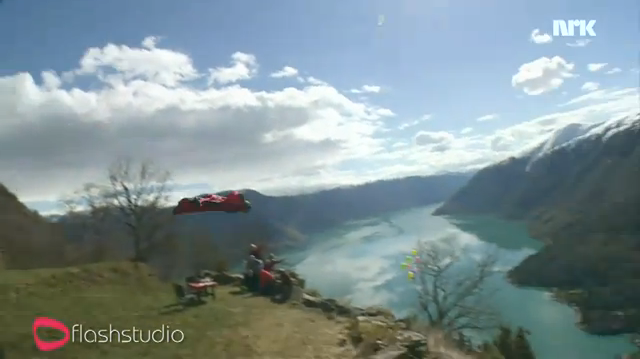
The Ultimate Wing-Suit Flyby: Oppdrag Sognefjorden
My heart just exploded. Performed by Jokke Sommer and Tom Erik Heimen for a Norwegian TV show, Oppdrag Sognefjorden, this stunt is literally one of the nuttiest, most unbelievable feats of human coordination that I’ve ever seen. Takes wingsuit flying to a whole new level.
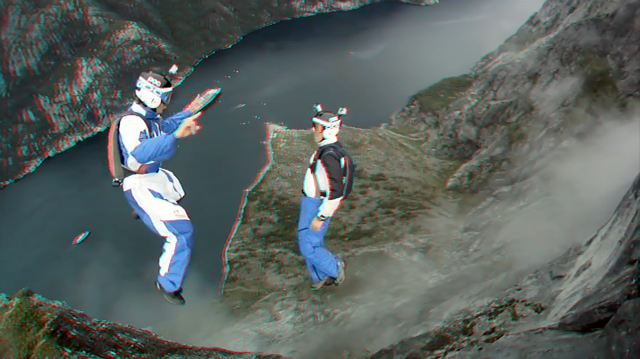
Another Wingsuit Base Jumping Video (Norway | GoPro Bombsquad)
The GoPro Bombsquad takes to the Katthammaren Wall in Norway. Shot with the GoPro HD HERO, this 3d footage includes members Neil Amonson, Jesse Hall, and Marshall Miller.

Freestyle Kite Flying in the UAE with Red Bull Kiteforce
Just when you think we’ve covered all the extreme sports out there, I stumble across this video of four guys on the Red Bull Kiteforce squad. A synchronized kite show over the U.A.E. — what a world we live in.