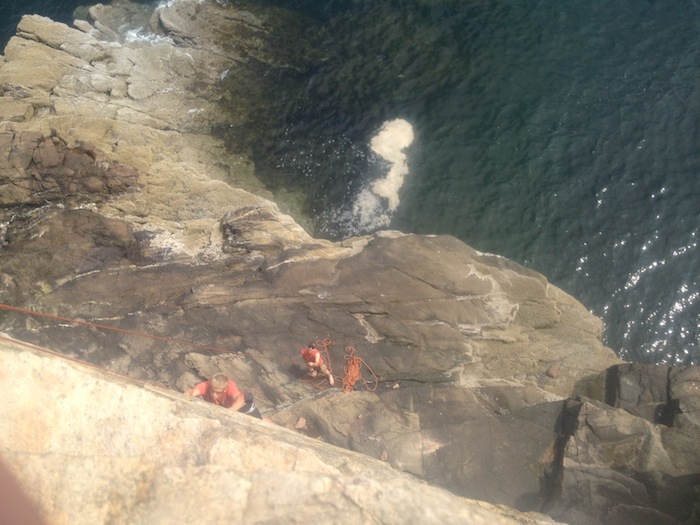
It was a cool, July morning in the farthest eastern location of the continental U.S. and my dog and I were trapped between a rising tide and a 100-foot granite wall. Before rappelling onto the platform hovering over the water, my rock-climbing companion Marcus Basiri had convinced me that I could send the climb. He pointed out that I’d conquered higher grades on routes near our home in Boston. What my strong, agile friend failed to take into account was my crippling fear of unclipping myself 100 feet in the air to complete the final 10 feet of the route without any protection. My lack of sleep and Red Bull-induced energy were also working against me.
Ted, my black Poodle-Bouvier mix, faced an even larger challenge. Four paws aren’t exactly ideal climbing equipment at Otter Cliffs. I decided to brave the Atlantic Ocean and swim to land, but the icy waves were too strong and cold for Ted’s 12-pound frame. Luckily, Tod, who was visiting Maine’s Acadia National State Park to lead a teen boy climbing expedition rushed to our rescue. He helped Marcus pack Ted into a backpack and teeter up the wall. Marcus’ chalked-up hands inched one over the other, grasping near-invisible ledges and cracks in the rough rock. His dark, shoulder-length hair remained secure in a low bun and Ted followed suit, keeping perfectly still. I swear he knew his life depended on it. The added weight pulled Marcus off balance, but finally, with Tod’s guidance, Ted and Marcus crawled up the wall to safety. If it wasn’t for the generous spirit of climbers like Tod at Acadia last summer, Ted may have been stranded at high tide.
That’s the type of community that rock climbing consists of: people willing to sacrifice their afternoon to lend a hand. This type of sportsmanship is rare in a sports world often dominated by competition, prizes and rank. We read about steroid abuse, cheating and even gun violence surrounding athletes in basketball, soccer and football. Rock climbing steers clear of scandal, largely due to the laidback culture associated with the sport. Sport climbing making its way into the Olympic games risks sacrificing its tight-knit, encouraging community.
In early 2012, the International Olympic Committee recommended wrestling be dropped from the 2020 Olympics to make way for a new sport. In September, wrestling will compete with baseball/softball, squash, karate, sport climbing, wakeboarding, wushu and roller sports for a place in the 2020 Olympics. Many climbing enthusiasts are eager to see their sport make it to the Games. Climber Adam Ondra admitted he’d compete if offered the opportunity, but plenty of climbers remain skeptical of the impact an Olympic slot would have on climbing. Those who embrace it for personal challenge, its tightly knit community or sheer adventure wonder how positive newfound popularity and enhanced competition will really be.
Michaela Kiersch [18] visited her Chicago home gym, Hidden Peak, over 100 times in the last six months. She was training for climbing competitions such as the American Bouldering Series, the national bouldering competition, hosted every year in Colorado. In the past five consecutive seasons, Kiersch competed in three adult world cups, two adult world championships and five youth world championships, where she placed 16th in August 2012. Last year, she competed in nearly 20 competitions, including regional, national and world, at times placing just a couple spots below big industry names such as Sasha DiGiulian.
But placing in national and world competitions is more than enough to satisfy Kiersch. Despite her success in the industry, she has reservations about rock climbing appearing in the Olympics in 2020.
“I look at climbing as a giant family, but if it grows we won’t be able to get as close to each other because there will be so many people,” said Kiersch. “It will be about winning and the glory of being the gold medalist instead of accomplishing something great.”
Kiersch worries that the familiar, friendly vibe of the climbing industry would fade with the sport’s Olympic acceptance. She admits the acceptance of rock climbing into the Olympics would bring the sport to more college campuses, resulting in college scholarships. Even though she’d love to pay for college with a climbing scholarship, she’s concerned that a newfound popularity would change her sport’s culture. At each competition, Kiersch and her competitors swap jerseys. This is how she makes friends from all over the world. Even the Russian climbers, whose instructors ban them from trading uniforms with other countries, have sneakily swapped with Kiersch, wanting to get in on the tradition.
Not all rock climbers are as concerned as Kiersch about the impact of sport climbing entering the Olympic Games. Legendary rock climber Alex Honnold, whose fame for his free solo climbing and record-breaking speed has only gained momentum since he was featured on 60 Minutes in October of 2011, doubts the acceptance or denial will have much of an impact on the sport. He assumes that Olympic acceptance would bring some more mainstream media attention to the sport that’s already rapidly growing in indoor gyms. In fact, 1,000 people take up rock climbing every day at U.S. climbing gyms.
“I don’t think that an Olympic appearance would drastically change that whole trend,” said Honnold. “It might speed things up a little bit. It might bring a bit more money to the sport, but probably wouldn’t revolutionize anything.”
Although Honnold’s life surrounds climbing [he dropped out of UC Berkeley to live out of his van, traveling and climbing] and he holds records like his soloing of the Yosemite Triple Crown—Mt. Watkins, El Capitan and Half Dome—in 18 hours and 50 minutes, he doesn’t consider it competitive climbing.
“Climbing is already pretty divided between indoor competition climbers and full on dirtbag adventurers,” said Honnold. “World cup competitors in Europe play a very different game than those of us who just climb outside all the time and travel and explore.”
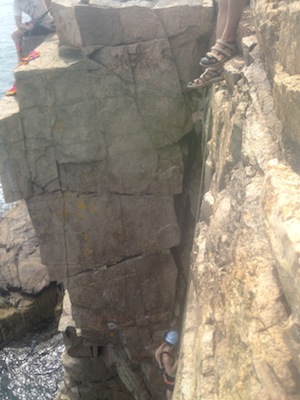
While Honnold continues outdoor climbing adventures, joining climbing bums on Yosemite’s soaring granite domes, Kiersch spends her free time training kids at her home gym, not for the Olympics, but for the pure joy of watching their accomplishments.
“A lot of people are inspired by the grades that pro climbers accomplish, but that’s not what inspires me,” said Kiersch. “I’m inspired when these kids overcome their fear of heights, send a problem that they’ve been working on for weeks or do four chin-ups instead of three. Accomplishing a goal that they’ve set and watching them get so excited gets me excited. The pro athletes are incredible for accomplishing such high grades, but in climbing, that kind of an accomplishment is more of a personal thing.”
Allowing sport climbing into the Olympics goes directly against the personal goal achievement that Kiersch speaks to. It risks glamorizing the sport and shifting its focus from personal accomplishment to gold medals. This type of competition may negatively impact the kind of community that’s perfectly content practicing in a dirty old basement bouldering gym. It may even take some of the generosity out of climbers willing to sacrifice an afternoon of their favorite activity to save my dog Ted from a high tide. Do we really want to risk changing a sport where the champions are known for their encouraging words, generosity and pure love of the outdoors?

 Meet Ron Cooper, world record holder for the most number of pull-ups in 60 seconds.



![Mark Vermeersch & Team Timex [Interview]](https://www.nerverush.com/wp-content/uploads/2013/02/mark-vermeersch-triathlon1.jpg)



![Buccaneer Rampage: Newport, Oregon’s First Obstacle Race [Interview]](https://www.nerverush.com/wp-content/uploads/2013/02/buccaneer-rampage-obstacle-race.png)

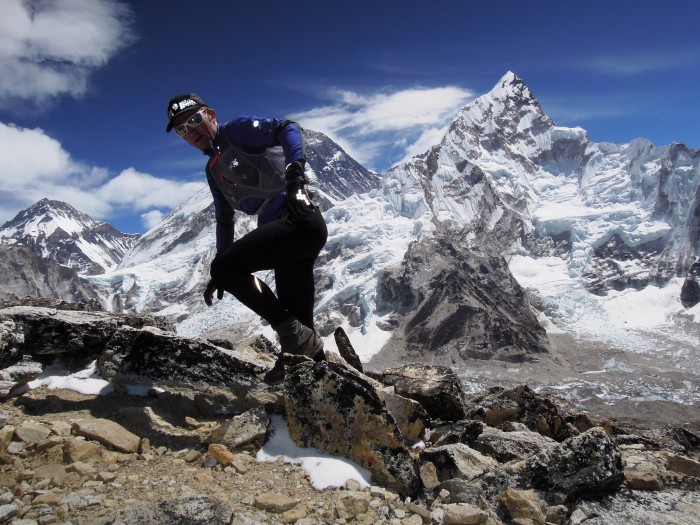

 Goal Zero’s growing list of ambassadors ranges from slackliners to anglers, photographers to alpinists. The company searches for athletes and individuals with a passion for living life to its fullest with zero regrets, zero boundaries, and zero apathy. Steck embodies the Goal Zero way of life in every way possible