Jeff Rowley puts his head underwater and does what needs to get done.
From torpedoing down 50+ foot sea-claws to extreme lung capacity training, Rowley, a professional big-wave surfer, rides waves amongst the world’s best. He is the first Australian to paddle into Maui’s nefarious Peahi “Jaws” without Jet Ski tow-in aid. This wave is considered one of the world’s biggest and most dangerous waves, and until recently it was thought impossible to catch and ride without tow-in support.
Nerve Rush HQ was fortunate enough to catch up with Rowley between summer storm swells. Jeff, we appreciate your time here, my man! Keep pushing the limits.
What were your favorite beaches growing up in Australia? How did you get into surfing?
I started surfing when I was 6 years old, my parents owned a surf shop in Anglesea, Victoria, Australia, and my dad was a surfboard shaper, so I pretty much grew up on the floor of my dads shaping bay. From about 6 years of age I was on my own surfboard, but before that I was riding boogie boards in the tiny little shore break near home. I first started surfing big waves when I was about 17 years of age and I was really launched into that on the southern coast of Australia, just off Victoria. There’s a lot of reef breaks there and they catch a lot of the winter swells in really cold water, and they’re super isolated, there’s no one around, there’s a lot of cliffs and most of the time it was just myself, or myself and one other friend.
Surfing Jaws was your Everest? Could you tell our readers more about Jaws?
Surfing Jaws was my Everest. I spent the last 18 months with laser beam focus on preparation and training for surfing Jaws, so overcoming my fears to paddle into the wave was fulfilling my dream.
Becoming the first Australian to paddle into ‘Jaws’ Peahi on the island of Maui in Hawaii on 4 January 2012 was one of my biggest life achievements. At the same time, I achieved my 2012 Charge for Charity quest to paddle into, and catch a 50-foot wave. I was going to catch that wave no matter what happened, it was massive and I was in the right position and it was my time to go for it. I stood up and the wind hit me and tried to rip my board from under my feet as I started freefalling, I couldn’t see a thing but I pushed down as hard as I could and made the ride. I was like trying to catch and ride a Tyrannosaurus Rex with your bare hands – the best thrill but you’re so glad to be alive!
I had to train hard, overcome a number of barriers and conquer my fears to achieve this.
Paddling in is the ultimate challenge, it’s man vs ocean, actually it’s man vs himself. You have to constantly make decisions that will impact what happens next. For the big wave I caught at Jaws on January 30, I knew I was in exactly the right position the moment I saw it. I didn’t want to waste any energy paddling, I was under it and it was going to eat me if I didn’t make it. It was amazing to be recognized for my achievements when I placed 4th in the world in the Billabong XXL Global Big Wave Awards in the Ride of the Year category for the wave I caught at Jaws on that day.
How do you train (mentally & physically) for big-wave surfing?
Preparation plus opportunity equals success. I know exactly what I want to be doing with my life and I’m giving it 150%, I love it! I train hard in the pool- my empty lung holds are up to 2:23. I eat well. I’ve got 5 boards over 9’6″ because I’m prepared. At the beach I don’t psyche up, I calm down. I perform lung exercises before I paddle out that deprive me of oxygen, so my body is in a state of conserving energy. And then I have to be there on the best days to create the opportunity.
Long hold downs are inevitable. When Im down I count seconds and spins. In the pool I get tumbled for 50 seconds, untie my leash and swim 25m on an empty lung. When you have a serious wipeout, you really lose count of spins. I’m training to make two wave hold downs enjoyable, so when it happens I wont be under pressure.
When I’m surfing and the waves are really big, I prefer to calm down. A lot of my training is around trying to conserve my energy and making sure that I’m in a really good mental state before I go out there. If you get too excited you get too pumped up, you’re getting all your blood flowing and you’re burning all your oxygen before you even paddle out in the surf, and if you’re doing that your going to get yourself in a really heavy situation and it’s going to make you really stressed and that’s when you can get in trouble, so I prefer to really calm down, do a lot of lung exercises to prepare my body for being in a situation where it’s not going to have much oxygen and I’ve still got to be able to maintain coherence and function at 100%.
So there’s been a huge shift in my training and it just gives me so much more confidence in the water. So I think training is really important for me because I want to be the best in the world at big wave surfing and I want to be the best that I can be. For me to train in the pool where it’s in a controlled and safe environment you can push yourself way beyond what you thought was possible, and then when you go out in the ocean, the idea is that it’s never as bad as what you have prepared for.
Any advice/recommended resources for aspiring big-wave surfers?
Fear is always present but you have to refuse to focus on it. You have to leave it behind and focus on what you can achieve if you don’t hold back, if you give 150%. If you hold back the result is certain, but if you give 150% who knows what may come.
It’s definitely just yourself out there in the water and it’s just you that has to turn around and catch the wave but, back on land you actually need the support of a whole team of people – your family, partner, friends, photographers, surfboard shapers. When you ask the universe for what you want, there is a whole world of resources that also opens up to support you achieving your goals.
In 2012, I’m completely focused on big-wave surfing. I want to be at all of the best locations in the world on the biggest days. I’m really looking forward to surfing Jaws 50% bigger, or twice the size of what we’ve tried to paddle into. So I’ve just got my head down – under water, in the pool, in the gym every day trying to get as strong and fit as I can, and increase my breath hold. Because I’m really looking forward to pushing it out there and being the best I can be.
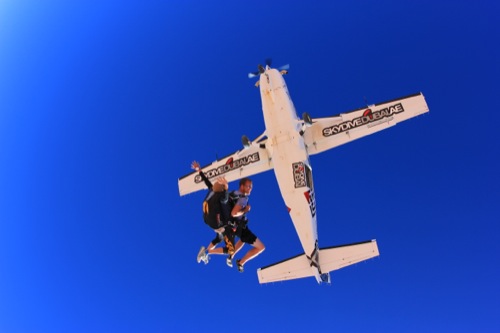
As Lead Adventurer here at Nerve Rush HQ, I recently took off for a week to experience adventure in Jordan as part of a partnership with the Jordan Tourism Board. One of these incredible adventures was skydiving over Wadi Rum (the valley of the moon). While practically extraterrestial, we’re still debating internally whether we can include this on our top 7 places to skydive on each continent (does the moon count as a continent?). Anyways, between finishing my jump on the moon (which, by the way, is every bit awesome as it sounds) I sat down with Marwan Atalla, director at Skydive Jordan to find more about the details behind this unique adventure.
Experiencing Gut-Wrenching Adventure First-Hand
Marwan, what can you tell us about Skydive Jordan, one of the most unique adventures in the Middle East?
The Royal Aero Sports Club of Jordan (RASCJ) was established with the purpose of promoting aero sports, and enhancing the tourists’ experience in Jordan. To date, RASCJ has offered Hot Air Balloon Rides, Micro-Light flights and Ultra-Light flights. The idea of introducing Skydiving has been under consideration for 3 years, but we wanted to do it safely, and professionally. We did our research and determined that Skydive Dubai had become one of the world renown skydiving facilities in the world. We approached them, and quickly found out that they were willing and enthusiastic partners. We signed a partnering agreement for offer skydiving in Jordan for a three week period during the summer if 2012. This would be a good way to test the location and the demand. Needless to say, everything exceeded our expectations, and Skydive Jordan 2012 was a huge success.
What makes Wadi Rum such a great jump zone location?
There are quite a few things about Wadi Rum that make it quite special, but the four main items include:
1. Weather
2. Location and proximity to Aqaba (only 40 minutes away).
3. The availability of a natural flat area for the skydiving operation.
4. The majestic view all the way from the ground, to 15,000 feet, and back down really makes you look like you’re skydiving on the moon.
I speak from firsthand experience – you treat your customers ridiculously well, from signing up to the waiting room and jumping. What is your secret?
One of our goals is to enhance tourism. Tourism is all about service, and the experience of the tourist is a crucial part of his/her trip. Our goal is to create positive, lasting memories for anyone visiting the south of Jordan and hope that this one-of-a-kind skydive experience can add to their overall experience in the country.
Is skydiving new to Jordan? Could you talk about your partnership with Skydive Dubai?
Jordan did have a very small skydiving operation, but it was located in an international airport, with a very small aircraft – so it was not sustainable. In order to move to a more sustainable model we entered into a partnership with Skydive Dubai which allowed us to tap into a pool of professionals with hundreds of thousands of hours of combined experience, as well as the latest equipment, aircraft and safety systems. We operate the skydive operation now as a partnership.
Could you walk through what it costs to Skydive Jordan? What kind of packages and jumps does Skydive Jordan offer?
The backbone of our revenue is the Tandem operation, in which a customer jumps with a licensed tandem master. We charge JD 190 per jump and jumpers get videos and photo stills included in that price. The price is below market in the Middle East and Europe thanks to the sponsorship of Skydive Dubai. Licensed sports jumper pay JD25 per jump.
Nerve Rush note: The current conversion rate is close to JD1 = $1.4US. To get US costs, simply multiply those costs by 1.4x.
Any future plans? What other adventures do you guys have up your sleeve?
We plan to do Skydiving again in summer 2013. We are also looking into parasailing and gyrocopters. Safety is our number one concern, so we deliberately take our time and study all aspects of any new aero sport before introducing it. We also have to coordinate with the Civil Aviation Regulatory Commission of Jordan, which oversees our operations.
—
Thanks Marwan for sharing the gut-wrenching adventure of Wadi Rum with us first-hand. We’ll definitely be coming back! If you’re searching for Middle East adventure, check out Skydive Jordan.
Former graphic designer turned adventurer and motivational speaker, Dave became disenchanted with work and, having recently taken up longboarding, decided to set out on an adventure. One year later, Dave skateboarded his way from Perth to Brisbane–yes, across the entire continent of Australia–received his first world record and book deal and never looked back.
Since then, Dave has paddled 2 of the world’s longest rivers from source to sea, crossed England (and Lake Geneva) by Stand Up Paddleboard, broken a world speed record on a human-powered hydrofoil — I could go on. The man is righteously adventurous.
I’m thrilled and humbled that Dave took the time out of his schedule to chat with us here at Nerve Rush HQ. We asked him a few questions about his Expedition1000 project, particularly his August 2012 plan to swim 1,000 miles of the lower Missouri River.
1,000 miles – wow! But we have to ask, why the Missouri River?
Until recently I wasn’t interested in doing a swim because I didn’t think I’d see anything, but then slowly I realised I would have a view, just a different one (two inches above the water!). Despite appearances, I’m not totally crazy, so I decided to swim downstream on a river with a decent current, and the Missouri fit the bill.
How long will it take? What do your logistics look like?
I’m not after any records on this one, it’s simply a personal challenge for someone who doesn’t swim so much to see how it feels to be in the water for so long. It’ll take 50 days, 20 miles a day between Yankton, SD and St Louis, MO. I’ll be dragging my own gear on a raft but will also have a team on the water around me. I love trickling down my experience to others so am assembling a team to do everything from still photography to safety kayak, all of them will be paddling the full 1000 miles on canoes, kayaks and SUP. If anyone would like to join the team here’s the link:
Hah! Well, now you ask…. I can’t remember the last time I swam more than 50 metres. I’ve just sailed across the Pacific and didn’t even touch the water. And I’m about to cycle a 4-wheeled bike from Miami to Memphis. I’ll do about a month of basic swimming, but nothing can prepare you for an expedition like the expedition itself. So I’ll take it easy the first couple of weeks and build up my strength. Besides, I figure I’ll be a brilliant swimmer by the end of the trip!
Now, this swim is a part of a larger project you’re working on called Expedition1000. Can you tell us about that?
Sure. If you want to call this a career, my goal is to undertake 25 separate journeys, each at least 1000 miles in distance and each using a different form of non-motorised transport. Along the way I’m encouraging people to get off their butts, to combine sport and travel to stay healthy and get in touch with nature a little more. I’ve not met anyone who spends time outdoors and keeps fit that hasn’t seemed pretty much at peace with themselves, so I figure the more people who do it the better. I’m also aiming to raise £1 million for charity, including the breast cancer awareness organisation CoppaFeel. Great cause, it’s all about giving ourselves as much life as possible.
You’re up to some crazy stuff. Where can our readers follow along with your adventures?
We always say the favorite part of running an adventure site is the people we get to talk to. Today is no different. As soon as we found out about the GORUCK Challenge, we tracked down the people in charge of this massive gut-check adventure and told them we needed to talk. We got in touch in with Lead Cadre, Lou Lepsch – the ex-special ops agent in charge of this ridiculously awesome event, and in true Nerve Rush fashion, we bombarded him with questions.
Lead Cadre & Ex-Special Ops Agent Lou Lepsch
Also, as a bonus, at the end – we’ve got something awesome to give away, so you’ll want to check that out. But before we get to that, here’s a little bit more about the GORUCK Challenge from Lou himself.
Thanks for talking with us Lou! Can you tell us a little bit about the GORUCK Challenge? How did you get involved?
Simply put, the GORUCK Challenge is 12-14 hours of simulated Special Operations selection processes. Participants cover about 20 miles wearing GORUCK gear filled with bricks (meant to simulate kit -i.e. ammo.) They are led by a GORUCK Cadre with a Special Operations background. The Cadre poses problems to the group, thus turning 30 individuals into a team over the course of the Challenge. Longer story, the GORUCK Challenge is a gut check – a test of one’s intestinal fortitude. It’s a slice of Special Operations training that gets your foot in the door.
I got involved after a night of pool water with Jason when he visited me at Fort Bragg. He briefed me on the CONOP (Concept of Operations), and I thought it was awesome. We sat around drinking pool water while Java (GORUCK dog) tore up cases of Bud Heavy, and I was hooked. Jason and I worked together in the Special Forces Q-Course, and the opportunity to work with him again was a no brainer.
How does being a Cadre fit into the race logistics? You lead classes?
First thing the Cadre does is a boots on the ground reconnaissance of the ground and some target analysis – working out potential missions for the participants. We get a route from HQ a few days before, but the Cadre needs to spend a good four hours minimum – sometimes longer – to work out how that route will play out in real life.
During the challenge, the Cadre poses scenarios to the team, events to test not only the individual but the team. The Cadre’s main job is to bring those individuals together as a team and form friendships for life. They just experienced something life changing and definitely not a 5K, and the bonds last a lifetime.
And you have a background in Special Ops? Whoa. Could you, ahem, elaborate?
No.
What separates the GORUCK Challenge from the many other adventure, obstacle and endurance races out there?
The team, the city, and the Cadre. Much like Special Operations training that the Cadre all went through, you never know what to expect. You’ve got to focus on the task at hand – while also focusing on the bigger picture. The bigger picture is the team. Our events are in cities, and the route is designed to be a guided tour – a shopping tour with many coupons along the way.
The city provides those real life problems for the team to solve. It’s not as if we are renting out a ski resort and putting logs there for people to carry from this cone to that cone. The Cadre separate us – you’ve got that legitimacy, but it also makes it a more personal event. It’s one Cadre with thirty people, and you really get to know each other. They always hate the Cadre at first, but by the end they love us. In the end, we want every single person to walk away knowing they accomplished something.
What training regimen would you recommend for a GORUCK participant expect?
It doesn’t matter, because you’re still going to be sore. But I would recommend a CrossFit regimen with some minor distance running for cardio. But in the end, it’s 90% mental. Don’t take it so seriously. Partake in some ACRT (Advanced Cellular Repair Technology, aka beer) like we all do.
Where can we learn more about the GORUCK Challenge?
Visit GORUCKChallenge.com and also check out @GORUCKChallenge on Twitter. The Cadre all tweet during the event, and we get a lot of suggestions from people following the challenge at home. It’s like watching GORUCK TV in real time!
—
Huge thanks to Lou and the GORUCK Challenge team for taking the time to speak with us. After this interview, I was so excited about GoRuck, I just had to do it. So I’m signed up for the first GoRuck Challenge as soon as I get back to the states.
Now for the cool part: If you want to give GORUCK Challenge a shot for yourself, we’ve got a free entry pass to any of the GORUCK Challenges across the country (sorry international guys, GORUCK hasn’t quite made it across the pond yet). If you want to win a free pass to any GORUCK Challenge, let us know why below and our unbiased team of judges will pick our favorite as the winner.
Note From Joel: A few weeks ago, we profiled the RAAM Race – or the Race Across America – the toughest race in the world. If you’re a little rusty on what it is, here are the basics:
3,000 miles
Starts: Oceanside, CA
Ends: Annapolis, MD (alternates direction every year)
It’s a time-trial race format as opposed to a race with multiple stages. You start in Oceanside and you keep riding until the racer arrives in Annapolis, eating, sleeping and stopping when necessary.
It crosses through 12 states: CA, AZ, UT, CO, KS, MO, IL, IN, OH, WV, PA and MD.
The race is open to professional and amateur racers.
The racer has to reach Annapolis in 288 hours (12 days) or be disqualified.
On average, only 50% of those who start the race are able to finish.
The racer is supported by a crew of at least 4 – usually there are 6-10 crew members. The crew keeps the racer riding.
Not only is it an insane race that taxes you physically, but it’s an incredible feat of endurance that takes extreme mental determination as well. “What’s going on inside these riders’ heads as they pedal non-stop for 12 days?”, we wondered. Fortunately, Nerve Rush field correspondent Jason Moore tracked down RAAM Race Finisher, Geoff Brunner to get his thoughts on the race, life and everything in between. Take it away Jason.
On your website bio page you talk about riding your bike everywhere as a teen growing up in Georgia. You say that you “learned to love freedom at an early age”.
For 27 years you dreamed about riding a bike across country. After 5 of your friends tragically passed away under the age of 45 within a short span, you decided to go for it. What were your emotions like after you dipped your bike into the Atlantic Ocean and began your first cross-country ride?
I was nervous…really nervous. I had no idea of what to expect, and I felt like I was the worst father and husband in the world. I second-guessed myself for the entire first day of the trip and definitely into the second day as I spent the first night at home (100 miles west of the ocean). But I had to do it – absolutely had to do it. As far as I know, you only go around once, and I sensed this was my only chance to fulfill my dream of riding to my grandparents’ house. I just kept telling myself, this is my only chance, this is my only chance. My grandparents were in their nineties still living in the house in which I had so many fond memories, and the childhood dream was to ride to their house to see them. There was only one way to get there – spin the cranks on the bike.
Can you describe how you felt when you arrived in California by the power of your own two legs, and realized your lifelong dream?
Actually, I expected a greater emotional feeling of accomplishment. My expectations were that I’d feel some great sense of relief or joy, when in actuality, I just felt fortunate. I’d pulled it off; “Ha, Ha – take that!” I thought to myself not knowing who or what was on the receiving end of the taunt. I really expected more self satisfaction (you know like trumpets blaring, a rainbow and angels singing). What it left me with was wanting more…
After 27 years, you finally accomplished your goal. How did that first cross-country ride change your life and outlook? Did you feel more liberated?
My first trip across the country firmly embedded in me the importance of not looking into the future, thinking about what “might happen”. I’m not suggesting that planning is bad, in fact, a certain amount of planning is essential to any challenging endeavor such as a cross country journey on a bike. What I’m suggesting is that the trip gave me a confirming lesson in the need to focus on the present….one pedal revolution at a time. I’ve found that this is very necessary in most aspects of life if I want to be “free”. I’ve not perfected this process though, but I’m always practicing it because I strongly believe that the biggest deterrent to freedom is thinking about the future.
What did you learn about yourself, and this country, on that first trip across America?
I learned that I’m mentally stronger than I thought I was. It was reinforced that I love my wife and son very, very much. I confirmed that I have the most supportive parents any person could ever ask for. I realized that I am extremely fortunate, and that I can accomplish whatever I choose to do.
I learned that there are some pretty bad roads in every state which can beat up a person’s body who is riding a bike. I learned that 99.9% of drivers are courteous towards cyclists, which is a much higher percentage than driver courtesy towards other drivers. I also learned that the beauty of America can ideally be witnessed at 15 mph. Our country’s natural beauty is awe-inspiring. Finally, and MOST-IMPORTANTLY, I came to a comfortable realization, that I am insignificant. The first hint at this reality came in the middle of Kansas. Field upon fields of everything from wheat to corn to cattle to grasses. Openness everywhere. Upon first getting this feeling, I was slightly overwhelmed, and then I came to a point in the panhandle of Texas where I had arrived at the top of a gentle rise, and it seemed like the whole world opened up to me. What I saw was amazing! Perhaps it was the fatigue from 1800 miles alone on a bike, but I know that the scenery gave me a sense of security in a wide open space. Two days later, I reached Vaughn, New Mexico and I suggested to my Dad that I wanted to go out of town a few miles, because I thought the stars would look “neat”. What a casual word (neat) compared to what I saw. I had never seen the “Milky Way” defined before (at least as far as I could remember). The stars were so brilliant, and there were so many. My sense of insignificance was so strong at that point, I realized that my life was mine to live. My time was my time.
Geoff Riding Across America
It takes guts to take a risk, do something big, and follow your dreams. At some point thoughts spark action. Can you tell me about the process of turning a dream or idea into reality?
Personally, I had to patiently wait for the right time. For my initial ride across the country, I had to reach a point in my life where I truly respected the finiteness of life. My perception at the time was that riding a bike across the country is dangerous. My dream to ride my bike to my grandparents life was surrounded by the concern of death: that someone is going to be on their phone, or drinking, or pass out…and run me over. I rationalized that this could happen while riding my bike within a mile of my house. Even more so, this could happen while driving to a work appointment on the Pennsylvania Turnpike. “What a waste of a good dying!“ I clearly remember thinking: If I’m going “out“, I’d rather have it happen in pursuit of a dream than on the way to work (worker‘s compensation benefits aside, of course)! Through circumstances in my life, primarily the loss of friends from cancer and accidents, I came to the further realization that it’s going to happen sometime, and I don’t want my last thoughts to be, “I wish I would have ridden my bike to my grandparent’s house”. After overcoming my future-focused fear of what might happen, the rest all fell into place.
My only hesitation was the effect this would have on my wife and son. Alison was very supportive of me, and she helped me communicate with Quincy about what this was all about. They were a part of the trip over the first few days and they arrived at LAX 10 minutes before my bike and I reached the end of the runway, so they were able to join me in Redondo Beach for the Pacific dipping!
We all have fears surrounding our decisions. How did you overcome your fears?
As mentioned above, the fear of death was the biggest challenge to overcome. Death of people I know well, for me, tended to alleviate this to a level necessary to go ahead with the trip.
Did you ever get lost, logistically speaking?
I had no GPS, and I only had a basic cell phone. I took maps with me and asked directions along the way. I’d stop often to ask people if I was headed in the right direction to reach a particular town, and in each case, the one I asked was more than willing to help, and several times, I ended up getting into a good conversation. On occasion, I ended up adding a few miles to a particular day through some miscues.
Ok, let’s get to this insane race. Riding your bike cross-country is an incredible feat on it’s own. But racing across country and trying to do it in 12 days or less, that’s just nuts man!
The Race Across America is known as “The World’s Toughest Bike Race.” When did you first hear about it and what on earth made you decide to take this long distance bike riding to the next level?
As I hinted at before, my first trip across the country left me wanting more. As I told my mother-in-law, “After the first time I kissed a girl, I didn’t think, ‘That was nice, and once was enough.’” Luckily, I have an a cool mother-in-law.
Practically speaking, I’m not in a position to take off 4 weeks from work. I don’t feel comfortable asking for it, and I’m not sure whether I’d be granted the request again, and frankly, I’d get too far behind. In addition to a cool mother-in-law, I have a cool manager. Given my time realities, the only way I could ride across the country again is if I had increased support and could do it in less time. The Race Across America provides the venue to accomplish this. I had heard about RAAM several years ago after it first got started, but I hadn’t thought about it until someone mentioned it after I rode across the country the first time. I wondered how far I could go, so I entered a 200 mile race in 2010 and finished 2nd despite cramping up badly after 80 miles and suffering the rest of the way. I figured that I’d take the next step by entering a RAAM qualifier a few months later and again finished second in the 544 mile race, and I qualified for RAAM. What the heck, if I could make it in 27 days with minimal support, I could make it in about half the time if someone is feeding me….this was my rationale!?!? Alison gave me a concerned nudge to go for it, and I entered the 2011 race. Additionally, I wanted to ride to raise money for a charity again. In 2009, when I rode across the country, I rode to raise money for the Children’s Hospital of Philadelphia’s Neonatal Research Department. They played a role in the greatest joy in my life, the birth of my son. In 2011, I raised money for Dream Come True, a charity here in the Lehigh Valley in Pennsylvania, which supports chronically, terminally and seriously ill children’s dreams. This was right in line with my achievement of my childhood dream to ride to my grandparent’s house. This provided added motivation for me as I raced in RAAM in 2011. Every child deserves to realize their dreams – as I mentioned before, I’m extremely lucky to have realized mine.
This race is unlike any other. The clock runs continuously and there are no stages (no set amount of distance you need to ride per day). This means you can push yourself well beyond your rational limits. What keeps you going when you want to stop?
This race is the ultimate test of freedom of choice, in my opinion. The racer can stop at any time. If he or she doesn’t ride at least 250 miles every 24 hours, they won’t make the various cut-offs along the way. Depending on the racer’s ability, training and desire this may or may not be challenging. There were two times when I was ready to quit – once in the desert and once late in the race in the mountains . My brother, the support team’s crew chief, kept talking me into getting back onto the bike. The fatigue is significant, and the voluntary nature of the self-abuse makes it very tempting to call it quits at times. The physical aspect is challenging, and when coupled with the total of 28 hours of sleep over 12 days, makes it that much more difficult. 110 degree temperatures in the California desert followed by 30 degree temperatures 36 hours later in Colorado at up to 11,000 feet in altitude plays havoc with the lungs. 55 mph headwind gusts on the edge of a thunderstorm in the Colorado prairie made me feel like I was pulling a truck. Relentless 100-300 feet climbs over and over in Missouri, Indiana and Ohio prevent any sort of cycling rhythm. The course ends with several hundreds of miles of steep climbs in the Appalachians of West Virginia, western Maryland and Pennsylvania. Then there’s the final 150 miles of heavy traffic in the East as Annapolis nears. Many claim the Race Across America to be the greatest human powered challenge on the earth. I don’t know about that – but what I do know, is that I can quit at any time, and that’s what makes it so appealing to me.
Last year was your first RAAM (is that correct?). What did you learn from that experience that will help you perform better this year?
Last year, our team went into RAAM like three blind mice. My crew was comprised of family members and the massage therapist who had worked with me for the past year. My father and my brother were the crew chiefs because they had the experience of helping me in the qualifier. Everyone else was relatively green. RAAM is as much about getting to the starting line in one piece as it is executing the race. The organization and preparation is severe, and I essentially organized the event on my own prior to arriving in Oceanside, California. Once there, the crew selflessly took over. No one knew what to do, but we figured it out both before and during the race. We were one of the few teams without an RV, so the crew and I had to sleep in motel rooms along the way. This is more comfortable, but not efficient and cost us time. Many circumstances along the way caused some challenges which we should be able to overcome this year. I came up with 15 ways to race faster in 2012 and feel confident that I can break 11 days and challenge the 10 day barrier if everything falls into place. Since 1982, only a few more than 200 racers from around the world have completed the race in the required time of 12 days for men and 13 days for women and men over 60. Significantly fewer can claim breaking the 10 day barrier on the modern course, riding 300 miles per day.
This isn’t a blog about training/fitness but I am curious about your preparation for something like this. A lot of endurance athletes are very meticulous and scientific when it comes to their training. Do you fall into this camp? Can you tell me a little bit about your training regimen?
I’ve always done things by feel more so than by design. I believe experience is the best teacher, so I search for what works and then try to tweak it. In preparation for the 2011 race I rode 8,850 miles from November through May. For the period from November though January, I develop an endurance base through completing at least one weekly 100 mile ride, and I try to ride another 100 miles during the week. In February and March, I increase my weekly long ride to 125-150 miles. This helps prepare the body for the April and May peak training period in which I include weekly interval and hill work and increase the long rides into the 200-250 mile range with several back to back 200-250 mile rides on weekends in May. I only use a heart rate monitor when I’m doing speed work and during the first two days of the race itself. I’m not a big data guy, and focus primarily on how I feel, pushing myself as much as I can without getting injured.
Tell me about your team, and the support they provide. I love that your Mom and Dad are a part of the team and with you the whole way. What does your team mean to you?
Wonderful, Amazing and many other superlatives describe the crew. They were low on sleep last year, in part due to inexperience, but towards the middle and end of the race they started to get into a rhythm. At the risk of sounding cliché, I would not have made it without them. I have at least one instance for each of them, where they said or did something that inspired me or kept me going confidently. Most are back next year, because we’re all very competitive at heart, we’ve all got a somewhat nomadic past, and we know we can do better. My mom and dad helped me across the country the first time and were so helpful in their support. Alison, Quincy and my mother-in-law, Carol, joined me for days 3 through 5 of the journey.
Geoff, your story is inspiring. How can we support you? (include links to any resources where people can donate, or whatever other resources you have)
Our team’s website has information about sponsorship of the team effort through Glory Hog which is one of my lead sponsors. Various sponsorship levels are available if a business or individual is interested in partnering with us to gain exposure. In 2012, I am continuing my fundraising effort for the Children’s Hospital of Philadelphia. There will be a link on the website to my fundraising page for the hospital.
Can you share any helpful resources you have for somebody who dreams of riding a bike across the country, but isn’t sure where to begin?
As with many topics the internet has a wealth of information about pursuing such an endeavor. One can google to their heart’s content and read about many people who have completed the journey and gain tips on long distance bicycle riding. I’m a member of the Pennsylvania Randonneurs group which supports long distance riding, and a local Randonneur group is a great place to start connecting with others who like endurance cycling.
Lastly, your Dad is a homebrewer, will he have a cold one waiting for you at the finish line?
He’s been brewing for some time now and has become particularly good at it. It would be a nice treat to top off another finish in 2012! Both he and my mom shared some great experiences with me on my first trip – it made it that much more special.
—
Major thanks to Jason & Geoff for sharing this with us. If you know of someone participating in some gut-wrenching adventure, send us a note – hq@nerverush.com – we can’t get enough of this stuff!
Here at Nerve Rush HQ, we are lucky to have such cool friends. Close amigo, Natalie Sisson, is going to be biking across Africa on the famed Tour d’ Afrique bike race. When we found out she was racing the Tour d’ Afrique and racing almost 6,500km of the race on her bike, we knew we had to have her on the site. I decided to jump in and find out more about Natalie and the race specifically.
____
What’s your cycling background Natalie?
I’d like to say it’s my favourite past time, but I’m more of a commuter cyclist, having braved the streets of London, England with a daily 40 minute commute one way, and then again in Vancouver. Canada. I’ve done a few sprint triathlons in the past and the cycle leg of one full triathlon, but nothing quite like this next adventure.
Just under 6,500km on a bike! Can you shine some light into your thoughts behind starting such a massive adventure?
It started with a conversation with a Canadian traveler on a slow bloat through Laos. When you have 8 hours to kill you can cover a lot of ground. We got to talking about this crazy bike tour that goes the length of Africa, from Cairo to Capetown. I was intrigued. I looked it up online and read the details of what was involved. I set myself a goal to do that ride one day.
One day happened to come five years later when I paid my deposit in early 2011 and committed to doing it in 2012. Once I commit to something it’s very rare that I don’t follow through on it. I also like to set myself personal challenges. It started in 2004 when I trained my ass off for 9 months to compete in a body sculpting competition… and won the regional title.
Then in 2007 I broke a world record by dragon boating across the English Channel with the Sisterhood. It felt Iike I was due my next challenge. This one seemed appropriate.
How are you preparing for this incredible adventure?
To be honest, not as well as I should have. In 2011 when I returned home to New Zealand for the first time in 5.5 years I got on a road bike and started training with my sister for a few events. The first was a 48km race, followed by a killer 100km race with some nasty hills.
This was all in the lead up to the Lake Taupo Cycle Challenge. This 160km race around the lake the size of Singapore, saw us in the saddle for over 7 hours. To me that was the best test of whether I could do that kind of distance. When I get to Africa we will ride between 100-180km 5-6 days in a row with just one day off.
Since that road race I’ve been travelling and running my business from the road and it’s really been hard to try and train under those circumstances. You actually need to base yourself somewhere to have access to your bike to ride daily and know routes to take. So I have been keeping fit playing Ultimate Frisbee, running and hitting the gym, but I really need to notch up some serious time in the saddle in these last 6 weeks!
I’ll do that by getting on my new bike I’ve bought or this epic adventure, and start cycling daily, as well as clocking up some longer 3-4 hour rides on the weekends, and building to a few days of riding in a row to get used to how my ass will feel.
Even with all those plans, there’s bound to be some things that come up. What are you most afraid of as you get ready for this race?
I have to say this one excites me and daunts me at the same time, I spoke to a guy who completed the whole trip last year, and he got typhoid from eating lettuce. He got so sick the organziers dropped him off at a hospital and told him to make his own way to Capetown. That part scares me a little. Being left to fend for yourself in a continent I’ve not yet travelled to. From the stories I’ve heard, it’s not one you want to be alone in, especially as a woman.
I guess the mental endurance is something I’m looking forward to testing out. I think I’m pretty tough from years of playing competitive sports, but this is something entirely different. Cycling up to 8 hours a day, pitching your tent, fuelling up on food, and then getting up to do it all again the next day, for 2 whole months is not for everyone.
I also had a friend send me this video clip from YouTube of a rider getting taken out by an antelope during a mountain biking race, I’m kind of hoping that won’t happen to me. Finally I’m adding pressure by attempting to raise $10,000 for Women Win and setting up my business to run without me for two months. That doesn’t scare me but it’s a whole other beast in itself from a preparation perspective.
This isn’t a short trip. You’ll be gone for quite a while. How are you funding all of this?
It is the most expensive trip I have undertaken in my life. The cost of the tour being the main expense at just over US$8,000. All up I’ve estimated it costing around US$15,000.
I am so lucky to have some fantastic sponsors who I approached, and who believed in what I was doing, I broke down my trip costs and they chose to sponsor a segment like bike parts, camping equipment, immunizations. So big ups to Chrometa, MeetingBurner, Unbounce, Six Figure Start and Kaleidoscope Marketing.
KP Athletic Wear stepped up to sponsor me with her own clothing line and GoPro sent me their awesome new Hero 2 HD camera plus bike and helmet mounts for free so I can capture the whole epic journey on video!
The rest I’m self funding as it was my personal challenge. My online business success over at the Suitcase Entrepreneur is picking up the tab :).
You’re doing this all for a purpose, right? Tell us about the cause you’re doing this for.
Yes I totally am. As a woman who’s played all sorts of sports since I was a kid, I can’t credit the impact playing them has had on my sense of worth, confidence, and naturally my mental and physical abilities. Playing an individual sport or being part of a team has taught me so much in life and in business.
So when I found out that an organization existed that was giving girls and women confidence and better rights through sport I had to check them out. Women Winisa leading global organization with a mission is to empower girls and women to achieve their rights through sport. Their vision is:
“a world where women and girls are strong leaders and agents of change in their communities.”
I’m doing a whole social media campaign and outreach in order to get maximum exposure for them and to raise $10,000 in donations. This amount could make a huge amount of impact for them. For example, here’s what the following donations can help with:
Amount Project
€ 10 A football for a girls sport team
€ 25 A sports uniform for 1 girl
€ 50 Monthly allowance for a girl leader training/ coaching girls
€ 100 1-year enrollment in a sports program for a girl
€ 200 Life skills workshop for 30 girls
€ 500 Tournament for raising awareness on GBV in a community
Where can Nerve Rush readers follow along with your journey? Anything else we should know?
I’d love for you to come visit the ride of my life on my blog. All the details are there, a fun video too and ways in which you can get involved.
In fact you can support my journey by buying a Human Powered Awesome t-shirt of which half the profits go to Women Win, or donate or simply spread the word!
Also come say hi on Twitter @nataliesisson and Facebook.
—
We’re pretty lucky here at Nerve Rush to run into so many people doing so many amazing things. If you know someone participating in some gut-wrenching adventure, send an email to hq@nerverush.com and let us know!
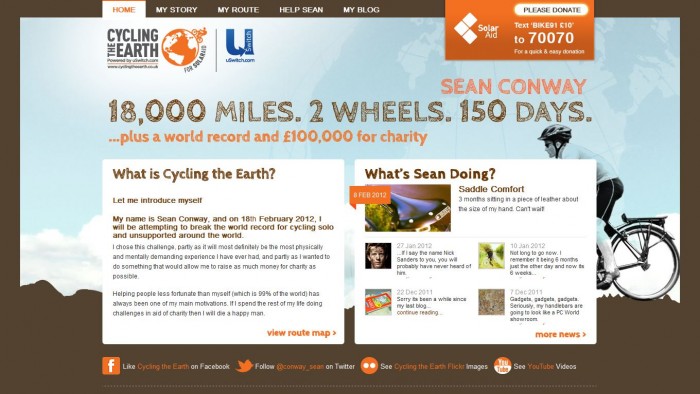
My name is Sean Conway, and on 18th February 2012, I will be attempting to break the world record for cycling solo and unsupported around the world.
I chose this challenge, partly as it will most definitely be the most physically and mentally demanding experience I have ever had, and partly as I wanted to do something that would allow me to raise as much money for charity as possible.
Conway will kick off his journey in Greenwich, London and make his way through France, Morocco, South America, the United States, New Zealand, Australia, Singapore, Bangkog, India and Istanbul. If his timing is right, he’ll make it back to London just in time for the 2012 Olympics.
An adventurer that one day plans to climb Everest and swim the English Channel–cycling being the hardest of the 3 challenges–Sean is also a motivational speaker and photographer with a penchant for charitable causes. During this particular journey, he hopes to raise £100,000 for Solar Aid.
While Sean has been uber-busy training and mapping out logistics, he was kind enough to answer a quick Nerve Rush email and tell us a bit more about his background. For a more comprehensive interview, check Sean out on Adventure Inspired.
You grew up in Zimbabwe. Where has your sense of adventure taken you so far?
Adventure, in its purest form, is simply a way of thinking. You don’t have to climb mountains or row oceans to be adventurous. I think adventurously. Yes, this way of thinking has made me climb Kilimanjaro dressed as a penguin, made me chase some cheese down a very steep hill, made me cycle the length of Britain in winter and sent me around the Himalayas. Those are the big ones. But we mustn’t forget the small yet equally important parts of adventure like walking home in the snow instead of taking the bus, waking up at 4:30am to play a game of chess on a hill at sunrise before work. It’s the small simple things that can make the big difference to our lives without us having to spend a fortune climbing a very steep hill.
Tell us about the history of the challenge. About Tommy Godwin & Mark Beaumont.
Well, firstly the bar has been lifted a bit and the record now stands at 96 days set by Alan Bate on 2010. Some say the bar has been lifted pretty far out of reach as I now need to average 188 miles per day. I say that the bar has been put back to where it was 70 year ago. Tommy Godwin cycled 75,000 miles in one year back in the 30’s. That’s an average of 200 miles per day for a year. Now that’s real cycling. When Guinness changed the rules in the 90’s to make it 18,000 miles instead of the previous 13,000, many people didn’t think it was worth doing. It took the likes of Mark Beaumont to take on the challenge and remind people of what was possible. He has just made long distance cycle records cool again. Thank you Mark. Now, 5 years on there are a bunch of us looking to push the boundaries even further. Around the world in 80 days. It that possible?
What can Nerve Rush readers do to help? Where else can we find you?
I am looking to raise as much money for charity as possible so am looking for everyone to follow my attempt. I will be blogging, tweeting and on Facebook the entire way round which will give everyone following a unique insight into what it’s like competing in the toughest race on earth. You can do this via my website www.cyclingtheearth.co.uk. It really will be all blood, swear, tears and gears. A true epic adventure.
Sean, Nerve Rush HQ thanks you for taking the time to tell us about your grand adventure. Best of luck. You’ve got our support and praise. Cycle your heart out!
Sean also wanted us to let you know that he would love to have folks come cycle with him as he rides through your city or town. Check out his planned route: if you are anywhere near him and interested in joining him for a day or two, let us know in the comments below and we’ll connect you with Sean!
I was scouring the interwebs the other day when I followed a link to The Azul Ocean and was instantly impressed. Focused on scuba diving and brilliant underwater photography, I discovered the creator was a man named Arthur Koch, with over 15 years in diving and underwater photography. I knew I had to talk to him so I tracked him down and he was gracious enough to answer a few questions. Here we go!
—
So, underwater photography. How does one fall into such a cool hobby?
I started diving in 1995, about a year later I picked in an Ikelite housing for the old Kodak disposable cameras. My initial idea was to bring pictures home to remember my dives and to show friends and family. Since then it has become a serious hobby and passion, I work regularly to improve my images by taking chases with different Underwater Photography Professionals, diving and shooting with friends who challenge me to improve.
What kind of equipment do you use for underwater photography?? How much does underwater photography cost?
I currently use Nikon D300 bodies, various lenses, Seacam Silver Underwater Housing and Ikelite strobes. I have over $20,000 USD invested in underwater camera equipment. It’s not uncommon for me to jump in the water holding $13,000 in a camera set-up.
You've traveled to 41 countries. What were some of your favorite to photograph?
You know, they are all great! Anytime you’re not in an office or factory and outside in nature, this is what it’s all about! (Nerve Rush note: we couldn't agree more!)
Love the good old USA; North Carolina for it’s big animal action-the Sand Tiger Sharks; Florida for the diversity of fish life (they have done a great job of building a sustainable reef system) and Hawaii, they got it all, small, medium and large!
Bonaire, Netherland Antilles’, in the southern Caribbean, awesome shore diving and great macro (small stuff).
Solomon Islands in the Coral Sea, great macro, sharks, manta rays and schooling barracudas.
What are 3 of the best photographs you've ever taken?
This is a very difficult question…even with being my own worst critic…so many “speak” to me for different reasons. With that in mind, my favorites change every day, but here are today’s picks.
Diving off the NC coast is some of the best in the world; I just love the NC Sand Tiger Sharks! This image was captured as she was heading to the surface to get a gulp of air for buoyancy. B&W illustrates the textures; fine details of shapes and curves that bring her to life and highlights’ her natural beauty.
2010 Key Largo – French Angelfish with Southern Stingray
While diving a coral reef you often see nature gracefully orchestrating a concert of her beauty. This image captures the natural beauty of a French Angelfish, the turquoise water of a swim through, the precise moment a Southern Stingray decides to swim away, all captured in slow motion that just grabs you!
2011 Wakatobi – Red Whip Coral with the eye of a Mimic Filefish (Paraluteres prionuris)
This image is of a Mimic Filefish hiding in a growth of Red Whip Coral. I spent the better part of 2 dives studying the fish’s behavior, potential photo opportunities and camera settings. On the 3rd dive I captured about 10 images at different angles; the contrast of the yellow eye, red of the whip coral, the black background and the fish silhouette dramatically highlight the reefs delicate and often hidden magnificence. This image marks turning point in my understanding of how to capture the oceans splendor and not just documenting its beauty.
What new projects do you have on the table for 2012?
I plan on exhibiting at 6 Art Festivals in Florida, South and North Carolina and Virginia. I’m leading an underwater photography trip aboard the Caribbean Explorer II in May to Saba N.A. and St Kitts. I will also be attending Stephen Frinks Digital Masters Underwater Photography course in Bonaire, N.A. during July. In between, I'll be diving off Florida and the North Carolina coast. Please check Facebook for details and sign up for The Azul Ocean newsletter of other details and promotions that I'll be running in the near future.
Where can Nerve Rush readers find more of you?
You can find me all around the web. Here's a few good links to start:
Massive thanks from the Nerve Rush crew to Arthur. We look forward to seeing much, much more of you and your work here at Nerve Rush in the near future.
When Srinivas Rao isn’t twiddling his thumbs, waiting for that perfect, deep blue, luscious curvature of a wave, he’s all over the Interwebs, interviewing people, talking about things like relationship marketing and making money online.
Srini, friend of Nerve Rush HQ, takes some time out of his day to teach us a little bit about surfing.
So, surfing. How did you get into it? What were some of the initial challenges you faced as a beginner?
I think it was inevitable that I would eventually surf. I went to business school in Malibu, which happens to be a world class surf destination. I did a summer internship in San Diego, and I lived in Brazil for 6 months. All signs kind of pointed to the ocean. But oddly enough, it took about 15 months before it became a regular part of my life. Two days before I left Brazil, I was in this small beach town called Garopaba. I finally figured out how to stand up on my board for the first time and that was the start of a lifelong journey. The first year of surfing is probably one of the hardest because you’re uncoordinated, you don’t know anything about surf conditions, and most other people in the water find you annoying since you have no idea what you’re doing. The hardest part in my opinion is learning how to stand up (a rather fitting metaphor for life). I couldn’t do it the first 15 or 20 times I went surfing.
You’ve lived and surfed in many different cities and beaches. What are your favorite spots?
Tamarindo, Costa Rica is actually one of the best places in the world I’ve surfed. On a good day, the waves just go forever, the water is warm and the scenery is unforgettable. Despite the frigid water, I love California. It’s home and I love the site of familiar faces in the lineup. In California my favorite spots are San Clemente, Cardiff Reef, Venice Beach, and a place called Sunset Point.
If you gave 3 tips to a beginning surfer, what would they be?
A guy I met in a bar once told me to surf 50 times. That way, you’re too invested to quit. It’s great advice for anything you want to learn.
Don’t be too hard on yourself. Most people are terrible when they start. I’m Indian and not genetically predisposed for anything athletic. So if I figured it out, anybody can.
All it takes is one good wave. Once that happens your life as you know it will never be the same.
What kind of physical training should a surfer focus on? Any muscle groups to target?
I’m the worst person to ask about this because I don’t do anything other than surf. I skateboard now because I’m living inland. But to the best of my knowledge, upper body strength makes a huge difference. So, do lots of pushups.
How much does surfing gear cost?
A really lousy foam board from Costco will run you $100. A wetsuit will run you $200. The beautiful thing about surfing is that once you buy your gear it doesn’t cost anything. I always like to say it’s the perfect sport for the unemployed since it takes a shitload of time and doesn’t cost any money. But you can spend a small fortune on surfboards. When you start buying real surfboards you should expect spend anywhere between $250-$500.
Do you have a dream wave? Can we join you when you’re ready to tackle it?
There are a few dream waves. There’s one that I never made it to in Costa Rica called Pavones. It’s the world’s longest left and breaks for about 3 minutes during a good swell. My perfect wave is the one that goes forever, even it’s only 3-4 feet high. I’d love it if you join me. Surfing is always better when you have friends to share the experience with.
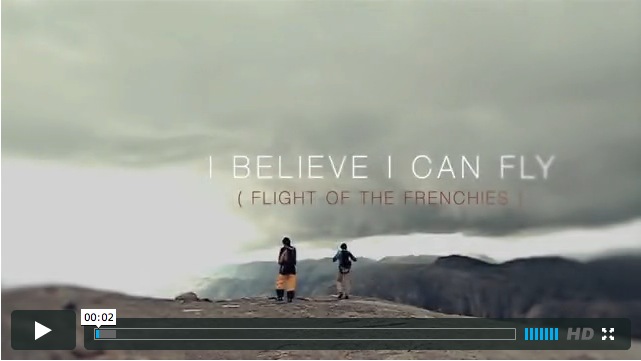
Sebastien Montaz has been a mountain guide for the last 12 years. On a few trips, he’ll bring his camera with him. But he’s not just some guy with a camera, living at the intersection of film and adventure, Sebastien knows his stuff. The proof is in his latest film: I Believe I Can Fly.
This incredible film narrates the story of the Frenchies, pioneers of a new sport called highlining which combines climbing, slacklining, and tightrope walking with base jumping. Sounds incredible? It is.
I watched the film trailer and it literally took my breath away. So, I did what we do here at Nerve Rush and figured out exactly how I could get Sebastien on Nerve Rush. I was able to track him down and thankfully he agreed to answer a few questions about his amazing film coming out today: 11.11.11.
5 Quick Hits With Sebastian Montaz: I Believe I Can Fly
Nerve Rush: How long did I Believe I Can Fly take to shoot? What went into it?
Sebastien Montaz: It took only 8 days to shoot it, which is extremely quick for the amount of nice images you have and a final 40-minute feature documentary. I was lucky to find the right conditions and meet extraordinary people on the way who really helped the story telling.
NR: What’s your background in extreme sports?
SM: I grew up in a ski resort called Les Arcs, in France and I am a professional IFMGM mountain guide for 12 years, so my background is mainly about skiiing, boarding, telemarking, rock climbing, bouldering, mountaineering and trail running.
NR: What drew you to this specific story of the Frenchies?
SM: I met them 3 years ago and started highlining with them which I loved. It is simply the biggest adrenaline rush I ever experienced. We kept filming together one new documentary each year. Two of them, Tancrède and Julien, decided to do free flight and went to the U.S. sky diving last year: they had an obsession in mind, jumping from a highline one day, which they did.
NR: What story or clip didn’t make it into the final edit? Any scary bloopers?
SM: Honestly I am really happy with the shooting results. It is far from being perfect. Some footage is out of focus, like when I am filming Bernhard soloing on the highline 1000 meters above the ocean. If you look carefully you will notice that he is out of focus and the focus point is mainly ahead of him. I focused on him to start, but then I started shooting with a steady camera to give some movement. He walked away and got slightly blurry. That’s probably my biggest regret! I opened my lens too wide 2.8 on the Canon 14 mm.
NR: What’s your next big project? And…can we come along for the ride? 🙂
SM: I love the fact that I do not know yet about my next project. It is a great period to get to find a new story…let’s take some time. Do you have nice stories or nice people to recommend ? I am open to suggestions!
—
Massive thanks to Sebastien for taking the time to talk to us. It’s an incredible understatement to say that we’re looking forward to the next time we get to talk to Sebastien here on NerveRush. Until then, you can check out the trailer for the film below (and impressive short-film on it’s own) and be sure to head over to Sebastien’s site in order to see the film in its entirety for free for a limited time. Enjoy!




 32-year old Dave Cornthwaite is downright cool.





 You grew up in Zimbabwe. Where has your sense of adventure taken you so far?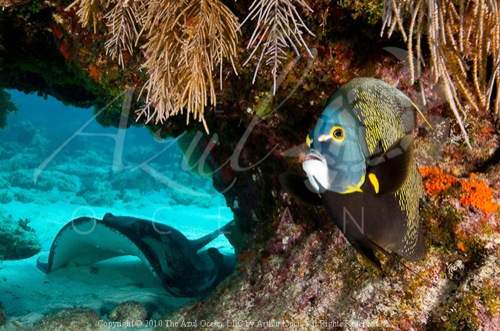


 So, surfing. How did you get into it? What were some of the initial challenges you faced as a beginner?