
You’re sure to enjoy this beautifully shot, fascinating skateboarding video featuring the impeccable skills of Kilian Martin, all set to a backdrop of some of India’s most stunning locations.
Blog
-

AFTERGLOW: Watch This Stunning Skiing Movie
From the day it was released, AFTERGLOW has been highly regarded as one of the most visually stunning and innovating skiing movies ever made. Shot at night in Alaska with the help of some beautiful and truly epic lighting techniques, this short film is something that anyone (skier or not) will enjoy seeing.
-

Kimi Werner Free Dives With A Great White Shark
During her many years of spearfishing, Kimi Werner learned to read the body language of fish. In this video, Kimi puts her knowledge to the ultimate test when she comes face to face with a great white shark.
-

NR002: Joe Mauko, 70 Lbs Overweight to Ultrarunner
Welcome to the Nerve Rush podcast, episode 2.
Podcast: Play in new window | Download
In this episode, we chat with Joe Mauko. Joe reached out to me a few months ago, and he wrote:
Alan, I am doing four impossible things to fundraise for cancer in 2014:
- Run 70km to the start of a marathon, and then run the marathon
- Complete a 100-mile ultramarathon
- Complete a 24-hour treadmill outside in a Toronto intersection
- Complete a 250+km multiday ultramarathon race in Chile’s Atacama Desert
What’s fascinating about all of this, is that while Joe just completed his fourth and final bullet point last month, 5 years ago he had almost lost everything.
He had a lien on his house. He was in a state of perpetual fatigue. He was recovering from cancer. He was 60-70 lbs overweight.
In this episode we talk about what drove Joe to start running. What those first few weeks and months of running were like.
We talk about how he got lost during a 100-mile race, what ultramarathon training consists of, and what racing through the Atacama
You’re going to hear it in his voice, folks. Joe Mauko is passionate. He exudes the kind of optimism and level-headedness we could all use a little more of.
I had a lot of fun hearing his story, and I know you will too.
Mentioned in this episode:
-

Rush Sturges Kayaks Over 70 Ft. Outlet Falls
Check out this actually insane GoPro footage of Rush Sturges taking an icy drop down the 70 ft. Outlet Falls in Washington.
-

Kelly Slater’s Ridiculous 720
Age simply doesn’t seem to impact Kelly Slater’s surfing capabilities at all. Last month, the 42 year old surfing legend was in Portugal, where he hit the waves during some free time at a competition. All we can say is that we’re glad someone had a camera on.
-
![Meet Motorsport Legend, Ricky Johnson [Infographic]](https://www.nerverush.com/wp-content/uploads/2014/11/RB-Frozen-Rush-2015-RJ-Infographic-50x50.png)
Meet Motorsport Legend, Ricky Johnson [Infographic]
Red Bull Frozen Rush, the world’s only off-road truck race on snow, is returning to the slopes of Sunday River Resort, Maine, January 9, 2015.
In the race, 900-horsepower Pro4 trucks will compete head-to-head, side-by-side, on the snow…for the first time ever.
Motorsport legend, Ricky Johnson, won the race last year and will lead the cast of all-star professional racers from around the country in a couple of months.
Below is an infographic that highlights Johnson’s career. Prettttttty awesome.

Share this Image On Your Site
-

NR001: Joel Runyon, Ultramarathons and the 777 Project
Welcome to Nerve Rush FM, episode 1.
Podcast: Play in new window | Download
In this inaugural episode, we chat with Joel Runyon, an ultramarathon athlete, online entrepreneur, philanthropist, and close friend!
Joel and I go way back. We started Nerve Rush together back in 2011. Since then, Joel’s gone on to do some pretty amazing things.
In this episode, we chat about his latest 777 Project, what it’s like to train for an ultramarathon, his favorite gear, and more.
Mentioned in this episode:
-

5 of the Most Extreme (Ancient) Sports
Those of us who spend most of our waking hours in a cubicle or other equally ordinary environment seek our own types of thrills – whether it’s an adrenaline-pumping outdoor adventure or the latest crazy food fad. But even before the advent of office jobs and Cronuts, the oldest earth dwellers also found unique ways of living – or in some cases dying – on the edge. Their inventions eventually gave rise to many of the adventure sports we know and love today. Here are five of the most extreme ancient sports you’ve probably never heard of.
5 of the Most Extreme Ancient Sports
LAND DIVING
If you think bungee jumping is extreme, try diving head-first off a wooden tower with nothing but two tree vines tied around your ankles.
On Pentecost Island in the South Pacific, the Vanautu tribes’ gravity-defying ritual to bless the annual yam harvest gave rise to modern-day bungee jumping. But land diving, or naghol, doesn’t offer the luxury of elastic ropes or safety equipment. Boys jump from the lowest level – still two stories high – as a rite of passage, while the most experienced men dive from as high as 100 feet. But the height alone isn’t what makes naghol extreme. The divers’ heads must brush the ground in order to bless the yams. If their vines were cut properly, they’ll just scrape the ground before bouncing back up. But an error of even four inches will cost them their lives.
Naghol is still practiced today and even draws tourists – to watch, that is. Foreigners are barred from trying this dangerous sport. Famously, Queen Elizabeth II saw a naghol diver die when she visited the island in 1974.
http://youtu.be/MdmbkeJe6zo
SHEPHERD’S LEAP
So, you’ve heard of pole vaulting. Now imagine vaulting yourself across rugged volcanic ravines and down steep cliffs as you follow your goat herd or try to outsmart the Spanish conquistadors who’ve come to take your turf.
For the ancient inhabitants of the Canary Islands – and especially goat shepherds – Salto del Pastor (Shepherd’s Leap) was not only a dangerous sport but also a clever mode of transportation. The sport involves a wooden pole ranging from 6- to 13-feet in length with a sharp metal tip. Gripping the top of the pole, the Canarians would aim the tip toward the ground in front of them and leap for dear life, sliding down it for a hopefully safe landing. Skilled leapers could jump even farther than the length of the pole, up to 26 feet based on some accounts. Worry not – you can also Salto del Pastor your way back up a cliff.
This sport is so risky that it’s surrounded by romantic legends like “Lover’s Leap” and “Half-Moon Leap.” Today, it’s mainly practiced for fun or competition.
HAWAIIAN LAVA SLEDDING
Belly-racing or surfing down steep mountain slopes on a 12 foot-long, 6 inch-wide sled, Hawaiian elites – the original he’e holua riders – once risked their lives to honor Pele, the goddess who created the islands with fire.
“At the same time we feared her wrath we also worshiped her or at times challenged her by riding down the steep hardened lava slopes to prove we could overcome her anger,” says Tom Stone, a university lecturer and expert sledder from the Big Island who is reviving the 2,000-year-old sport. “Most times we lost.”
Today there are nearly 100 active riders who surf down natural or manmade courses Stone likens to ocean waves. He’s uncovered over 50 courses, “including a monster on the western shore of Hawaii that was once 60 feet wide and 5,200 feet long,” according to Outside magazine. Capable of speeding up to 50 miles an hour, he’e holua is not a sport to try at home!
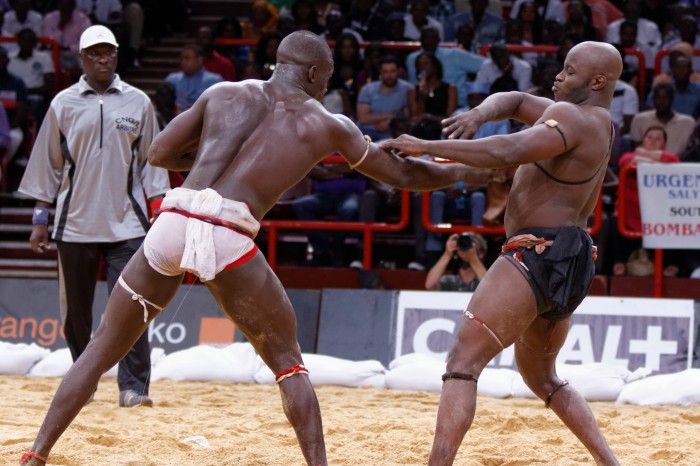
SENAGALESE WRESTLING
Centuries ago, Senagalese fishermen and farmers would wrestle for fun, to defend their village’s honor or even to win crops. Since then, laamb, as it’s called in Wolof, has become so popular it’s even replaced soccer as the country’s favorite spectator sport. The best fighters are A-list celebrities and can rake in as much as $100,000 per match.
Unlike other forms of West African wrestling – and most sports in the rest of the world, for that matter – laamb sometimes allows bare-fisted punches. The first fighter to put his opponent’s head, back or both hands and feet on the ground wins.
Laamb has held onto many of its rituals throughout the years. Fighters still wear magical talismans called gris-gris or jujus, and before even stepping into the dirt ring, they meet with a shaman, perform ritualistic dances and use protective baths. “The gris-gris and baths are just for protection against negative tongues and eyes,” explains Mbaye Gueye Dieng, a spiritual guide, in a New York Times article.
MESOAMERICAN BALLGAME
The first ball game in history may have emerged in Mesoamerica over 3,500 years ago. But this wasn’t your average game of catch – historians believe it was a matter of life or death.
“The ballgame was a fast and dangerous sport played with a heavy ball that could break bones – or even kill,” according to the Mint Museum of Art. More than just a sport, the game symbolized a battle between the gods and demons, and the 8- or 9-pound rubber ball represented the sun. The exact rules are unknown, but the idea was for two teams of up to five players to keep the ball in play, and perhaps dunk it into a hoop, on an “I”-shaped course without using their hands. It was a great honor to win, but the losers? Evidence suggests the losing captain or even entire team would be sacrificed to the gods, sometimes by decapitation.
Although Mesoamerican ballgame is an endangered sport, versions like ulama, where players hit the ball with their hips, are still played by indigenous peoples in parts of Mexico and Central America. Luckily for aficionados, the blood-spilling finale is believed to have died out back in the 1300s.

-

Google VP Secretly Shatters High-Altitude Skydive Record
On October 14th, 2012, after 7 years of planning and a 2 1/2 hour ascent, Felix Baumgartner jumped from 128,100 feet above Earth’s surface, breaking 3 world skydiving records in just over a 10 minute period with the Red Bull Stratos project.
Just last week, Alan Eustance, a 57-year old computer scientist and Senior Vice President of Knowledge at Google, shattered that record.
Tethered to a helium balloon that sped upwards of 1,600 feet per minute, Eustace smoothly rose from an abandoned Roswell, New Mexico runway, soaring to an altitude of 135,890 feet, over 25 miles above Earth’s surface.
Then, after just over two hours, Eustace ignited a small explosive device that severed himself from the balloon. For a full 15 minutes, he reverse-rocketed back down to Earth, at one point, triggering a sonic boom as he hit a top speed of 822 miles per hour.
“It was a wild, wild, ride,” Eustace explained to the Times.
Background: Alan Eustace’s Three Year Secret
Eustace decided to pursue the project back in 2011, connecting with Taber MacCallum. McCallum is one of the founding members of the Biosphere 2 project, an artificial ecosystem built to explore concepts like the possibility of space colonization.
Eustace thought he could develop a simpler system that what Baumgartner used, working with MacCallum’s company, Paragon Space Development Corporation, to develop a life-support system that would allow him to breathe pure oxygen in a pressurized suit, during both his ascent and fall.
While Eustace’s company, Google, offered to help with the project, he declined support, worried that his jump would become a marketing event. Instead, Eustace recruited a small team of engineers to help him actualize the project.
Kudos to Eustace and his team for pulling this off so successfully. Here’s looking at you, Baumgartner, to take it to the next level 🙂