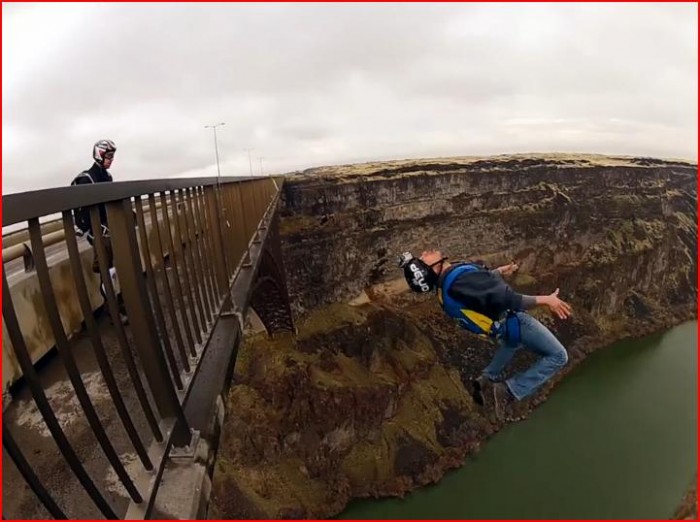
Ladies and gentlemen, meet the Seattle BASE Clan, a group of BASE jumpers out of Seattle, Washington. They’ve got some gnarly videos over on their Facebook page. This one features jumps in Twin Falls, California and Moab.
It was very lunar. a very desolate place, very isolated. My feeling was one of complete isolation, from all of humanity.
James Cameron, we salute you.
On March 26th, 2012, Cameron completed what is now the deepest solo-man dive in world history. 6.83 miles to the bottom of the ocean. With 30+ deep-sea dives to the Titanic and 7 years of preparation for this particular voyage, Cameron was no stranger to the open ocean — check out this clip to hear him wax philosophical on his experience.
The Challenger Deep is a small, slot-shaped depression of the Mariana Trench, the world’s deepest canyon, situated about 200 miles southwest of Guam in the Pacific Ocean. The descent in Cameron’s proprietary bullet-shaped submarine took 2 hours and 36 minutes, and while the vessel was designed for a 6-hour trip, the mission was cut short a couple of hours in when a hydraulic fluid lead obscured Cameron’s view. It only took 70 minutes to ascend.
Cameron spent more than 3 hours drifting along the Challenger Deep, an alien-esque, desolate landscape more than 50 times grander than the Grand Canyon.
Armed with tools like a robotic claw, “slurp gun” and sediment sampler, Cameron collected samples. Video footage was captured via an 8-foot tall tower of LED lights.
When Cameron surfaced, he was unable to fully extend his arms and legs for hours.
A half-hour special, James Cameron: Voyage to the Bottom of the Earth, is running on National Geographic and showcases Cameron’s expedition.
A longer video than usual today on Nerve Rush, but it’s well worth it. Nike athletes Ben Horan, Andrew Pastura, Matt Manzari and Nick Taylor try out their wakeskates on film and capture some sick footage. Kick back, hit play and enjoy.
sport. But how did this insane test of endurance come about? We’re so glad you asked.
The Start
It all got started in 1978. In Oahu, Hawaii, following a running race, a debate broke out between endurance swimmers and runners. Who was the better athlete? Both slides remained unflinching. Meanwhile, someone claims that cyclists have the highest VO2 output (a measure of cardiovascular endurance).
A challenge was born. Navy commander John Collins suggested that a combined race could finally settle the argument once and for all. As a result, the 3 longest distance races on Hawaii at the time were combined into an epic endurance race:
The Waikiki Roughwater Swim (2.4 mile / 3.86km swim)
The Around-Oahu Bike Race (115 miles / 185.07km bike)
The Honolulu Marathon (26.2 miles / 42.195 km run)
Collins recalls saying;
“The gun will go off about 7 a.m., the clock will keep running and whoever finishes first we’ll call the Ironman.”
Because the race needed to have consecutive legs, the bike race was shortened 3 miles to 112 miles so it would end at the marathon starting line. This meant the official distance for the first Ironman race ever was a total 140.6 total miles – and it’s been the same ever since. Whew! 12 people–including Collins–competed in that first race and Gordon Haller, a taxi cab driver at the time, crossed the finish line first and became the “original” Ironman with a time of 11 hours, 46 minutes and 58 seconds.
The race was held on Oahu until 1981, when it was moved to the Big Island of Hawaii where it now has its namesake of the “Kona Ironman.” The lesser populated island has proved to be an infamous location, daring athletes to brave 45mph crosswinds and 95 degree heat. The Kona Ironman is truly the ultimate test of endurance.
Kona Ironman, Memorable Finishes
Julie Moss 1982
Named one of the most defining sports moments of sport by ABC Sport, Julie Moss’s Ironman finish in 1982 shot the sport of triathlon into the mainstream. With just a few minutes of televised footage, Moss turned a fringe sport into an international competitive sport. So what was so extraordinary about this? Moss was a 23-year old physiology student racing as part of a research experiment and surprisingly found herself out in front of the women’s course with just a few hundred yards left – her body began to fail and she could barely walk.
Unable to keep moving forward on foot, Moss dropped to her knees and began to crawl towards the finish line. Just yards away from being done, Julie was passed by Kathleen McCarty who won the race. Undeterred, Moss, while being watched by millions, continued to crawl across the finish line where she collapsed capping off a race finish that truly has to be seen to be believed. Luckily, we have that video for you right here.
Channeling memories of Julie Moss’s ghost, Sian Welch and Wendy Ingraham experienced one of the very similar endings as Julie 15 years later. Just a few yards away from the finish line as they were entering the final shoot, both competitors collapsed. As they struggled to get up and continue racing, they discovered their body simple had nothing left. With their ability to walk, gone, they both began to crawl towards the finish line with Wendy Ingraham pulling ahead at the end with Sian Welch right behind her. Once again, a memorable finish you have to see to fully experience.
Craig Alexander of Australia holds the current men’s Ironman course record with a finish time of 8 hours, 3 minutes and 56 seconds. Chrissie Wellington of Great Britain set the women’s course record in 2009 with a record time of 8 hours, 54 minutes and 2 seconds. Needless to say, these finishers were moving!
Qualifying For The Kona Ironman
After the incredible televised finishes and the seemingly incredible distances athletes have to cross, the Ironman entry has become a hot ticket item in endurance racing. To handle the demand, Kona race organizers developed a qualifying system. Instead of an open registration, athletes can qualify 1 of 3 ways.
Earn a qualifying spot at a Ironman World Championship qualifying event (these can be either the 70.3 or 140.6 Ironman branded races)
Win a slot through the Kona lottery selection program
Win a slot through the Kona Ironman eBay auction.
If you manage to get a slot, you’ll get to pay around $750 to participate in one of the most incredible races on earth (not to mention one of the most taxing). So if you’re up for it, remember the Ironman athletes’ motto:
“Swim 2.4 miles! Bike 112 miles! Run 26.2 miles! Brag for the rest of your life!”
Do you have what it takes to be called an Ironman?
___
If you’re interested in running an Ironman..it all starts with a Sprint Triathlon. While Ironman athletes might look like Superman, they all had to start somewhere. Most triathletes start out with a sprint triathlon and despite what you might think, no matter your fitness level, you can train for a sprint triathlon in just 3 months. Give it a shot.
Some people get a rush by skydiving. For those where skydiving isn’t enough, there’s basejumping. For those where that’s not enough, there’s skylining. For those where that isn’t enough, there’s
skydiving without a parachute. Say what? Yes, skydiving without a parachute. We’re all for adrenaline rushes, but this is as crazy at is sounds. There really aren’t words to describe this, so just go ahead and watch.
Skydiving is a prominent thing to do on most people’s bucket lists. It frequents itself at the top of the list so often that some say skydiving has lost its perennially #1 ranking as the world’s biggest rush.
So why not step it up a notch, Nerve Rush style. Skydive on every continent!
Below are the best places to skydive on each of the 7 continents:
With a drop-zone located only a few miles away from the Pacific Ocean sky-dive Santa Barbara offers up breath-taking panoramic views of the California coast line. This drop zone isn’t just a create spot for first timers. For those that have jumped before but are looking to add a little extra thrill to the experience, Santa Barbara offers up the highest tandem skydive in North America. An 18,000 ft jump with over a minute and a half of free-fall time is sure to give a fix to any adrenaline junkie.
Aside from its chocolate, banks, and watches, Interlaken, Switzerland houses one of the most extraordinary drop zones in the world. At the base of the Swiss Alps and nestled between Lake Thun and Lake Brienz you will have the option of jumping from an airplane or helicopter. Scenic views of mountain tops and glaciers offer a unique look as your shoot opens. If skydiving wasn’t enough to tickle your fancy, Interlaken also gives you the opportunity to test your nerves through hang-gliding, Alpin rafting, and paragliding.
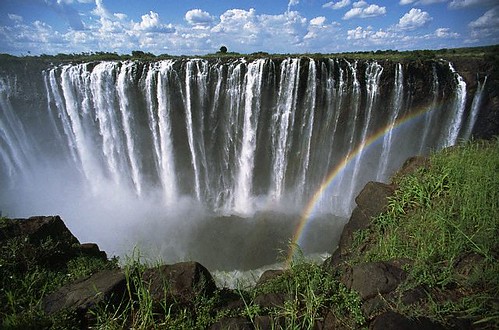
From bungee jumping, to elephant back riding, and now skydiving. Victoria Falls in South Africa, located on the Zambezi river between Zambia and Zimbabwe, gives those with a few screws loose a chance to see one of the worlds largest and most beautiful waterfalls from a unique perspective. A 25-minute scenic flight with Skydive Vic Falls gives you a chance to see the falls up close as well as many other local landmarks.
The indigenous name for the Falls is “Mosi-oa-Tunya” – which translates to “The Smoke that Thunders.” If that doesn’t scare the crap out of you, I don’t know what will.
Well on its way to becoming one of the worlds best skydiving resorts on the planet, Skydive Dubai offers thrill-seekers a chance to fly over a man-made peninsula that is literally on the water and even has its own private beach. After taking in the views that include the World archipelago, the 7-star Burj Al Arab hotel and the Burj Khalifa – the tallest building in the world – you can take a dip in the Arabian sea or enjoy the world-renowned night life. If that is not enough, hop on a quad and rip in up in the desert.
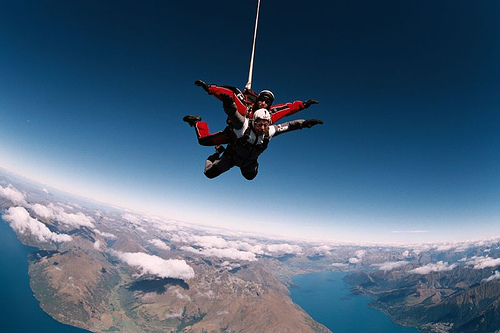
Deemed the adventure capital of the world, Queenstown is located on the south island. Between Queenstown and Rotorua, a 2nd location on the north island, 180,000 people have tumbled out of planes since 1990. The first commercial skydiving operation in New Zealand gives you the chance to leap from up above the Remarkable’s mountain range (how fitting is that). The Rotorua location is found between two towering volcanoes and is surrounded by mud pools, active geysers, and steaming lakes. The sky above this drop zone is known as Ranginui, or the Maori Sky God.
6. South America: Skydive Sao Paulo, Brasil
Perfect blue skies and wonderful weather make Sao Paulo a pristine drop zone. Located near the Atlantic ocean just outside of Rio De Janeiro, this jump offers up one of the most beautiful skylines in the world. If you time it right, you might be able to get a jump in as well as catch Formula 1 race, attend the ATP Brasil Open, or an Indy 300 event. The 2011 Skydiving world championships were held here..so you know it’s legit.
7. Antartica: OK..Maybe Not
This is not for the noob. Valery Rozov was the first man to climb the nearly 10,000 ft Mountain, Ulvetanna and base jump off of it. The free fall lasted roughly 45 seconds through -30 degree Fahrenheit winds. Although you might not be able to experience what Valery did there is a chance to get close.
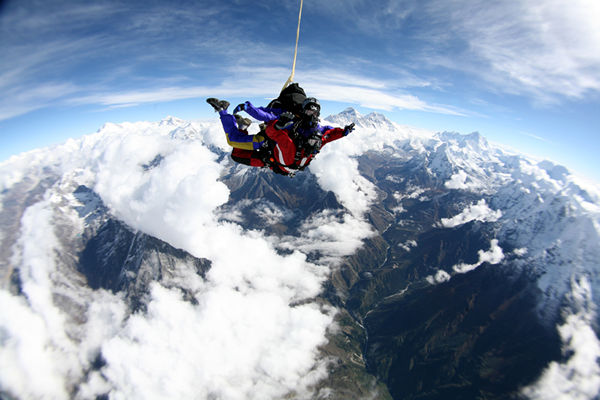
Falling from 29,500 ft in the air will give you plenty of time to pull your shoot. You’ll also be able to land on the highest drop zone in the world at 12,350ft. The Everest jump team only conducts four jumps over the course of a year. You’ll need to throw down a few clams as well to prove your serious. About $25,000 worth! Word on the street is that you get a pinky ring and diamond studded wing suit, John Travolta style. Reserving your spot needs to be done six months prior to the jump date. If you’re looking to put some hair on your chest, this may be your best shot.
*Bonus 2: Outerspace
For a jump that is seriously out-of-this-world, check out Felix Baumgartner and team Red Bull starts. These fools plan to jump from a stratospheric balloon 120,000 ft above the earth. Felix will be testing the limits as gravity yanks him back into our atmosphere at supersonic speeds. This jump will exceed the current world record held by Joe Kittinger in 1960 by nearly 18,000 ft.
I’m not sure how long the free fall will be..due to the weight of this guys balls.
If you decide to put this on for bucket list better save it for last.
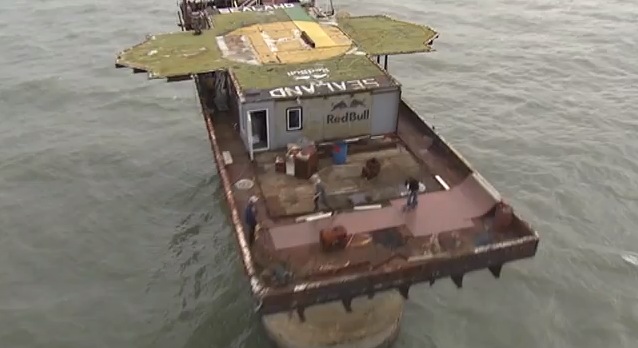
What do you do when you get access to the world’s smallest country? If you are the Red Bull skate team, you skate it. So they did. Not many outsiders get access to Sealand – a small WWII sea fort settled by Sir Paddy Roy Bates in 1967, but we’re glad the Red Bull team did and had the chance to film it.
Skydiving. That’s the one item that seems to be on most everyone’s “bucket list.”
When most people say “skydiving,” they mean making a tandem jump where you’re strapped to an instructor during freefall. Scary, sure, but not quite scary enough to qualify as gut-wrenching adventure. So, while tandem jumping is a great experience, if you have the extra time, money, and desire to scare yourself silly, forget the tandem jump and sign up for an Accelerated Free Fall (AFF) course – the course that lets you jump out of a plane by yourself.
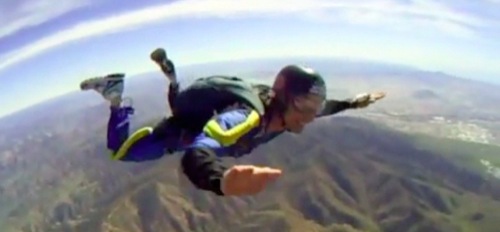
At the end of your first lesson on the very first day, you’ll skydive wearing a parachute without being attached to anyone. Two instructors will fall along side you to help keep you steady. If you completely freak out they might be able to help you open your chute but other than that . . . you’re on your own.
Mock Airplane Door
After you complete seven AFF lessons you’ll be cleared to jump solo. Completely on your own. No instructors. Just you. By yourself from over 2 miles straight up. I swear.
Scary? Yes.
Worth it? Definitely.
Starting The Class
My AFF class, which had about six students, began at 8:00 a.m. on a Saturday morning. Maybe it was my imagination, but everyone in class looked like they were on the way to a firing squad.
The class started with the instructor telling us that it’s not too late to back out if we don’t think we can go through with the jump. Better to just stay on the ground instead of getting dressed up in skydiving gear, flying up to altitude only to chicken out and ride back down in the plane. Who wants to climb out of the plane after it lands and take the AFF walk-of-shame?
Well . . . what a happy, cheerful way to begin the class.
After that we were told of all the possible ways the parachute might malfunction. They even had videos showing various skydivers who had problems opening their chutes. They only showed us the first part of the videos, so I don’t know how the ill-fated jumps ended.
We then learned about the gear we would use. The skydiving rig is like wearing a backpack but, instead of camping gear or dirty laundry, there are two parachutes inside.
The main parachute is stuffed in a bag that’s attached to a smaller parachute, called a pilot chute. The bag with the main parachute is packed in the backpack-like container while the pilot chute is stuffed in a pouch on the bottom of the container. On the end of the pilot chute is a leather ball, slightly larger than a golf ball, which acts as a handle.
The Chute
So, to open the main chute, all you have to do is reach behind to the bottom of the container, grab the leather ball on the end of the pilot chute and fling it out. The pilot chute inflates and pulls the main chute out of the bag and container so it can inflate. Then we float safely to the ground. At least that’s the plan.
In case things don’t go as planned with the main cute, another parachute, or “reserve” chute is also tucked away inside the container. We never see it because it’s only opened in case of an emergency. So we really don’t want to see it but if we need it, it’s there.
We learned the basics of how the parachute fits in the container, how to open the chute, how to cut away the main parachute in case it malfunctions, how to open the reserve chute, and how to control the parachute after it opens.
Then we learned the exact jump sequence we would use when exiting the aircraft. Every single step was rehearsed even to point of how to stand in the airplane door as get ready to jump. Something like this . . . left leg back, right leg bent at the knee, both hands holding the door frame, chest upright and facing the front of plane . . . etc etc. No detail was too small to ignore.
Everything is rehearsed over and over and over. And over again. Because when actually jumping out of a plane wearing a parachute for the first time, a human brain goes into “slow motion stupid mode.” Tunnel vision takes over and the brain operates like it filled with glue.
The Jump
Okay, class is over and now it’s time to suit up and actually do this. It’s around 1:30 in the afternoon when it’s finally my turn. Rehearsal one last time on the ground with my two instructors. Then we climb into the plane.
The plane ride up to 13,000 feet takes a little over 10 minutes. Looking back, it was all a blur.
About half way up, one instructor makes me tell him one more time exactly what we’re going to do during the jump. How we stand in the door. What to do during freefall. How to open the chute. How to steer the canopy. How to land. I’ve gone over the steps all morning about a thousand times. And now one more time as we climb to altitude.
The plane levels off and someone opens the door, which rolls up like a small garage door. We make our way to the exit just like we rehearsed. Only during the ground rehearsal there isn’t an 80 MPH wind blowing by the open door. Yikes.
Taking tiny steps I get in position in the door between the two instructors. I make eye contact with the instructor inside, turn and looked at the instructor hanging on the outside the plane, bend my knees slightly while keeping my chest upright, look forward at the propeller, and then . . . push off.
This is crazy.
Now we’re falling. Seriously, this is really crazy.
The Altimeter
I look straight at the ground and can see the airport below. I’m supposed to be counting to 5, but I forget. Oh well, can’t remember everything. I guess at what feels like 5 seconds and then check the altimeter worn like a watch on my left wrist. It says 11,000 feet. I think.
Then I make eye contact with the instructor on the left and then with the one on the right. They both give me a thumbs-up.
That’s the end of the first task. Nothing more complicated than looking at my left wrist, reading a number on a dial, and then looking at two people who are only a couple of feet away.
If someone asked you to do that on the ground, you would laugh. But when falling through the air at 120 MPH the impact of stress on my feeble brain makes this feel like quantum physics.
The next task is to practice touching the handle that opens the parachute. Since I can’t see the small leather ball attached to the pilot chute, I have to locate it by touch. Slowly reach back with my right hand to the bottom of the container and touch the leather ball. Then bring my hand back up near my head.
Repeat five times. Check altitude again. More eye contact with both instructors. More thumbs-up.
Somewhere in this process, the goggles get loose on my face. I’m wearing glasses underneath them so maybe that’s part of the problem. One instructor adjusts the goggles for me and somehow, my glasses come off. Never to be seen or heard from ever again.
Oh well. My vision’s not that bad so I can still see well enough without glasses. Besides it’s not like we can go look for them.
When I see 6,000 feet on the altimeter, I “lock on” to it as rehearsed. At 5,500 feet I wave my hands in front to signal I am about to open. Then reach back to the leather ball, toss it out and guess what? The parachute opens. Just like they said it would. Crazy.
Now the rushing wind of free fall is replaced by silence as I slowly glide to the ground. The instructors are gone and I am by myself under the canopy at about 4,500 feet. Above my head are two toggles attached to lines attached to rear corners of the canopy. Pull on the left toggle and the parachute turns left. Right toggle turn to the right. Pull both at the same time and the parachute slows and almost stops. Perfect.
This is the best part of the day, since the parachute is open. It’s open without a malfunction, and I can fly around. Life is good.
But then I realize I’m at the east end of the airport, when I should be at the west end for landing. Oops. All of a sudden, life is slightly less than good. A little correction gets everything back on track.
At 1,000 feet, I fly parallel to the runway and at 500 feet make a left 90 degree turn. At 250 feet another left 90 degree turn to where I’m lined up for the landing area. The instructor talks to me in a radio attached to my helmet.
Pull on the toggles that slow the parachute right above the ground and I land standing up. Back on the ground in one piece. Amazing.
In the next several weeks I finished the AFF course and less than a year later I have made a total of 100 jumps. That’s a lot of jumps for me but still a very low number compared to many instructors who have thousands of jumps. Thousands and tens of thousands.
And we’re still alive. It’s breathtaking, scary and definitely gut-wrenching, but it’s all worth it.
So here’s the deal. If you ever think you’d like to learn to skydive . . .my recommendation? Do it.
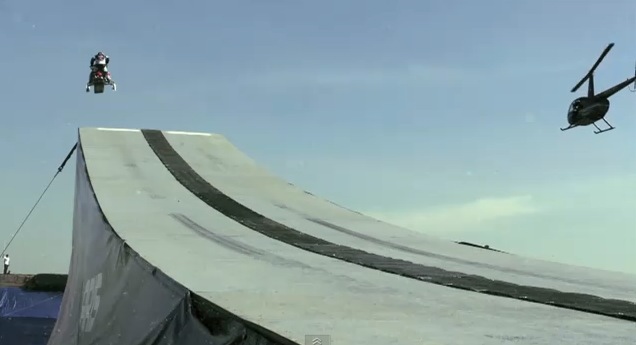
Levi LaVallee jumps 361 feet on his snowmobile (60 feet longer than the current world record) at a Red Bull event in San Diego. Red Bull is there to capture the whole thing and make sure Levi’s f
A unique race, never attempted before – from Peru to Guyana in 3 weeks, going through Ecuador, Colombia and Venezuela. The adventure begins on 1st of August 2012! Do you dare to take it on?
What is ‘The Inca Rally’?
Imagine blitzing across the Peruvian Andes, hustling through Ecuadorian deserts and Colombian plains, cruising through Venezuela’s Caribbean coastline and plunging into the depths of the Guyanese Amazonian jungle in just under 3 weeks. That’s The Inca Rally.
As you race along its 8,000 km route, you will experience one of the most stunning landscape ranges and mingle amongst some of the most exciting cultures of any rally. You will party the nights away in the different capitals, learn about great community projects en route and challenge yourself throughout with all the other racers that you meet.
This is real adventure. With a purpose.
The Route
The rally is an unsupported and untested charity race across South America’s most challenging terrains; taking racers from Peru to Guyana through Ecuador, Colombia and Venezuela in 3 weeks.
These are the countries once fabled to be home to the mythical golden city of El Dorado, believed for centuries to be hidden deep in the South American jungle. Along the way, racers will climb vertiginous Andean peaks, cruise through vast plains, bask in the Caribbean sun and plunge into the Amazonian basin. There is no official route – just parties organised in each capital for the drivers who make it that far.
This is the first and only rally to cross this challenging section of South America, from the Pacific coast to the Caribbean beaches.
Peru Lima – 1st Aug 2012
Ecuador Quito – 5th Aug 2012
Colombia Bogota – 9th Aug 2012
Venezuela Caracas – 13th Aug 2012
Guyana Georgetown – 18th Aug 2012
The Charities
As a social enterprise, we are highly committed to our charitable causes. Each year drivers vote for one of three chosen charities to receive funds they’ve raised for the rally. 2012 nominees are Incawasi, a Peruvian charity trying to break the cycle of family poverty; EveryChild, working to prevent children from growing up vulnerable and alone; and Survival International, campaigning for tribal people’s rights worldwide. All three charities operate in countries along our route.
Requirements
We love the roads less traveled, the local communities and the foreign cultures. We seek the unexpected, the challenges and the victories. We do all this to challenge ourselves and help others.
Here at the Inca Rally, we get a kick out of hurtling ourselves headfirst into the unknown armed with just a questionable overconfidence in our ability to be resourceful enough to get out of any sticky situations. So that is what we are about. Shaking the safe monotony of daily life and plunging straight into adventurous randomness.
Are you up for the challenge? You can find out more information on the Inca Rally official website. Sign up as an individual and join an existing team, or rally your friends together and fundraise for a team of your own.

 The Challenger Deep is a small, slot-shaped depression of the Mariana Trench, the world’s deepest canyon, situated about 200 miles southwest of Guam in the Pacific Ocean. The descent in Cameron’s proprietary bullet-shaped submarine took 2 hours and 36 minutes, and while the vessel was designed for a 6-hour trip, the mission was cut short a couple of hours in when a hydraulic fluid lead obscured Cameron’s view. It only took 70 minutes to ascend.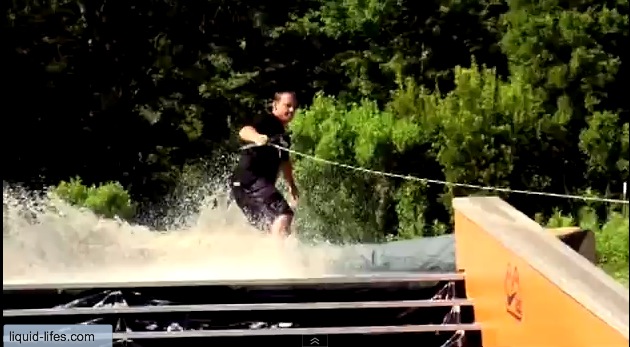
![Kona Ironman World Championship [Race Profile]](https://www.nerverush.com/wp-content/uploads/2012/04/Ironman-Run.jpg)






![The Inca Rally [Race Profile]](https://www.nerverush.com/wp-content/uploads/2012/05/The-Inca-Rally.jpg)

