Category: Blog

  • Introducing, the AirKick Human Water Catapult

    Put this on the list of things we want for our next birthday.

    Remember as a kid, when you would go to the circus and see the guy getting shot of out of the cannon? Yea, compared to this, that’s child’s play – literally.

    Introducing, The AirKick Human Water Catapult

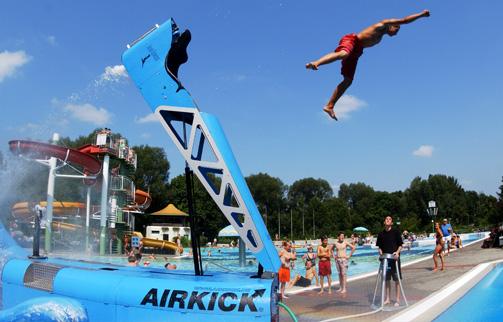
    This amazing device, well, kicks you into the air. Yes, this is an air and water-powered human catapult (also known as what we’ve been waiting for our entire adult lives).

    Users sit in a customized seat and at the press of a button, the AirKick uses over 60 liters of water to propel the riders over 25 feet into the air into a foam pit or swimming pool of your choice.

    You can order it directly from Baller Toys for just a measly $130,000 – although we think that at that price, they should throw in your very own pool for free.

    According to the website, the AirKick is specifically designed for promotional companies, but there’s no saying that they’d turn us down if a generous reader wanted to donate 130k to NerveRush’s “We Need An AirKick” Charity. Don’t worry, you’re all invited to the first major party we have.

    The AirKick

    via Baller Toys

  • An Ode to Nitro Circus, Reality TV at its Finest

    An Ode to Nitro Circus, Reality TV at its Finest

    Nitro Circus, I miss you. Come back to TV, please.

    If you haven’t heard of Nitro Circus, fear not, for Nerve Rush is here to rescue you.

    [vimeo id=”3340521″ width=”600″ height=”350″]

    Nitro Circus is an American television series that features Travis Pastrana–a professional motorsports competitor and stunt performer–and his friends traveling around the world, performing insane stunts that involve dirtbikes, base jumping, tricycles, epic water slides, you name it.

    In 2006, it was originally produced as a miniseries for Fuel TV, then in January 2009, it began running as an episodic reality TV show on MTV. So far, there have been two seasons, and like many others out there, I’m patiently waiting for a third. From what I’ve read it looks like in lieu of a third season, we’ll be seeing a 3D movie. Apparently the crew is filming now. GIDDY UP.

    In the meantime, check out one of their first episodes, titled “Medina Lake”:

    In Season 1, Episode 2, Nitro Circus romps around the Pastrana family lake house on Medina Lake in Maryland, where the crew likes to hang out after the X Games each year. Racing big wheels, launching pit bikes off of trampolines, back-flipping monster trucks–it’s a great episode.

    [image via Deviant Art]

  • Alex Honnold, the Quirky Rock Climbing Beast

    Alex Honnold, the Quirky Rock Climbing Beast

    There are rock climbers, and then there’s Alex Honnold.

    There is no adrenaline rush. If I get a rush, it means that something has gone horribly wrong. Because the whole thing should be pretty slow and controlled. I mean, it’s mellow.

    Surviving on less than $1,000/month and living out of his white van, Honnold is a rock climbing prodigy. Armed with nothing more than rubber shoes and a bag of chalk, he tackles walls thousands of feet high. Without a rope. It’s called free solo climbing, and it’s one of those sports that, even here at the Nerve Rush headquarters, we cringe when thinking about it.

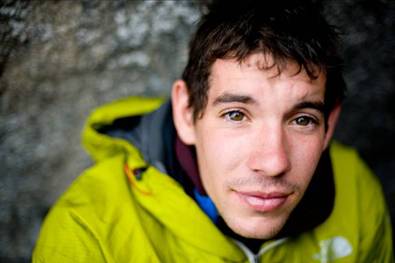
    Alex Honnold Portrait

    It’s not like Alex is unqualified to do what he does. He started climbing indoors at the age of 11 and was there 3 hours a day, 6 days a week honing the physical skills and mental fortitude required for such a demanding sport. At the age of 19, Honnold dropped out of his engineering courses at UC Berkeley to devote 100% of his time to rock climbing. By the time most of us heard about him, he had completed more than 1,000 free solo climbs.

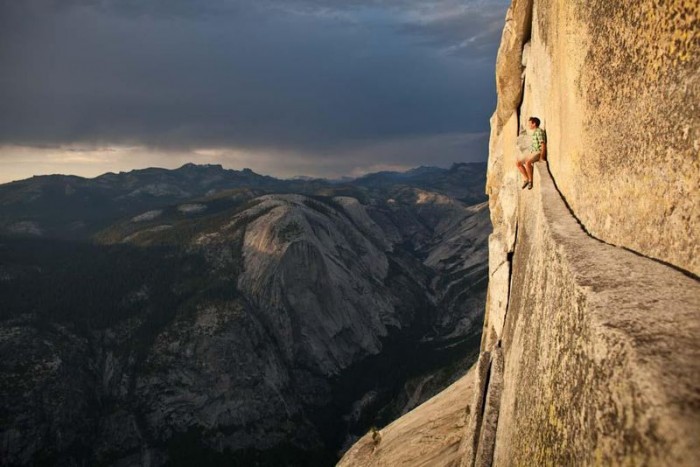
    His toughest climb to date, featured in the film Alone on the Wall, was a free solo ascent of the northwest face of Half Dome, a 2,000 foot granite behemoth in Yosemite National Park.

    [images via Wikipedia and National Geographic]

  • RIP Antoine Montant, French Extreme Sports Star

    RIP Antoine Montant, French Extreme Sports Star

    The extreme sports community lost one of its own this week.

    Antoine Montant, a French extreme sports star, was killed in a tragic accident in the French Alps, where he was BASE jumping. Local police found his body on Sunday and are investigating additional details.

    Antoine Montant grew up just outside the French Alps and is one of those guys who learned to ski as soon as he could walk. At age nine, Montant learned how to paraglide from his older brother Valéry, an experienced hanggliding and paragliding pilot that helped pioneer the sport of speed flying — paragliding with skis down steep, snowy slopes. Valéry was killed in an accident in 2006.

    Montant was a certified instructor in skiing and paragliding and certainly one of the world’s top athletes in both sports. He was an avid extreme skiier, BASE jumper and speed flyer.

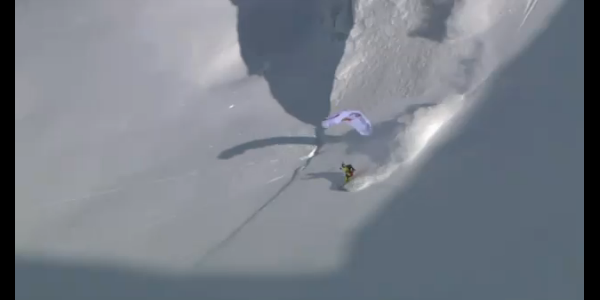
    To give you an example of what Antoine Montant could do, below is a clip of the first-ever speed flight along the cables of Chamonix’s old cable car:

    [youtube id=”_yKU03F1f2A” width=”600″ height=”350″]

    Nerve Rush HQ’s thoughts are with Antoine Montant’s friends and family.

  • Inside the Red Bull Flugtag

    Inside the Red Bull Flugtag

    So, you drink Red Bull, the nectar of the adrenaline gods.

    But have you heard of the Red Bull Flugtag? “Red Bull gives you wings” takes on a whole new meaning. Flugtag, German for “airshow” or “flight day,” is a Red Bull annual event where competitors launch homemade human-powered flying machines off a 30ft high platform into a body of water.

    The vast majority of these flying contraptions don’t fly more than a few feet from the platform. The event is mostly for entertainment and show—a promotional event for Red Bull more than anything else.

    Here are a few images of the event, taken in my hometown of Nashville, Tennessee back in 2007.
    Red Bull Flugtag NashvilleRed Bull Flugtag Nashville 2Red Bull Flugtag Nashville 3

    Red Bull Flugtag History and Rules

    Brainchild of Red Bull owner and billionaire Dietrick Mateschitz (he holds 49% of the company’s shares), the Red Bull Flugtag started in Vienna, Austria in 1991. Due to its success, it has been held every year since and also in over 35 cities around the world.

    Anyone is eligible to compete in the event—to participate, each team must submit an application, and their homemade contraption must meet Red Bull’s event criteria. In the United States, for example, each flying machine must have a maximum wingspan of 30 feet and a maximum weight of 450 lbs.

    Ultimately powered by “muscle, gravity and imagination,” the aircraft ultimately end up the water, so they must not have any loose parts and must be constructed with eco-friendly materials.

    Teams are judged in three categories: distance, creativity and showmanship. Back in 2007, I witnessed the U.S. record for the longest flight in Nashville, Tennessee. Today, that record is held by team “Major Trouble and The Dirty Dixies,” who flew 207 feet in St. Paul, Minnesota in front of more than 90,000 people in 2010.

    Bottom line, if you ever have the chance to attend a Red Bull Flugtag event, go for it. You’ll laugh, you’ll be energized and you’ll walk away with a whole new appreciation for gut-wrenching adrenaline, something we at the Nerve Rush HQ value highly.

  • Reporting Live: 2011 Reel Rock Film Tour

    Reporting Live: 2011 Reel Rock Film Tour

    A few weeks ago, Nerve Rush HQ received an email:

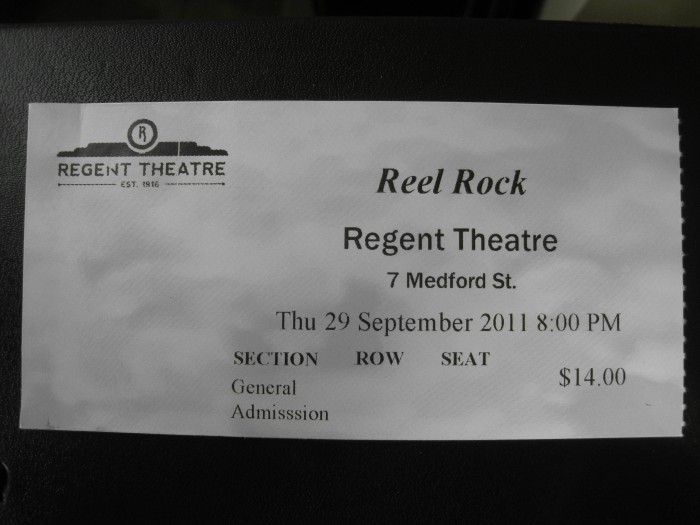
    I bought two tickets to the Reel Rock Film Tour…The six movies being shown look incredible.

    I hopped on over to the website and found this trailer:

    Boom goes the dynamite–I was in. Waiting in line, I realized I should have gotten there earlier. The theater was packed.

    Reel Rock Film Tour 2011 line

    History of the Reel Rock Film Tour

    The first Reel Rock film tour premiered in 2006 in Boulder, Colorado, featuring two new climbing movies. Founded by Josh Lowell and Peter Mortimer, both who have been producing and directing adventure films for more than a decade, the Reel Rock film tour is organized annually and promotes films about rock and ice climbing, mountaineering, BASE jumping and other adventurous mountain sports. The tours often include gear raffles, athlete appearances and signings and fundraising for non-profit organizations. The tour is put on by Sender Films and Big Up Productions, who team up with North Face and Windstopper as primary sponsors.

    Reel Rock Film Tour 2011

    Reel Rock Film Tour 2011 screen

    This year, the 6th annual film tour kicked off with two winners from a filmmaking competition. The judges picked one winner, and online votes (or “the people”) chose the other winner.

    The judges choice, “Crash Pad Test Facility,” featured a comical sequence of tough situations, all of which were handled miraculously by the bouldering crash pad. The people’s choice, “The Climber Kid,” was a climbing parody of The Karate Kid.

    There were six other films:

    Ice Evolution
    A beautiful film shot at British Columbia’s Helmcken Falls, maniac ice climber Will Gadd, a 30+ year veteran to the sport, shows us his dream climb–a heinously difficult but perfectly aesthetic overhanging climb behind a waterfall. Gadd and Tim Emmett dodge 30 foot icicly bombs and climb undoubtedly the hardest pure ice climb in the world. My favorite part of the film? When Gadd and Emmett used a metal detector to hunt down ice-covered bolts from the previous season. It was hilarious.

    Cold
    “What the fuck am I doing here? We have to get down.” Over the past 26 years, 16 expeditions have tried and failed to climb Gasherbrum II, one of Pakistan’s highest peaks (over 8,000 meters), in the winter. In February 2011, Simone Moro, Denis Urubko, and Corey Richards became the first to achieve this goal, surviving -50 degree temperatures and a massive avalanche. In this first-person look at modern super-alpinism, Richards captured both the glory and pain of the trip.

    Project Dawn Wall
    Tommy Caldwell, one of the world’s best rock climbers, has devoted the last decade of his life to opening free climbing routes on Yosemite’s El Capitan. Three seasons into his ultimate project–the seemingly impossible Dawn Wall–Tommy documents his first big ground-up push, showing us pitch after pitch of 5.14 first ascents. Eventually, an epic storm shuts the team down for the season, but boy did they come back with some nutty footage–imagine what it looks like to sleep on a completely vertical face. Ever heard of a portaledge?

    Origins: Obe & Ashima
    One of the more inspiring adventure films I’ve seen, Obe & Ashima profiles nine-year old Ashima Shiraishi, a New York City bouldering prodigy under the tutelage of her passionate coach, Obe Carrion, a former professional. In part of the film, they head to Hueco Tanks, TX, seeking out the highest concentration of boulder problems in the U.S., where Ashima tears it apart. After climbing the notoriously difficult V12 Martini Right, Obe says to Ashima, “This is how psyched feels.”

    Race for the Nose
    It’s the wildest competition known to man, the speed record on the Nose route of Yosemite’s El Capitan. For 50+ years, the world’s best climbers have been one-upping each other, racing up 3,000 feet of vertical granite rock in under 3 hours, risking life and limb to shave mere seconds from the climb. In this film, we follow Dean Potter and Sean Leary, who duke it out with other teams for rock climbing’s ultimate prize.

    Sketchy Andy / Slacklife
    Andy Lewis is a nutty guy who, among other hobbies, enjoys BASE jumping, naked slacklining and aerial “trick-lining.” This film showcases someone who is pushing the limits–some might think too far–with some pretty gnarly feats. Below are some highlights, not from the film tour, of Andy’s best.
  • The World’s 10 Most Dangerous (and Extreme) Sports

    The World’s 10 Most Dangerous (and Extreme) Sports

    From TermLifeInsurance.org:

    Defining the world’s most dangerous sports remains a tricky subject, mainly due to limited data and a reluctance among organizers and participants to publicize deaths in their sport.

    If an activity involves being exposed to the elements of using special equipment on an inherently incontrollable and unpredictable environment, we’re classifying it as a dangerous sport.

    Here are ten of the most dangerous:

    The World's Most Dangerous (and Extreme) Sports

    I discovered this infographic when researching the world’s most dangerous and extreme sports. I’m not sure when it was put together, or how the numbers were culled, but regardless of the validity of the data, it’s an interesting list to think about.

    A lot of thought put into this, but I wouldn’t necessarily agree with the list. White water rafting? BMX? What about mountaineering, or free-climbing? The latter is particularly daunting.

    What do you think?


  • Cliff Jumping at a Granite Quarry

    Cliff Jumping at a Granite Quarry

    Oh, granite, how I love thee.

    Prized by rock climbers for its steepness, soundness and crack systems–some of the best rock climbing spots in the world, like Yosemite, the Mont Blanc Massif and parts of the Karakoram are granite climbs–granite is also good for cliff jumping.

    Many of New England’s abandoned granite quarries fill with rain and groundwater and become lakes. Others are converted into landfills. Some, like Boston’s Quincy Quarries Reservation, are filled in and become popular rock climbing spots.

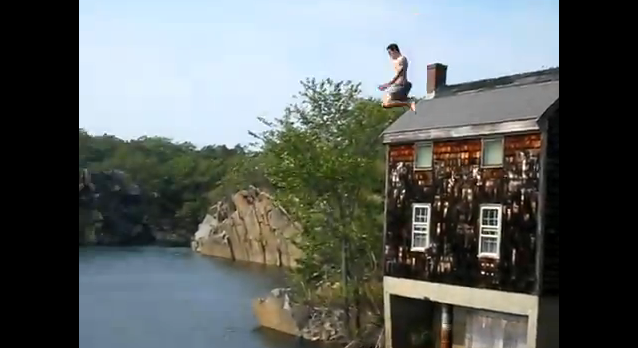
    On Labor Day, I traveled outside of Boston to a top-secret granite quarry with a few friends. The day was perfect, the water deep, the sandwiches delectable to the palate. And there wasn’t another person in site, an ideal setting to goof off, swim around and document the day with picture and video.

    One of the highest jumps is around 35 ft. and has one of the clearest water exits I’ve ever seen. This is me running and jumping:

    [youtube id=”4vm6BI39T4M” width=”600″ height=”350″]

    My friend David, more daring than I, decided to show me up with a front flip. Thanks, bro:

    [youtube id=”Fk6pt4NLtQM” width=”600″ height=”350″]

    Going to try to make it out there one more time before the New England weather begins to turn.

    Any takers?

  • It’s Official, Nerve Rush has Launched

    It’s Official, Nerve Rush has Launched

    It’s official. We’re live.

    Here, deep in the trenches at the Nerve Rush headquarters, we’re focusing our efforts on one thing, and one thing alone:

    Gut-wrenching adventure.

    Syndicating videos, publishing interviews with extreme athletes, profiling endurance races and obstacle courses, detailed how-to guides–we’re here to make sure you get your proper dose of adrenaline.

    We’re not sure what this ride will look like, but we imagine it’ll feel something like this:

    https://vimeo.com/29017795

    With all of the amazing sites throughout the vast superhighway of the Interwebs, we appreciate your attention.

    From time to time, we’ll jump in to let you know what’s going on, but in the meantime, have fun, poke around, and get comfortable. It’s going to get wild over here.

  • Bossaball, the World’s Newest Extreme Sport

    Bossaball, the World’s Newest Extreme Sport

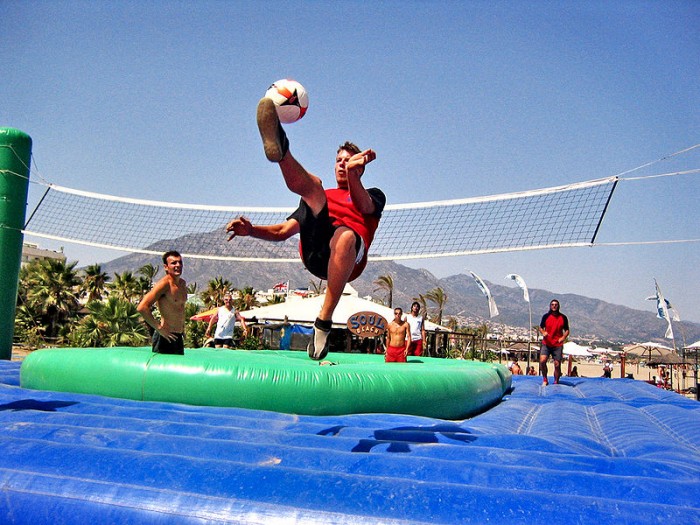
    Introducing Bossaball, a delicate mélange of volleyball, soccer, gymnastics, capoeira and extreme trampolining.

    Developed between 2003 and 2005 by Filip Eyckmans, Bossaball is played on an inflatable court that takes less than 45 minutes to set up. The inflatable playing surface and change in gravity allow for a range of techniques, team tactics and strategies.

    Eyckmans, a Belgian living in Spain, grew up playing tennis for the Belgian national team. Off-court, he assisted live soccer matches and DJ’ed private parties.

    In the early nineties, he was traveling in Brazil as a band manager and became fascinated with capoeria, the Afro-Brazilian, half-martial arts, half-dance phenomenon. Eyckmans ultimately developed Bossaball, the ultimate combination of flexibility, agility, coordination and sport.

    Bossaball clubs are popping up all over the world. So far, you can find them in countries like Brazil, Germany, Netherlands, Portgual, Singapore, Ecuador and Saudi Arabia. The most famous club teams, the Selection of Spain and the Selection of Brazil, travel the world to promote the game and perform Bossaball exhibitions.

    Bossaball Court

    How to Play Bossaball

    Each team consists of three to five players on each side of the Bossaball net. One player, called the attacker, stands on the trampoline. Similar to volleyball, one team serves up the ball over the net, with the intention of landing the ball on the opposing teams inflatable surface or trampoline surface. The defending team must not use a combination of more than six (or eight?) contacts with the ball to return it over the net. Any body part can be used, with a maximum of two successive contacts with the head or feet and a maximum of one contact with the hands. Get creative, folks.

    During a rally, the one attacker jumps on the trampoline in order to gain height, trying to position him or herself while one of the other players aims the ball’s trajectory at just the optimal height. It’s one of those sports you have to see to believe.

    The rally continues until the ball drops in one of the scoring zones. Three points for a drop on the trampoline, and one point for a drop on the larger inflatable area. The team that scored gets to serve again, and the same server is used. When possession rotates–when the defensive team wins the point–the team is rotated to feature a new server, similar to volleyball.

    The game continues until one team scores 25 points and is two points ahead. In one Bossaball match, it’s best two out of three games, or sets.

    For more information, check out the official Bossaball site, Bossaball Sports. Have any of you tried playing?