Category: Blog

  • An Anatomically Correct Nut Tool for Climbers

    Just last week, a new climbing tool was launched on Kickstarter, and it’s causing quite a stir in the climber community. Dick’s Nut Tool is a nature-inspired nut tool designed in Portland, Ore., for crushers who want to send hard.

    What’s a Nut Tool?

    First used by British climbers in the 1950s, “nuts” are used to chock cracks for protection while climbing. Occasionally, nuts get stuck, and the hooked tip of a “nut tool” is used to hammer them out.

    Made of stainless steel 304, Dick’s has a Rockwell hardness of 70 and is almost twice as strong as aluminum, making it capable of busting out nuts in a multitude of shapes and sizes.

    The company was founded by Dick Cocksure in 2015, and recently, while ascending the rugged rocks of Lake Tahoe, Dick reflected on why he climbs and why he set out to revamp the nut tool:

    There’s just something magical about climbing, the way it stimulates so many parts of my body and brain at once. It leaves me totally awed.

    dicks-nut-tool

    Less than one week into the crowdfunding campaign, Dick and his team have raised almost 20% of their goal, and they’re absolutely delighted to see folks relishing the fruits of our labor.

    Campaign backer Andrew Traylor of Mountain Refugees writes:

    As a diehard old-school traddy, I’m naturally disgruntled by any new innovation in climbing technology. It just chafes me the wrong way, like a pair of cotton undies after a week in the Winds. So when I saw Dick’s new sparkly thing, I was pissed. How dare he make improvements to a product that already exists? Does he not understand that the initial form of any device is the most true and pure form achievable?

    The only thing that allowed me to even touch the damn thing was his encouragement of placing nuts. The more nuts, the better in my book. So I reluctantly took hold of this crack-probing implement and took it for a spin. To my surprise, it fulfilled my needs — my nuts have never moved so quickly! I’m happy to report its aid in removing hexes, wooden chocks, and stashed ham sandwiches from various fissures. I no longer cringe seeing Mr. Cocksure’s device swinging be- low my swami belt. I’ve decided that I’ll let it stay on my rack, for now.

    Echoing Andrew’s enthusiasm, A. Osborn writes from Portland, Ore.,

    I was following this off-width, really giving it all I had. It was way out of my league, but my leader was a babe, and I didn’t want to disappoint. So, was playing it real cool. Everyone knows that good protection is key to any tight spot. She was plugging a good mix, cams for days, but nuts too.

    I started feeling good, you know, in the rhythm. And like the hand of god smiting any chance of pride, a #10 BD nut was good ’n stuck. Fixed. My feeble hands quickly resigned their fate. I meekly called for a take.

    The good news was I had my nut tool. Dick’s Nut Tool, ergonomically designed just for such oc- casions. I grabbed my tool by the balls and set that nut free without so much as a second thought. Protection is key, but the tool is just as important.

    Lol. Check out the tool here.

  • Meet Motorsport Legend, Ricky Johnson [Infographic]

    Meet Motorsport Legend, Ricky Johnson [Infographic]

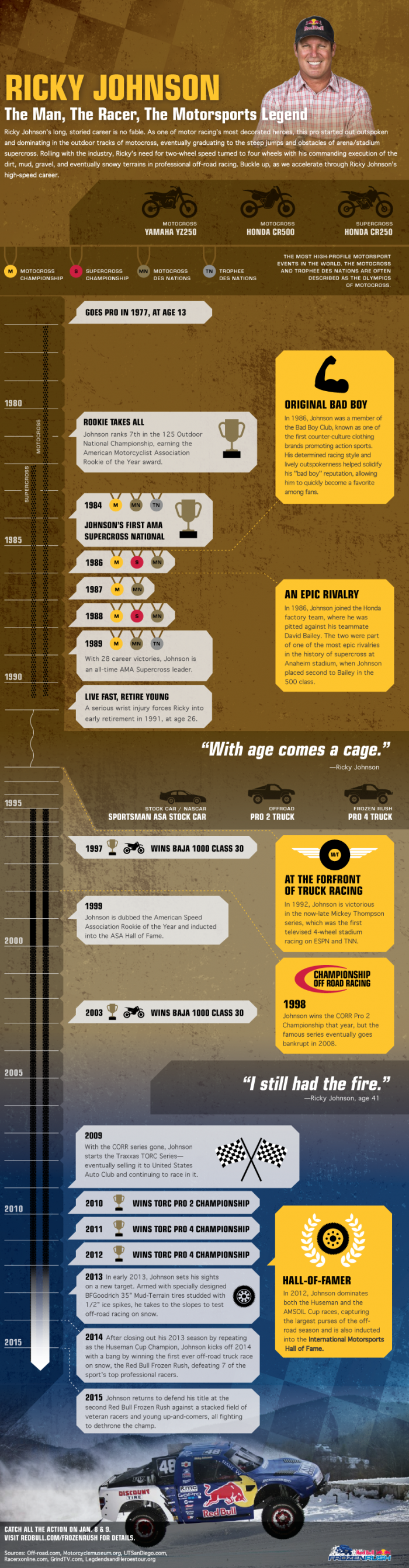
    Red Bull Frozen Rush, the world’s only off-road truck race on snow, is returning to the slopes of Sunday River Resort, Maine, January 9, 2015.

    In the race, 900-horsepower Pro4 trucks will compete head-to-head, side-by-side, on the snow…for the first time ever.

    Motorsport legend, Ricky Johnson, won the race last year and will lead the cast of all-star professional racers from around the country in a couple of months.

    Below is an infographic that highlights Johnson’s career. Prettttttty awesome.

    Red Bull Frozen Rush Ricky Johnson

    Share this Image On Your Site

  • 5 of the Most Extreme (Ancient) Sports

    5 of the Most Extreme (Ancient) Sports

    Those of us who spend most of our waking hours in a cubicle or other equally ordinary environment seek our own types of thrills – whether it’s an adrenaline-pumping outdoor adventure or the latest crazy food fad. But even before the advent of office jobs and Cronuts, the oldest earth dwellers also found unique ways of living – or in some cases dying – on the edge. Their inventions eventually gave rise to many of the adventure sports we know and love today. Here are five of the most extreme ancient sports you’ve probably never heard of.

    5 of the Most Extreme Ancient Sports

    LAND DIVING

    If you think bungee jumping is extreme, try diving head-first off a wooden tower with nothing but two tree vines tied around your ankles.

    On Pentecost Island in the South Pacific, the Vanautu tribes’ gravity-defying ritual to bless the annual yam harvest gave rise to modern-day bungee jumping. But land diving, or naghol, doesn’t offer the luxury of elastic ropes or safety equipment. Boys jump from the lowest level – still two stories high – as a rite of passage, while the most experienced men dive from as high as 100 feet. But the height alone isn’t what makes naghol extreme. The divers’ heads must brush the ground in order to bless the yams. If their vines were cut properly, they’ll just scrape the ground before bouncing back up. But an error of even four inches will cost them their lives.

    Naghol is still practiced today and even draws tourists – to watch, that is. Foreigners are barred from trying this dangerous sport. Famously, Queen Elizabeth II saw a naghol diver die when she visited the island in 1974.

    http://youtu.be/MdmbkeJe6zo

    SHEPHERD’S LEAP

    So, you’ve heard of pole vaulting. Now imagine vaulting yourself across rugged volcanic ravines and down steep cliffs as you follow your goat herd or try to outsmart the Spanish conquistadors who’ve come to take your turf.

    For the ancient inhabitants of the Canary Islands – and especially goat shepherds – Salto del Pastor (Shepherd’s Leap) was not only a dangerous sport but also a clever mode of transportation. The sport involves a wooden pole ranging from 6- to 13-feet in length with a sharp metal tip. Gripping the top of the pole, the Canarians would aim the tip toward the ground in front of them and leap for dear life, sliding down it for a hopefully safe landing. Skilled leapers could jump even farther than the length of the pole, up to 26 feet based on some accounts. Worry not – you can also Salto del Pastor your way back up a cliff.

    This sport is so risky that it’s surrounded by romantic legends like “Lover’s Leap” and “Half-Moon Leap.” Today, it’s mainly practiced for fun or competition.

    http://youtu.be/-P0t3uAyp5E

    HAWAIIAN LAVA SLEDDING

    Belly-racing or surfing down steep mountain slopes on a 12 foot-long, 6 inch-wide sled, Hawaiian elites – the original he’e holua riders – once risked their lives to honor Pele, the goddess who created the islands with fire.

    “At the same time we feared her wrath we also worshiped her or at times challenged her by riding down the steep hardened lava slopes to prove we could overcome her anger,” says Tom Stone, a university lecturer and expert sledder from the Big Island who is reviving the 2,000-year-old sport. “Most times we lost.”

    Today there are nearly 100 active riders who surf down natural or manmade courses Stone likens to ocean waves. He’s uncovered over 50 courses, “including a monster on the western shore of Hawaii that was once 60 feet wide and 5,200 feet long,” according to Outside magazine. Capable of speeding up to 50 miles an hour, he’e holua is not a sport to try at home!

    http://youtu.be/i2qCXB78bkc

    SENAGALESE WRESTLING

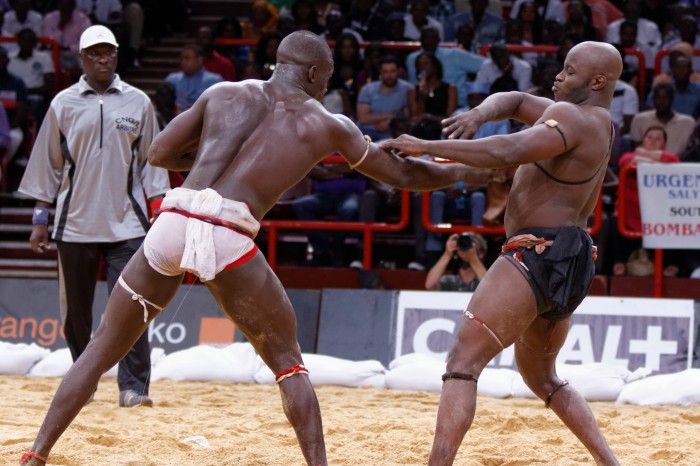
    Centuries ago, Senagalese fishermen and farmers would wrestle for fun, to defend their village’s honor or even to win crops. Since then, laamb, as it’s called in Wolof, has become so popular it’s even replaced soccer as the country’s favorite spectator sport. The best fighters are A-list celebrities and can rake in as much as $100,000 per match.

    Unlike other forms of West African wrestling – and most sports in the rest of the world, for that matter – laamb sometimes allows bare-fisted punches. The first fighter to put his opponent’s head, back or both hands and feet on the ground wins.

    Laamb has held onto many of its rituals throughout the years. Fighters still wear magical talismans called gris-gris or jujus, and before even stepping into the dirt ring, they meet with a shaman, perform ritualistic dances and use protective baths. “The gris-gris and baths are just for protection against negative tongues and eyes,” explains Mbaye Gueye Dieng, a spiritual guide, in a New York Times article.

    Lutte_sénégalaise_Bercy_2013_-_Mame_Balla-Pape_Mor_Lô_-_27

    MESOAMERICAN BALLGAME

    The first ball game in history may have emerged in Mesoamerica over 3,500 years ago. But this wasn’t your average game of catch – historians believe it was a matter of life or death.

    “The ballgame was a fast and dangerous sport played with a heavy ball that could break bones – or even kill,” according to the Mint Museum of Art. More than just a sport, the game symbolized a battle between the gods and demons, and the 8- or 9-pound rubber ball represented the sun. The exact rules are unknown, but the idea was for two teams of up to five players to keep the ball in play, and perhaps dunk it into a hoop, on an “I”-shaped course without using their hands. It was a great honor to win, but the losers? Evidence suggests the losing captain or even entire team would be sacrificed to the gods, sometimes by decapitation.

    Although Mesoamerican ballgame is an endangered sport, versions like ulama, where players hit the ball with their hips, are still played by indigenous peoples in parts of Mexico and Central America. Luckily for aficionados, the blood-spilling finale is believed to have died out back in the 1300s.

    Pok_ta_pok_ballgame_maya_indians_mexico_4

  • Top 15 (Ridiculous) Russian Dash-Cam Videos

    Top 15 (Ridiculous) Russian Dash-Cam Videos

    DOD-GS600-590x434

    Due to corrupt traffic police and a high percentage of accidents per capita, dash-cams have become nearly standard amongst Russian vehicles. These little cameras have been responsible capturing some of the most ridiculous traffic incidents you can find on the Internet. A search for “Russian dash-cam videos” in YouTube delivers thousands of gnarly dash-cam compilations, exposing first hand experiences of close calls and wild traffic incidents.

    We sifted through some of the most extreme videos to bring you our top 15.

    1) Driving Through a Tornado

    This Russian driver made the brave attempt to drive through an epic storm featuring a destructive tornado. The dash-cam video shows the storm in action and ultimately the aftermath of the tornado’s destruction.

    2) Dash-Cam Captures Flaming Meteor

    https://www.youtube.com/watch?v=sl_RknL9G-Q

    A parked car doesn’t usually see much action. That was not the case with this one! In a rare twist of events, this Russian dash-cam captured a flaming meteor flying through the night sky!

    3) Sorry Cows!

    https://www.youtube.com/watch?v=AzKoZqsDpYg

    In this insane Russian dash-cam video, a roofless tractor-trailer transporting about 30 cows tips over, sending the poor cows scattered across the street! Fortunately, it looks like everyone survived.

    4) Black Bear Get Off The Road!

    https://www.youtube.com/watch?v=AsaK6GGuTAk

    This dash-cam footage shows a head on collision with a huge bear as it tries to cross a Russian highway. Bears clearly need to look both ways before crossing too.

    5) Share The Road Please!

    https://www.youtube.com/watch?v=X3CnugkmWig

    This compilation of bicyclists getting hit by Russian cars is a gut-wrenching reminder that we need to share the road with cyclists!

    6) Watch Out – Landing Zone!

    https://www.youtube.com/watch?v=sj_wxdM-MQ4

    This extreme dash-cam video shows Russian drivers frantically trying to steer clear of debris as a plane crashes near the highway.

    7) Terrifying Motorcycle Collision

    https://www.youtube.com/watch?v=rQjM49zfg3Q

    Thankfully, everyone survived this extreme collision between a motorcyclist and motorist. The crash was caught on camera by three different dash-cams!

    8) Beware Of Ice

    This extreme video shows multiple Russian vehicles spinning out on black ice. Always remember to pump the breaks!

    9) Close Calls

    https://www.youtube.com/watch?v=vZlilgQM3wI

    Close calls make for great dash-cam videos because you can be sure everyone made it out alive! This compilation of close calls keeps you on the edge of your seat so you can take in all the ridiculous action and still have a clear conscience.

     10) Two Lane Highway Gets Turned Into a Makeshift Three Lane

    https://www.youtube.com/watch?v=At_PAhvQHLc

    Drivers on this Russian highway don’t seem to mind the white lines separating the two way street. It seems like pretty much everyone is weaving in and out of traffic and making up their own rules as they go along.

    11) The Closest Call

    https://www.youtube.com/watch?v=VYUPPybsaAQ

    This near-collision will have you breathing a sigh of relief as the two vehicles narrowly escape what would have been a major wreckage. 

    12) Car Flips on Tram Wire

    You would never expect to see a car flip over going below 20 MPH, that’s exactly what happened to this Russian driver. The car drove onto a cable tram wire and did an oddly slow back flip which was captured on a fellow motorist’s dash-cam!

    13) Casual Escape From Epic Crash

    This Russian truck driver narrowly escapes a fatal crash and then proceeds to casually get up and walk around. It’s extreme. It’s casual.

    14) Extreme Drivers Cross Floating/Sinking Bridge in Russia

    https://www.youtube.com/watch?v=ITlf6jYBEUk

    The fact that this bridge is mostly underwater did not stop some extreme Russian drivers from continuing to cross it, even after a car gets stuck and is basically sinking in the middle. Only in Russia.

    15) Lightening Strikes SUV

    https://www.youtube.com/watch?v=mpSAfp_kzKE

    Perhaps the most insane on the list. Watch as this SUV gets struck by lightening. And the driver continues driving!

  • NYC Action Sport Top-10 Bucket List

    NYC Action Sport Top-10 Bucket List

    Outdoor adventure and action sports doesn’t have to be reserved for hidden forests and secluded beaches in the middle of nowhere. City dwellers still need to get their adrenaline pumping too! NYC is filled with opportunities for thrill-seekers to get outside and move. Although we likely don’t cover everything the Big Apple has to offer, this list of 10 action sports for NYC residents (or visitors) is a great starting point for anyone looking to break out of the daily grind.

    1. Kayaking on the Hudson River

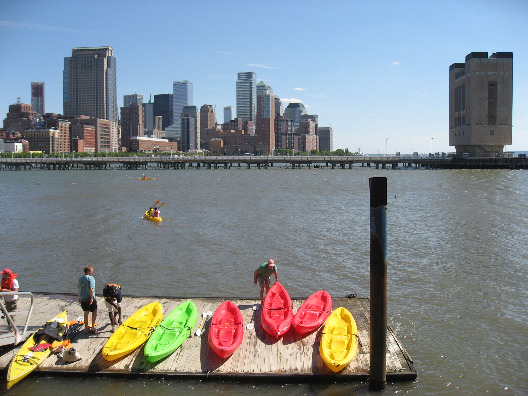
    Want to go kayaking but don’t have access to a lake or the ocean? No need because NYC’s non-profit Downtown Boathouse offers free kayaking on the Hudson River. This volunteer organization opens up the river in May to all shapes, sizes and levels  of experience to come out and enjoy a nice day out on the river every weekend until October. Oh, and did we mention that it’s completely FREE!? Check out any or all of their three locations at Pier 40, which is west of Houston Street, Pier 96, which is west of 56th Street and in Riverside Park at 72nd Street.

    10 action sports for nyc residents kayaking on the hudson river

    2. Bridge Running

    There are over 2,000 bridges in New York City. Although we’re not suggesting you go for a run across every single one of them (some don’t provide pedestrian foot paths), we can suggest a list of the top four bridges to incorporate into your Manhattan morning run.

    → Brooklyn Bridge

    As the most well-known bridge in the New York City Area, the Brooklyn Bridge definitely tops the list as one of the most trafficked bridges in the city. Despite the fact that you will have to deal with a lot of walkers and bikers, the Brooklyn Bridge provides a beautiful view of the Manhattan skyline to distract you during your run.

    10 action sports for nyc residents brooklyn bridge running

    → Manhattan Bridge

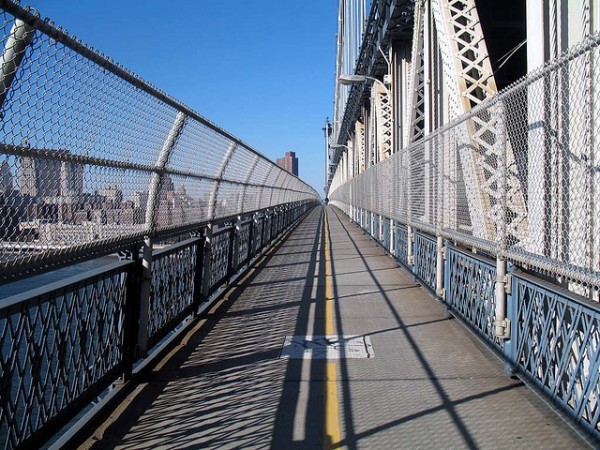
    The Manhattan Bridge is less trafficked than the more popular Brooklyn Bridge which means you’ll probably have an easier, less stressful time getting across. This bridge starts higher up than most other bridges in the area therefore providing a more gradual incline. The only downfall is the loud noise of the trains passing by, so just turn up the volume on your iPod and kick it in to the other side.

    10 action sports for nyc residents manhattan bridge running

    → Williamsburg Bridge

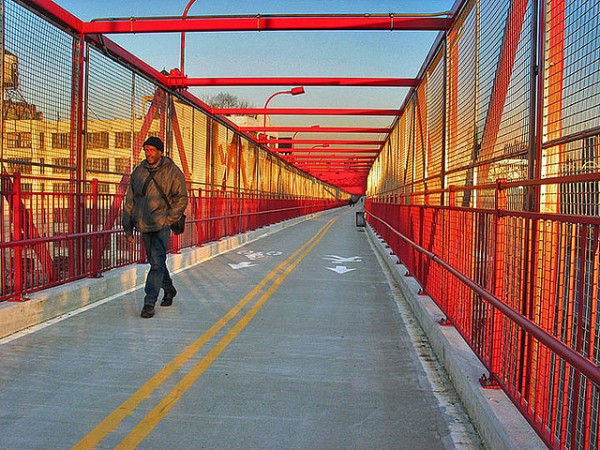
    As one of the most difficult bridges to get across, the Williamsburg Bridge stretches from Bedford Ave. to Delancey St. One of the great things about the Williamsburg Bridge is that for the majority of your run you won’t have to share space with bikers. The bridge is rather steep in both directions so it’s a great way to get in some hill workouts!

    10 action sports for nyc residents williamsburg bridge

    → George Washington Bridge

    Looking for a long bridge run? Head up to Washington Heights and take the George Washington Bridge over the Hudson River to Jersey! It’ll lead you straight to a park on the other side where you can either hang out and relax or keep running and explore. Either way, although the views from this bridge are not as delightful as the others on the list, you’ll definitely feel satisfied on your way back to the city from this long run.

    10 action sports for nyc residents george washington bridge

    3. Roller Blading the West Side Highway

    If you’re new to New York City, you’ll definitely want to check out the West Side Highway Bike Path. While you’re at it, bring your roller blades and soar down the 13-mile path from Battery Park to Fort Tryon Park!

    4. Biking in the Palisades

    Palisades Park is a 2,500 acre park located in Alpine, NJ just over the George Washington Bridge. This park offers 30 miles of hiking and ski trails, which are also great for biking. Getting here can be a hike in itself as you’ll have to cross over the GW Bridge and then head another 7.5 miles until you turn into the park. Nevertheless, biking through the Palisades Park is a great way to get away from the hustle and bustle of the city. For those who don’t own a bike, check out Metro Bicycles on West 96th St. and Master Bike Shop on West 72nd St. in the Upper West Side.

    10 action sports for nyc residents biking in the palisades

    5. Running in Central Park

    Hopefully you’re familiar with Central Park or you’ve at least heard of this NYC landmark. This is a great spot located right between the Upper East Side and the Upper West Side is a nice little getaway complete with a few miles worth of running and bike trails. The best times to run through here are weekdays from 10am to 3pm and 7pm to 10pm and weekends beginning at 7pm on Fridays. This park has a bunch of different loops of varying length to check out, which you can find on this nifty map of Central Park Trails. The largest loop cover just more than 6 miles.

    10 action sports for nyc residents central park

    6. Bouldering in Central Park

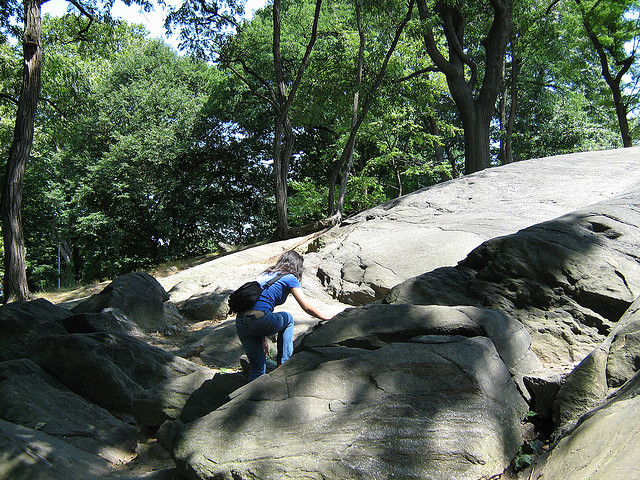
    Not really a fan of running? No problem. For rock climbing experts and beginners alike, you can get your fix right in the center of NYC in no place other than Central Park! In fact, well known 13-year old American rock climber Ashima Shiraishi has been known to climb here from time to time. Step foot on child prodigy bouldering soil and get in some awesome climbs right in Central Park.

    10 action sports for nyc residents bouldering in central park

    7. Hill Running in Washington Heights

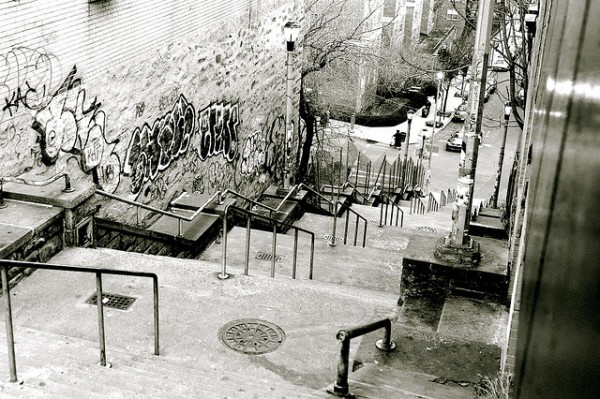
    Need to get in some hill training or just want to challenge yourself on a hard run through Washington Heights? Luckily the USATF has provided a nice hilly 2.5 mile run that starts on the corner of Fort Washington Ave and West 181st Street and ends by the Lissemore Music Studio. If you’re up for a good workout this run is a must! But if you want to switch up the route and add in a couple flights of steep steps, see if you can handle the staircase that runs from 187th and Fort Washington Ave to Bennett Ave (pictured below).

    10 action sports for nyc residents hill running in washington heights

    8. Run Up the Empire State Building

    Speaking of stair running, the Empire State Building Run-Up is an annual race up 1,576 steps to the top of the Empire State Building. This “vertical marathon” is the ultimate thigh-burner and will undoubtedly leave the winner, or anyone who tries their hand at this feat, feeling pretty good about themselves. The race is a great opportunity to raise money for charity but you have to apply well in advance as race entries are limited!

    10 action sports for nyc residents annual empire state building run up

    9. Scuba Diving with Pan Aqua Diving

    Let’s be real, when you think of New York City you don’t immediately picture yourself scuba diving. But, being the great city that New York is, you can not only picture yourself scuba diving, you can actually go scuba diving! There are a few options but one cool place to check out is Pan Aqua Diving located on West 43rd Street.

    10. Trapeze Flying with Trapeze School New York

    Clearly we saved the best for last, because who wouldn’t want to go trapeze flying in the middle of the city!? The Trapeze School New York has three locations. The outdoor facilities, which are open from May-October, are located in the South Street Seaport at Pier 16 and in Hudson River Park on the top of Pier 40. Their indoor location, which is open October-April, is located in the Circus Warehouse in Long Island City. TSNY offers classes and workshops for beginners and experts alike as well as the option to host parties on site.

  • 8 Best 2014 World Cup Commercials

    8 Best 2014 World Cup Commercials

    Every four years, the world pauses to watch the FIFA World Cup, a nationalism-infused display of the world’s best soccer (football) players. Just two days into the tournament, and we’ve  already seen questionable calls, amazing headers and heroic displays of endurance, agility, speed and coordination.

    There’s no better way to get amped up between matches than to watch a good ‘ole fashioned big brand World Cup commercial.

    Here are the best ones we’ve seen so far:

    McDonald’s: Gol!

    Regular folks doing awesome tricks. Nice soundtrack and a happy vibe from one of the world’s most recognized (and eaten!) brands.

    Adidas: House Match

    Zinedine Zidane and David Beckham face off indoors in this ad from Adidas.

    KIA: Adriana Lima

    For one month, let’s “all be futbol fans.” These short commercials from KIA feature Brazilian supermodel Adriana Lima.

    Nike: Winner Stays

    This is my favorite of my the bunch. In this commercial, featuring Brazil’s golden boy, Neymar, kids take on their favorite players. This is how I feel when I play the FIFA video game.

    Beats by Dre: The Game Before the Game

    Did you know that Lebron James made $30 million when Beats by Dre sold to Apple for $3.2 billion dollars? In this 5-minute long commercial from Beats by Dre, see how the world’s top athletes prepare themselves before the game. Get inspired. Get amped up. Get your head in the game.

    Nike: The Last Game

    In this much longer 5:28 spot from Nike, watch an animated Cristiano Ronaldo, Zlatan Ibrahimović, Neymar, Wayne Rooney and Tim Howard battle an army of perfect clones to save football. There’s no greater danger than playing it safe, folks.

    Hyundai: The Beginning

    “For all the football fans around the world, waiting for the World Cup, our journey has begun.” While this commercial feels a little stale in comparison to others on this list, it’s interesting to note that this was first released by Hyundai back in November 2013. Are there more Hyundai videos to come?

    Adidas: All in or Nothing

    Kanye West delivers the soundtrack in this short spot from Adidas, where the dreams are vivid and it’s time to go all in.

  • Chicago’s First Big Rock Climbing Gym Set to Open This Winter

    Chicago’s First Big Rock Climbing Gym Set to Open This Winter

    Chicago’s skyline towers over any hill within a several-hour-radius- not the ideal terrain for rock climbers. Countless yoga studios, weight rooms and pools clutter the third largest city in the country, enough to satisfy any athlete, with the exception of climbers. Outside of a handful of rock walls thrown into gyms as afterthoughts, and one solid, yet tiny, bouldering room, Chicago lacks an indoor rock climbing facility. As soon as Winter 2014, this will all change when First Ascent comes to the Windy City.


    I had a conversation with three climbers who are spearheading the new gym’s launch to find out details about what we can expect from First Ascent. CFO Joe Zentmyer’s heading the gym’s financial needs, while Dan Bartz is taking charge of most of the gym’s groundwork. Jon Shepard runs general business oversight and the legal side of First Ascent. All three are heavily involved in the climbing community, along with majority of the investors backing Chicago’s first big rock gym.

    First Ascent will reside on the north side of Chicago, north of Logan Square, near Avondale, at 3500 N. Spaulding Avenue.  The new gym will offer climbers 26,000 square feet of climbing, including a main wall and 5,000 square feet of bouldering. Climbers will have the opportunities to lead, sport climb and top rope, and a fitness center featuring weights and cardio machines will be available for cross training. First Ascent will even save space for a yoga studio, where climbers can stretch and strengthen. An added café and locker rooms with showers will give work commuters somewhere to climb and freshen up before or after work.

    “There will be lots of climbing surface,” said Shepard. “With anything from beginner terrain to expert, overhanging and lead terrain.” Shepard said that it is especially exciting for all of those who head down to the Red River Gorge, the best close climbing to Chicago (and close, meaning 400 plus miles). Many at the Red encounter trouble sending new routes because of their lack of training space options. First Ascent will give those dedicated climbers a spot to train for their next big projects during the workweek.

    While First Ascent’s steep climbs and advanced bouldering will cater to the elite climbers, the First Ascent team also hopes to draw in beginners and everyone in between. Classes in safety, technique and outdoor climbing will be offered, as the First Ascent team, especially Bartz, a Teach for America alum, highly values education within the sport.

    The team behind First Ascent is also interested in expanding competition climbing in Chicago. While elite climbing competitions have gained more media hype in recent years, there aren’t as many competitive opportunities for average climbers. The opening of a large rock gym, like First Ascent, could bring attention to Chicago as a mecca for this type of climbing competition, with the potential to grow the climbing community in the Midwest.

    “The Chicago climbing community is extremely unique,” said Bartz. “Because we live so far away from real rock, you really have to be dedicated to the sport, so there’s a really supportive network here. Everyone’s down-to-earth. It’s kind of that Midwestern charm that you get a little bit too.” Bartz expects First Ascent to work with that community and grow it, giving climbing access to those who just don’t have it right now. He also hopes it will unite a currently fragmented community, divided between small gyms scattered throughout the city. “We’re excited to have a place where everyone can climb together and allow people from different climbing pockets to come together, meet each other and get psyched up for their next project,” said Bartz.

    So why has it taken so long for a solid rock gym to make it to Chicago? According to Zentmyer, it’s really tough to build one in the Chicago area. It’s challenging to find the right location and real estate situation for a building as big as a climbing gym requires, not to mention the funding to back it. A location change, moving First Ascent from the South Loop to the Logan Square/Avondale location also slowed down the project, but with the kinks worked out, the gym should be up and open this coming winter. The First Ascent team members attribute a large portion of their success to sourcing themselves directly from Chicago, the city they’re building in, surrounding themselves with the climbers for whom they’re building First Ascent.

    Rock climbers in the Windy City anxiously await the long overdue arrival of a large rock gym, like First Ascent, pulling with it the potential to put Chicago on the map in the rock climbing world.


    Photo courtesy of Walltopia

  • 5 Apps No Adventurer Should Be Without

    5 Apps No Adventurer Should Be Without

    In August, I loaded up my car with climbing gear, hiking boots, my new tent, my old, beat-up sleeping bag, my recently shaved dog and everything in between. We spent the better part of the last month road tripping from Myrtle Beach, north along the East Coast to Quebec, west to Montreal and back down south, along the Appalachian Trail. After three solid weeks on the road, I’ve come to appreciate my smartphone’s knowledge of the weather, sense of direction and ability to Google, “free camping [insert state here].” I also downloaded an embarrassing amount of iPhone apps throughout my trek. Here are the five I found most useful, that no adventurer should be without:

    AllTrails
    Price: Free

    AllTrails is the best hiking app on the market. Users vote on, review and contribute pictures from various hikes. Think of it as the Yelp! of hiking. With a wide variety of trails across the country, paths range from easy to difficult (and trust me, they mean difficult- many of the tougher climbs require technical climbing). Both mountain bike and hiking trails are featured, but hiking definitely dominates most of the database. The app features length, type of trail and all kinds of details, like if you should bring your dog or not. The best part is the option to search for trails around you, making AllTrails perfect for road trips and even discovering new hikes near home.

    Fishing Spots
    Price: Free

    This is awesome for finding good fishing spots nearby and what kind of fish users are catching. Users share tips for snagging the biggest catches in the area and demonstrate what type of bait to use. As far as apps go, it’s a bit on the excited side of notifications, but the information is incredibly useful and I’d highly suggest using this app if you’re looking for a new fishing spot.

    Slow Shutter Cam
    Price: $0.99

    Slow Shutter Cam’s simple to use and perfect for capturing starry night shots from your iPhone.

    Launch Sites
    Price: Free

    Those who travel with boats will love Launch Sites. It shows spots to launch kayaks, canoes and paddle boards all over the country. It has an extensive selection of over 17,000 launch sites across the U.S. Plus, fellow users report any fees, facilities and overall reviews of the launches.

    Woodall’s
    Price: Free

    Those desperate for a place to pitch their tent need look no further than Woodall’s iPhone app. Don’t let the name scare you. Although Woodall’s is primarily meant for RVs, there’s plenty of information about tent pitching too. Users filter their results based on location, pet availability and swimming sites. My only complaint is that most of the sites are in the $20+-range. I’d suggest checking out www.freecampsites.net before looking on the app, but it’s great in a pinch.

  • DIY Downhill Off Road Skates

    DIY Downhill Off Road Skates

    This is a guest post from Jyles who, in his spare time, built his own off road skates. Take it away Jyles.

    Have you ever wanted to try a new extreme sport and can’t, or you don’t want to spend the thousands of dollars these sports seem to cost?  I have. In fact, I have those feelings all the time. So, here are my efforts, in the spirit of Z-boys of Dogtown (D.I.Y. skateboarders), to create my own version of a summer downhill skiing experience.

    I love skiing, I will happily ski everyday in the winter. I ski the first 1 inch dusting in fall and I ski the highest elevations till late spring. I wish I could ski year round…. One day I thought why not? There’s got to be a product out there for that purpose. I’d heard of the road skis for practicing cross country skiing, but the wheels are tiny and there’s no way they’d survive a cliff drop. After pouring over the web I found great opportunities for All Terrain Boarding (Snowboarding in summer), but there’s little out there for skiers.

    Here’s what I learned

    Summertime downhill skiing isn’t a completely new concept. It’s been around a couple decades. It hasn’t gained a lot of popularity, equipment is hard to come by, and impossible to rent for a day to see if you like it.

    The 4 most impressive models for summertime downhill skiing I saw online were:

    1. Grass Skis 

    grasskiusa.com

    A track, like a tank tread, is under each foot. My problem with these is the need for a very smooth skiing surface. You can’t go off piste. I like that you wear regular ski boots. Oh yeah… no brakes!

    2. Coyote Rollerblades

    Three 6 inch wheels per foot, solid boots, and the Rollerblade brand name to back them up, however they aren’t manufactured anymore and are hard to find.

    3. Gate Skates

    skates.com/Off-road-skate-p/21lg.htm

    Two 8 inch wheels per ski spaced about 2 1/2 feet apart. These look to be better suited for bumpy terrain, but have limited ability to turn, wheel base is too far apart. Strapping right in with sneakers seems to be questionable for stability. Comes with brakes.

    4. Terrablades

    terrablades.com

    Four 7.5 inch wheels per ski, mounted inline. These seem to match my needs exactly. Big wheels for bumpy terrain, ski boot mounts, tighter wheel configuration for better turning, and brakes.  The company is 1500 miles away so I couldn’t test a pair before buying. Starting at $850.00 seems reasonable, but I wasn’t prepared to make a purchase without testing first.

    I was pumped.

    I’m a carpenter and have a decent amount of tools, so why not build a pair myself?

    I decided to try building the 2 wheel per ski design and just buy more wheels and modify the design later if I wanted to add wheels. I scoured the internet for cheap 8 inch pneumatic wheels and found replacement wheels for a dolly, $20 each with bearings. 4 wheels $80. Perfect.

    When the wheels came in the mail, I went to my favorite hardware store. This hardware store has everything, its been in one family for 60 years, the floor has never been swept and the store is so disorganized and packed full you have to turn sideways to get through some of the aisles. I spent a few hours in the basement digging through stuff till I found what I needed to build the base for the skis.

    3/4 inch 3 sided square aluminum channel and a handful of nuts and bolts.

    I grabbed a 3/4 inch by 3.5 hardwood board and made a 2 foot base to mount ski bindings. I sandwiched the wood with the aluminum channel so it ran past 6 inches on each end. Drilled holes in the aluminum, put in the bolts for axles and added wheels. Add a few wood screws to hold it all together and viola. What could go wrong?

    I headed out to a small hill on a dirt road for my first test.

    I immediately realized that I have to physically lift my feet to change direction, no pivoting on that wheel base. The ride was nice and smooth but it felt nothing like skiing.

    [youtube id=”eIuS8m0trjM” width=”600″ height=”350″]

    Next test I went to an abandoned ski resort near my house and tried riding the jeep trail that zig-zags to the top. I rode the bottom for a little while with out much trouble. I was actually starting to get the hang of stepping each turn. I headed up to the top where it gets a little steeper and bumpier and that’s where it all went downhill. Pun intended.

    The first part is fairly steep and there is loose gravel, I was very nervous and came up with an emergency stop plan. Jump and turn so I slide sideways. I took a few deep breaths and headed down. I was going uncomfortably fast in about three seconds, so I pull the emergency brake plan. It worked beautifully…. but the aluminum channel twisted from the sideways pressure and my wheels now faced the wrong direction…. it was a long disappointing walk down. Upon further inspection I find that the wood started to split along the grain where the aluminum was attached.

    Back to the drawing board.

    I need materials strong enough a to handle my demands. I want to rip it up! I could go rollerblading if I want to have a gentle ride on smooth surfaces, but no, I want to ride anything a mountain bike can, and I want to do it fast and with at least some control.

    I head back to the hardware store and dig through more boxes, drawers and barrels. I find hollow square steel rods and I find barn door hinges and $100 later I’m headed home to build version 2. Unfortunately version 2 looked way cooler than it actually functioned. The changes from version 1 are:

    • The hardwood became two layers of 1/2 pressure treated plywood
    • The aluminum became steel and only stuck out in the front to catch the front wheel
    • The rear wheel was set up as a swivel wheel and was supposed to allow me to shift my weight and steer.
    • The weight doubled
    • They looked awesome

    I spent hours getting everything just right. I shaped metal, sanded down the edges of the plywood, I even rounded the edges of anything metal to avoid sharp edges. Everything was precise and exactly how I envisioned it, however… Version 2 never hit the slopes. My first trials on the gently sloping dirt road were complete failures. I had no control and they weighed a ton.

    I gave up during ski season, I was too busy.

    Ski season ended in May and I jumped right into version 3. I gave up on the two wheel per ski design and concentrated on making a light weight but sturdy 4 wheel per ski design. I read everything I could about the Terrablades, I studied the pictures on the website and decided I could basically copy those.

    I needed more wheels and I needed to get lighter wheels. The dolly wheels could bear 250 pounds per wheel and were very solid, but they weighed a lot.

    I considered buying 7 or 8 inch pneumatic wheels but decided on 4 1/2 inch solid wheels intended for skateboards. $90 for 8 wheels and bearings. The larger wheels were triple the price.

    I went back to the hardware store and got more hollow square steel and the right size bolts to use for wheels axles, as well as some nylon spacers to hold wheels in one spot and a few more bolts to hold a plywood deck on to the square steel frame. $75

    The basic design per ski is:

    • Two pieces of steel set parallel.
    • Holes are drilled in the steel to allow an axle though and 4 wheels are set between the two pieces of steel.
    • Risers come up out of the steel and hold up a simple plywood base with the ski binding mounted to it. The ply wood is just a half inch above the wheels.
    • Everything is braced and triangulated for maximum stability and to ensure that the ski responds to my movements.

    I switched to a lighter ski boot binding (snow blade boot bindings). No quick release, but the skis are so short I don’t think I’ll have any trouble.

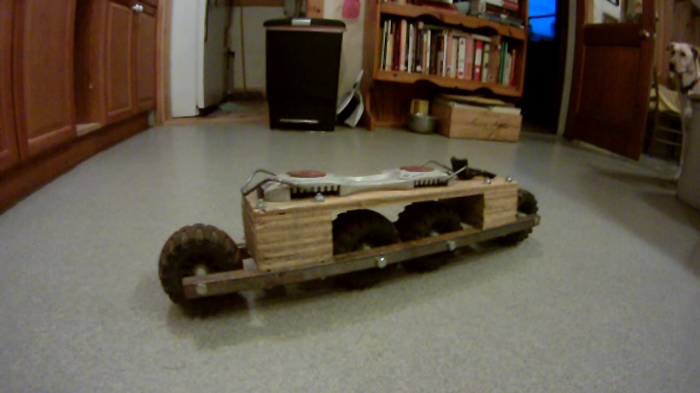
    I read about the Terrablades having a slightly rockered wheel base, like ice hockey skates. The part directly under foot touches while the front and back gently rise up off the ground. This offers an ability to turn very easily (like pivoting) and provides an initial rise to get over bumps. I used this feature. The two center wheels are under foot and are a quarter inch closer to the ground. The front and back wheels act as training wheels for forward and back stability.

    My design is severely lacking in professionalism compared to the Terrablades and we have some differences, but the basic design is similar.

    diy downhill skate

    These work like a dream!!!

    I can steer.

    At low speeds I can whip them around for a sliding stop (I fall over every time, but at least the skis hold together).

    They don’t weigh a lot. They are sturdy. It feels like skiing. I’ve hit 30+ MPH. Dropped a 3-foot stone wall into grass.

    Roads, hiking trails, jeep trails, mountain bike trails. These things can ride over anything.

    I’m hooked.

    I doubt I’ll adopt the Terrablades slogan: ‘let it melt’, but I’m very happy to feel like I can ski year round.

    I spent a few hundred dollars instead of a thousand and I’m proud to say I built the things I’m riding.

    Though, I still have to figure out how to attach some brakes…

  • Wreck Diving in the Cold Water of Lake Michigan

    Wreck Diving in the Cold Water of Lake Michigan

    The only sound heard over the buzz of the motor as the boat cruised on Lake Michigan was “Everybody’s Got a Cousin in Miami” faintly tinkling tropical beats over the speakers. It was 50 degrees and sunny, but the wind had a leftover winter bite to it eight miles off the Chicago shoreline. The lake was blue and glasslike, clear with 100-foot visibility under the surface, an advantage of emerging early in the season before the algae started to grow. The water sat only 12 degrees above freezing. It was a cold day for wreck diving, even with a dry suit.

    “I hope you like Jimmy Buffett,” said Hank Fiene with a shrug to the blaring speaker. His grey hair danced a little in the wind as he looked over his shoulder, leaving both hands on the wheel. “Captain Jim’s crazy about him.”

    Captain Jim was a large man with a large personality. He had a tremendous smile and beer belly that jiggled beneath his under armor every time he bellowed a particularly enthusiastic laugh. His backwards baseball hat covered his thinning head of hair and his grey-white beard stood out against his tan face. The sunburned skin on his nose peeled away in places, exposing pink patches underneath. His hands gestured wildly whenever he spoke, which was often.

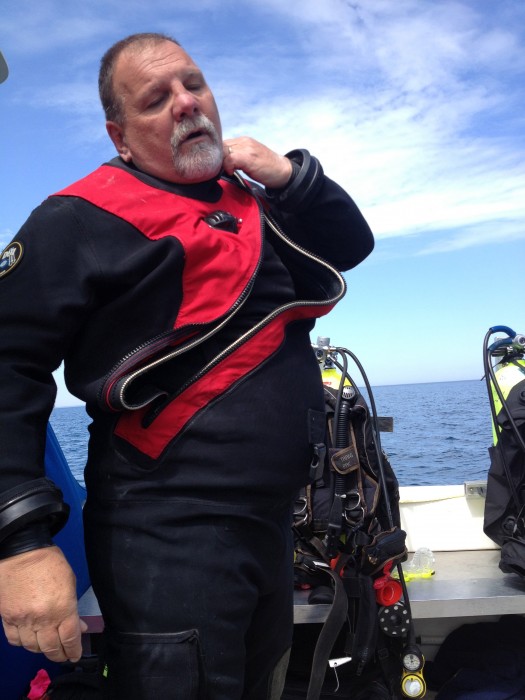
    As the boat slowed to a stop, Jim Gentile started to prepare for Windy City Diving’s first expedition of the season. Two days earlier, on April 14, he’d docked his boat at Burnham Harbor near the Planetarium. With a few grunts, he pulled his tight, black dry suit over his feet and legs, wiggling around as he yanked it over his hips and stomach. He gasped a couple times when he squeezed his head through the neck hole. “I think I gained a few pounds since the last time I wore this,” said Gentile as he tugged at the rubber lining that his large neck was spilling out of.

    Wreck diving in the freshwater of Lake Michigan offers a different experience than diving in saltwater. The freshwater doesn’t dissolve wood like saltwater does, giving divers the chance to check out a variety of old shipwrecks. Steamboats from the late 1800s, cargo ships from the early 1900s and one luxury yacht clutter the bottom of Lake Michigan.

    The shipwreck the Morais’ set out to visit that day was one that Gentile had sunk for his clients to observe. Gentile bought the Straits of Mackinac, a 204-foot car ferry, for $1 at an auction. First, Gentile, a former Environmental Protection Agency scientific diver, cleaned the ship, removing all of its lead-based paint, lubricants and espestice, an especially important precaution for the 33 million whose drinking water comes from the Great Lakes. Gentile used donations and fundraisers to fund the cleaning process. After selecting a spot and jumping through regulation hoops with organizations such as the Illinois Environmental Protection Agency and licensing with the Illinois DNR, a process that lasted 18 months, Gentile sunk the Straits.

    GentileThe day they sank the Straits of Mackinac, Gentile and Fiene set out at 5 a.m. They jumped into the icy water and Gentile swam around, scoping the space to make sure the zone was completely clear. The boat sits upright in 82 feet of water and Gentile and the Morais’ dove down to visit her on the 10-year anniversary of her sinking.

    Fiene, a long-time friend of Gentile, was along for the ride and to lend an extra hand, rather than diving into the 42-degree water himself. He zipped the captain in and both men went over to assist the first shipwreck scuba clients of the season. The clients were a South African pair. He laughed easily at Gentile’s jokes. She was quiet except for the loud, bright, sparkling blue polish chipping away on her fingernails. They both wore leftover tans from their diving trip in Hawaii a couple weeks earlier. After seeing the tropics, Antonetta, who had never been to the U.S. before, and her husband Frikkie Morais drove Route 66. Their final U.S. stop was Chicago, where they wanted to conquer their coldest dive yet: Lake Michigan.

    An Illinois native, Gentile grew up near Lake Michigan. He started diving on family trips to Florida 41 years ago at age 12. The scuba bug bit him. When he turned 16, he got certified. His instructor worked with Ralph Erickson, who went on to co-found the Professional Association of Diving Instructors, a training organization started in Chicago in 1966. It’s now the largest in the world. At the time, the certification process was mostly leftover military training. New divers stood by the side of a pool and tossed all of their gear into the water before diving in after it. The instructors told their students this was a valuable hiding skill to perfect if they were being shot at, an event Gentile doubted he’d encounter in his recreational dives. The entire process took between 12 and 16 weeks.

    Today, by watching instructional videos and sifting through readings ahead of time, the process is much faster. Gentile has certified divers in as little as two days. He requires divers to prove certification before jumping into the lake. He no longer certifies clients himself. Instead, he works with other companies in the Chicago area who take care of certification and rent equipment. Then, Gentile leads them into the depths.

    Gentile has accompanied visitors into the lake for 17 years. The first year, he took 30 divers into Lake Michigan. The next, he hit 70. Now, each year, he takes over 100 divers down. Depending on temperature, the seasons usually run from April to November, but Gentile loses 20% of the weekends to weather. Once the seas hit three feet, the waters require more skill to maneuver so too much wind is enough to cancel an expedition. The higher the waves, the higher the risk.

    Diving in Lake Michigan is different than scuba diving in more popular areas like the Red Sea or Turks and Caicos Islands. The freshwater is less dense than saltwater. Divers need less weight to maintain natural buoyancy in Lake Michigan than they do off the Pacific Coast.

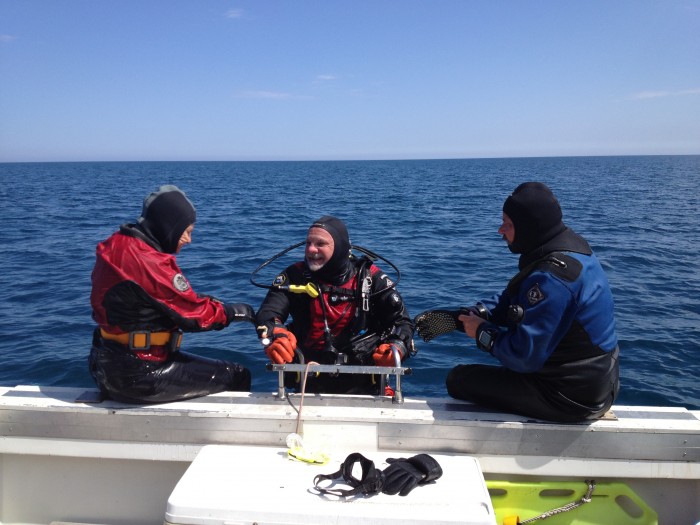
    Even without the added weight for denser waters, the Morais and Gentile waddled around the ship in their gear. They moved bags and extra equipment to the front of the boat where it would stay dry. They secured zippers on their bulky suits. They strapped neon tanks of oxygen to their backs. They bounced up and down to stay warm.

    To combat the cold water left over from months of Chicago’s winter ice, Gentile requires his divers to wear dry suits if the water is colder than 55 degrees. Dry suits keep water out, which makes for better insulation in extremely low temperatures. Divers need a hearty soul to withstand the 42-degree water he and the Morais’ were plunging into. The cold temperatures require more cumbersome gear. “We tend to look more like spacemen than Caribbean divers,” said Gentile.

    Before jumping in, Fiene and Gentile grabbed three pairs of gloves and masks from an orange Gatorade tank of warm water. The scuba accessories steamed like breath on a cold, winter day as the three divers tugged them on. One by one, they plopped into the water. First Frikkie, followed by Antonetta, dropped into the lake. Each plunge sent sparkles of water flying, disrupting the calm lapping of waves. There, Fiene handed each diver a set of goggles, which they secured, grinning through chattering teeth. Finally, Gentile plopped in to join his clients, bobbing next to each other. Each grabbed the rope that would lead them to the bottom and followed it down to the shipwreck. As the cluster of bubbles floated farther away from the boat, the blobs of color blurred more until they blended completely with the dark below the surface. The only sound outside of the gentle lapping of waves was Jimmy Buffett twanging over the speakers.

    After about 20 minutes, the trio emerged from the depths. Antonetta popped up first, her goggles filled with blood. The pressure beneath the surface gave her a bloody nose, but she seemed unphased. She shrugged off any concern about the blood and eagerly waved for Fiene to help pull her out of the icy water. Frikkie surfaced next, chattering uncontrollably. Gentile surfaced last with a grin.

    All three divers fled from the wind to their dry possessions, quickly stripping off their wet scuba gear. The crew huddled together in the tiny, enclosed front of the ship, munching on Subway sandwiches. Antonetta said she couldn’t wait to tell her friends about the dive. They wouldn’t believe it. Jimmy Buffet returned to the speakers and Frikkie took sips of warm tea through his chattering teeth. It would be quite sometime before he stopped shivering.