Category: Climb

  • 7 Best Beginner Places to Rock Climb Around the World

    7 Best Beginner Places to Rock Climb Around the World

    There’s nothing like the feeling of fresh air, the beating sun and rough rock under chalked hands. But you don’t have to be Alex Honnold to enjoy some of the best crags in the world. Whether you want to jet overseas or stay put near your hometown, odds are there’s a good fit for you in one of these seven best beginner places to rock climb around the world.

    7. Frankenjura, Germany

    Don’t let its reputation for challenging sport climbing fool you. Frankenjura has over 8,000 established routes, including nearly 300 graded under 5.9. Known for its pocketed limestone and variety of route lengths, there’s a little something for everyone in this land of crags and picture-perfect forests. Beginners can fool around, build up technique and pick up some knowledge by watching the experts go hard on their down time.

    6. Red River Gorge, Kentucky, U.S.

    Some of the most popular climbing spots in the country aren’t necessarily the best for beginners. The East Coast Gunks, for example, is filled with trad routes, many of which are multi-pitch.  Seneca Rocks has a bit of sport climbing, but is still made up of almost solely traditional routes. Red River Gorge, however is about 2/3 sport climbing. The area saw a surge of traffic in the ’90s, which was when many of the bolts were put into place and continued to grow. While it’s a safe bet that newbies will run into some serious climbers at the Red, every weekend during the on-seasons the place is packed with a wide variety of levels, beginners included.

    5. Wye Creek, Queenstown, New Zealand

    Wye Creek sits just outside of Queenstown, the “adventure capital of the world,” and is home to an annual climbing festival each January. While mostly sport, Wye Creek offers a gigantic bang for its buck. Set on a cliff overlooking a bright blue, glacier-fed lake, even a short and simple climb feels like you’re on top of the world. The climbs are satisfying, and doable for beginners, but nothing beats the view.

    4. Boulder Canyon, Colorado, U.S.
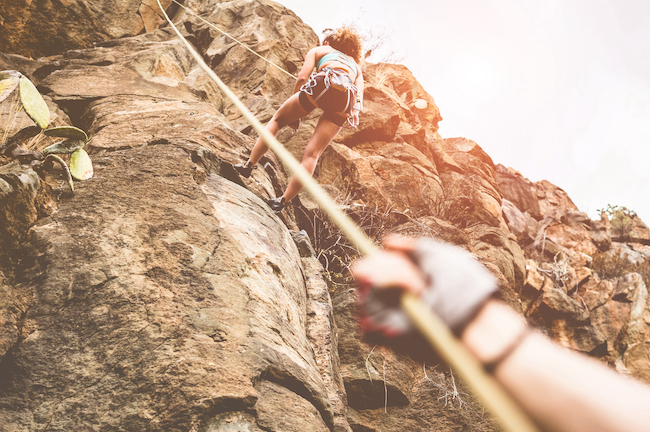
    There’a reason that Boulder breeds so many serious climbers. The state offers an abundance of climbing options, meaning they’ve got a fair share of easier routes mixed in with the more challenging ones. Boulder Canyon features over 400 routes graded 5.9 and below, not to mention nearly 200 spots to set up a toprope anchor, for those not yet comfortable with sport or trad. Plus, it doesn’t hurt to kick back and enjoy Boulder’s killer beer scene after a hard day of climbing.

    3. Railay, Thailand

    railay beach rock climbing For those who are new to the sport, Railay, Thailand offers one of the most exotic places that still has a fair share of beginner routes. The pocket of paradise, accessible only by boat, features soaring, dramatic cliffs over the sparkling, blue water that surrounds the tiny island. With thousands of routes to choose from, a beginner is bound to find more than a few right up their alley. To make matters easier for climbers not yet comfortable with trad, nearly half of the routes in Railay are already bolted, making it simple to clip in and climb or boulder right over the water, where the warm waves will catch your fall.

    2. Yosemite National Park, California, U.S.

    Yosemite is known around the world as one of the most magical places to climb. With gigantic domes and magnificent cliffs, driving toward the park’s tunnel feels a bit like entering a different time. Thousands of climbers sweep through Yosemite’s granite each year, speaking different languages, living out of vans, tents and cabins and enjoying their sport in what’s arguably the climbing mecca of the world. And the park’s history is as rich as its climbs, including the famous Camp 4, a campsite-turned-climbing-classroom that bred some of the greatest stone masters of all time. Yosemite National Park is well worth a visit for any beginner, even if only to soak up some history and observe the greats.

    1. Your Neighborhood Gym

    The truth is that if you’re very new to the sport, it’s typically not safe nor practical to head outdoors right away, unless you have an experienced mentor or guide. For most people just taking on climbing, it’s easiest, safest and tremendously cheaper to start in your local rock gym. Sure, it may not be as glamorous as Thailand, Germany or Yosemite, but indoor climbing is a solid way to quickly build strength, technique and a circle of climbing buddies.


    Did we miss any? Let us know in the comments below!

  • Kyle Maynard Climbs Kilimanjaro (with No Arms or Legs)

    Kyle Maynard Climbs Kilimanjaro (with No Arms or Legs)

    Born with congenital amputation, Kyle Maynard has never had it easy. But living without arms or legs has never stopped him. In this incredible video, Kyle treks to the top of the highest mountain in Africa, Mount Kilimanjaro. Not only does he reach the summit, but he does so using the most technically challenging assault passage, the steep Western Breach.

    His story is a true inspiration to those of us fortunate enough to be able-bodied, but perhaps more importantly, his spirit for life illustrates the immense power of a positive attitude!

    This video was suggested by Mark Whitman, who runs Climb Kilimanjaro Guide, the leading online platform that helps people prepare to trek Mount Kilimanjaro. Mark is also the best-selling author of Mount Kilimanjaro: Trekkers Guide to the Summit

  • Candid Thoughts on Mt. Everest

    Candid Thoughts on Mt. Everest

    National Geographic speaks to people who know Mt. Everest best. Climbers and Sherpas both present and past wax philosophical on the world’s highest peak.

  • Trad Climbing Festival in China

    Trad Climbing Festival in China

    Rock climbers Cedar Wright and Matt Segal meet up with friends in China for China’s first ever Trad Climbing Festival.

  • 9 of the World’s Most Extreme Jobs

    9 of the World’s Most Extreme Jobs

    For those who spend their days trapped in a cubicle, the idea of extreme jobs may be too far-fetched to understand, but for those who live for adventure, battling rough waves or traversing cliffs may be considered dream jobs. There are those out there who risk their lives on a daily basis in pursuit of thrill and a paycheck. Here are nine of the world’s most extreme jobs.


    9. Skydiving Instructor

    Skydiving instructors’ jobs involve much more than falling from great heights. Not only do these professionals have to worry about their own bodies and actions, but they’re also responsible for both teaching and assisting newbie jumpers.

    Wages: Outside of owning a skydiving business, the job of an instructor generally leans toward seasonal or part time, earning around $25 per every class taught.

    Extreme factor: What could be more thrilling than soaring through the air after jumping from a plane? Skydiving earns extreme job points for the simple act of the fall itself. It also involves the responsibility of another’s life. On average, there’s one death for every 142,000 jumps.

    safari

    8. Safari Guide

    Lions and tigers and bears… Safari guides get to see nature at its wildest. They learn about plants and animals, drive through rough terrain and are responsible for both their own survival as well as that of the group for extended periods of time.

    Wages: Wages may vary dramatically, depending on the location of the safari, but the median guide averages $73,000 per year.

    Extreme factor: The animals that safari guides encounter are often dangerous, but those in charge are trained to deal with them before hand. The real risks often come in smaller packages, like poisonous snakes or insects. There are also, of course, risks of diseases that aren’t seen in the U.S.

    whitewater rafting

    7. Whitewater Rafting Guide

    Whitewater rafting guides live a life of true adventure, cruising down wild rapids and steering their way through rough currents.

    Wages: Depending on experience, company and location, raft guides often make somewhere between $2,000 and $9,000 per season.

    Extreme factor: The extremity of a whitewater guide depends largely on the location and its surrounding rivers. While some guides may lead simple, lazy trips down a calm river, others could be navigating customers through class 5 rapids. As with any whitewater sport, for which the overall fatality rate is 0.87 deaths per 100,000, rafting has its share of danger.

    divers

    6. Scuba Diver

    Commercial divers get to experience the great unknown and see creatures most of us will never encounter. Divers may head underwater to inspect, fix or collect artifacts that sit below the water’s level. Some may even conduct experiments or run scientific tests.

    Wages: The median income for a commercial scuba diver is just under $48,000.

    Extreme factor: As always, with pushing the body to new extremes, come extreme risks. The most common causes of death for divers is equipment failure, heart attacks and mistakes in the ascent or descent. Roughly every 200,000 dives results in at least one death.

    pilot

    5. Search and Rescue Helicopter Pilots
    Outdoor adventurers take risks, often ill-advised ones, and for these mistakes are search and rescue helicopter pilots sent to save those in extreme danger. They may need to save sailors from sinking boats or rescue rock climbers from misjudged climbs.

    Wages: The median salary for a search and rescue pilot is $57,000.

    Extreme factor: These pilots fly into dangerous situations where others have already failed. They must right wrongs and often find themselves in life or death situations that require fast-thinking and skilled decisions. When one of these planes crashes, nearly one third of the accidents are fatal.

    mining

    4. Miners

    Although definitely not as typically “extreme” as other occupations on this list, miners face some of the highest fatality rates of all outdoor jobs.

    Wages: The average mining salary, depending on the state, could be anywhere between $40,000 and $100,000 per year.

    Extreme factor: Mining is one of the oldest, yet one of the most extreme professions in the outdoor world. If thought of as almost a form of caving, this makes sense. They risk cave-ins and suffocation on a daily basis. There are over 15 mining-related deaths per 100,000.

    crabfishingboat

    3. Fishermen

    There’s a reason the Discovery Channel’s the Deadliest Catch has been running for 10 consecutive seasons. Whether they’re battling choppy waters or reeling in gigantic catches, the life of a fisherman is rarely dull. It’s also one of the most deadly professions in the U.S.

    Wages: For risking their lives on a regular basis, fisherman are a bit short-changed. The median salary for a fishermen is just over $30,000.

    Extreme factor: With nearly 95 percent of the country’s salmon supply stemming from Alaska, many fishermen call the Last Frontier home. Alaska’s waters, however, are notoriously choppy and unpredictable, often resulting in massive waves and slick, icy decks. Over 120 out of 100,000 workers die on the job.

    logging

    2. Logging Workers

    Logging workers, like lumberjacks, are portrayed in folktales as strong, indestructible men like the famous Paul Bunyan with his Blue Ox. The fictional tale isn’t far off base when compared to modern day logging workers. The job demands grueling, manual labor, literally surrounded by risks.

    Wages: In today’s industry, logging workers average around $37,000 per year.

    Extreme factor: In many ways, logging workers are at Mother Nature’s mercy every single day. They’re surrounded by falling trees and sharp tools, resulting in nearly 128 deaths per 100,000 workers. But it’s not only about strength of overcoming fears, the physical part of cutting down and loading up timbre takes a ton of muscle.

    everest

    1. Everest Guides

    Mountaineering guides lead extreme lives, taking their lives, as well as their groups’ lives, into their hands with every climb, but Everest guides take extreme to an entirely different level. The world’s tallest peak has been conquered by more than 6,000, but has little over a 55 percent success rate for those who attempt it. And when guides lose their way or meet unlucky deaths on the mountains, climbing customers are left to find their own way back to safety, much like Jon Krakauer in Into Thin Air.

    Wages: Mountaineers are generally paid by the day, but wages range dramatically based on company, position and mountain and climb they’re guiding. A guide at Mount Rainier may start at $125 per day, but those on bigger, more dangerous mountains, such as Everest, they tend to make more. Climbers pay between $5,000 and $7,000 for a Sherpa guided summit attempt. Western-guides, on the other hand, expect their climbers to fork over somewhere between $45,000 and $65,000.

    Extreme factor: Not only must these workers be incredibly skilled mountaineers, but they must also deal with changing weather and altitude adjustments. Often, they need to make split-second, life or death decisions. Fatality rates for anyone who climbs Everest are incredibly high. In fact, there have been over 4,000 deaths of Sherpas, those who are often much more acclimated to the mountain’s conditions, in the past decade. A Sherpa stationed at a base camp on Everest is 10 times more likely to die than a commercial fisherman, making an Everest mountaineering guide the most extreme job in the world.

  • Rock Skiing with Paul Solarek

    Rock Skiing with Paul Solarek

    On the plus side, at least you don’t have to wax your skis. I’m not sure about this whole falling thing though. I’d likely wrap myself in mattresses before attempting to rock ski.

  • El Misti Volcano Climbing in Peru

    El Misti Volcano Climbing in Peru

    Towering over the city of Arequipa, Peru, El Misti is a volcano that’s relatively easy to access. The trail is a basic switchback path, but as any good climber knows, there are other variables at play. Watch this nice montage of footage from someone who attempts to summit the volcano. I can definitely relate to their experiences.

  • Jimmy Chin Talks Yosemite Climbing

    Jimmy Chin Talks Yosemite Climbing

    A lot of the greatest rock climbing feats have happened at Yosemite. It’s the epicenter of rock climbing, both historically and today. Listen to Jimmy Chin talk rock climbing and share his story as a rock climber.

  • Meet Steph Davis, Female Rock Climber and BASE Jumper

    Meet Steph Davis, Female Rock Climber and BASE Jumper

    Professional climber and BASE jumper Steph Davis heads to Mineral Canyon, Utah. Watch her re-discover an old and difficult Steve Hong route, where she BASE jumps off the top.

  • Chicago’s First Big Rock Climbing Gym Set to Open This Winter

    Chicago’s First Big Rock Climbing Gym Set to Open This Winter

    Chicago’s skyline towers over any hill within a several-hour-radius- not the ideal terrain for rock climbers. Countless yoga studios, weight rooms and pools clutter the third largest city in the country, enough to satisfy any athlete, with the exception of climbers. Outside of a handful of rock walls thrown into gyms as afterthoughts, and one solid, yet tiny, bouldering room, Chicago lacks an indoor rock climbing facility. As soon as Winter 2014, this will all change when First Ascent comes to the Windy City.


    I had a conversation with three climbers who are spearheading the new gym’s launch to find out details about what we can expect from First Ascent. CFO Joe Zentmyer’s heading the gym’s financial needs, while Dan Bartz is taking charge of most of the gym’s groundwork. Jon Shepard runs general business oversight and the legal side of First Ascent. All three are heavily involved in the climbing community, along with majority of the investors backing Chicago’s first big rock gym.

    First Ascent will reside on the north side of Chicago, north of Logan Square, near Avondale, at 3500 N. Spaulding Avenue.  The new gym will offer climbers 26,000 square feet of climbing, including a main wall and 5,000 square feet of bouldering. Climbers will have the opportunities to lead, sport climb and top rope, and a fitness center featuring weights and cardio machines will be available for cross training. First Ascent will even save space for a yoga studio, where climbers can stretch and strengthen. An added café and locker rooms with showers will give work commuters somewhere to climb and freshen up before or after work.

    “There will be lots of climbing surface,” said Shepard. “With anything from beginner terrain to expert, overhanging and lead terrain.” Shepard said that it is especially exciting for all of those who head down to the Red River Gorge, the best close climbing to Chicago (and close, meaning 400 plus miles). Many at the Red encounter trouble sending new routes because of their lack of training space options. First Ascent will give those dedicated climbers a spot to train for their next big projects during the workweek.

    While First Ascent’s steep climbs and advanced bouldering will cater to the elite climbers, the First Ascent team also hopes to draw in beginners and everyone in between. Classes in safety, technique and outdoor climbing will be offered, as the First Ascent team, especially Bartz, a Teach for America alum, highly values education within the sport.

    The team behind First Ascent is also interested in expanding competition climbing in Chicago. While elite climbing competitions have gained more media hype in recent years, there aren’t as many competitive opportunities for average climbers. The opening of a large rock gym, like First Ascent, could bring attention to Chicago as a mecca for this type of climbing competition, with the potential to grow the climbing community in the Midwest.

    “The Chicago climbing community is extremely unique,” said Bartz. “Because we live so far away from real rock, you really have to be dedicated to the sport, so there’s a really supportive network here. Everyone’s down-to-earth. It’s kind of that Midwestern charm that you get a little bit too.” Bartz expects First Ascent to work with that community and grow it, giving climbing access to those who just don’t have it right now. He also hopes it will unite a currently fragmented community, divided between small gyms scattered throughout the city. “We’re excited to have a place where everyone can climb together and allow people from different climbing pockets to come together, meet each other and get psyched up for their next project,” said Bartz.

    So why has it taken so long for a solid rock gym to make it to Chicago? According to Zentmyer, it’s really tough to build one in the Chicago area. It’s challenging to find the right location and real estate situation for a building as big as a climbing gym requires, not to mention the funding to back it. A location change, moving First Ascent from the South Loop to the Logan Square/Avondale location also slowed down the project, but with the kinks worked out, the gym should be up and open this coming winter. The First Ascent team members attribute a large portion of their success to sourcing themselves directly from Chicago, the city they’re building in, surrounding themselves with the climbers for whom they’re building First Ascent.

    Rock climbers in the Windy City anxiously await the long overdue arrival of a large rock gym, like First Ascent, pulling with it the potential to put Chicago on the map in the rock climbing world.


    Photo courtesy of Walltopia